Topics

Explore critical topics shaping today’s SAP landscape—from digital transformation and cloud migration to cybersecurity and business intelligence. Each topic is curated to provide in-depth insights, best practices, and the latest trends that help SAP professionals lead with confidence.

Regions

Discover how SAP strategies and implementations vary across global markets. Our regional content brings localized insights, regulations, and case studies to help you navigate the unique demands of your geography.

Industries

Get industry-specific insights into how SAP is transforming sectors like manufacturing, retail, energy, and healthcare. From supply chain optimization to real-time analytics, discover what’s working in your vertical.

Hot Topics

Dive into the most talked-about themes shaping the SAP ecosystem right now. From cross-industry innovations to region-spanning initiatives, explore curated collections that spotlight what’s trending and driving transformation across the SAP community.

Topics

Explore critical topics shaping today’s SAP landscape—from digital transformation and cloud migration to cybersecurity and business intelligence. Each topic is curated to provide in-depth insights, best practices, and the latest trends that help SAP professionals lead with confidence.

Regions

Discover how SAP strategies and implementations vary across global markets. Our regional content brings localized insights, regulations, and case studies to help you navigate the unique demands of your geography.

Hot Topics

Dive into the most talked-about themes shaping the SAP ecosystem right now. From cross-industry innovations to region-spanning initiatives, explore curated collections that spotlight what’s trending and driving transformation across the SAP community.

SAP GRC

SAP GRC focuses on the governance, risk, and compliance practices, technologies, and processes used to keep SAP environments secure, auditable, and aligned with regulatory requirements. For SAP customers, this includes SAP GRC products as well as related capabilities for access control, process control, risk management, threat detection, identity governance, financial compliance, and privacy governance across SAP ERP, SAP S/4HANA, cloud, and hybrid landscapes. The topic is relevant to IT, security, audit, finance, compliance, and business process owners who need stronger controls, better visibility, and more confidence in how SAP systems are governed

What is SAP GRC?

SAP GRC is the set of tools and business processes organizations use to manage governance, risk, and compliance across SAP systems. In practical terms, it helps enterprises control user access, monitor segregation of duties, automate compliance workflows, detect risk, support audits, and align business processes with internal and external requirements. SAP GRC can refer to SAP-native solutions such as SAP Access Control and SAP Process Control, as well as broader GRC activities connected to SAP environments. The goal is to reduce risk while making compliance repeatable, visible, and scalable.

SAP GRC focuses on the governance, risk, and compliance practices, technologies, and processes used to keep SAP environments secure, auditable, and aligned with regulatory requirements. For SAP customers, this includes SAP GRC products as well as related capabilities for access control, process control, risk management, threat detection, identity governance, financial compliance, and privacy governance across SAP ERP, SAP S/4HANA, cloud, and hybrid landscapes. The topic is relevant to IT, security, audit, finance, compliance, and business process owners who need stronger controls, better visibility, and more confidence in how SAP systems are governed

What is SAP GRC?

SAP GRC is the set of tools and business processes organizations use to manage governance, risk, and compliance across SAP systems. In practical terms, it helps enterprises control user access, monitor segregation of duties, automate compliance workflows, detect risk, support audits, and align business processes with internal and external requirements. SAP GRC can refer to SAP-native solutions such as SAP Access Control and SAP Process Control, as well as broader GRC activities connected to SAP environments. The goal is to reduce risk while making compliance repeatable, visible, and scalable.

How do enterprises use SAP GRC?

Access control and segregation of duties

Enterprises use SAP GRC to manage who can access sensitive transactions, data, and processes in SAP systems. Access control and SoD monitoring help prevent conflicts, reduce fraud risk, and support cleaner audit outcomes.

Continuous controls monitoring

SAP GRC supports ongoing monitoring of business and IT controls rather than relying only on periodic manual reviews. This helps compliance teams identify exceptions earlier and standardize control testing across SAP processes.

Audit readiness and evidence management

Organizations use SAP GRC to document controls, track remediation, and provide auditors with clearer evidence. In SAP environments, this is especially valuable for financial controls, user access reviews, and regulated business processes.

Risk management during transformation

SAP GRC becomes especially important during SAP S/4HANA migrations, cloud adoption, and business process redesign. Teams can reassess roles, controls, approval workflows, and compliance requirements as part of transformation planning.

Identity governance across hybrid landscapes

As SAP landscapes expand across cloud, on-premise, and third-party systems, enterprises use GRC and identity governance tools to maintain consistent policies. This supports access reviews, role design, and risk visibility across mixed environments.

Where does SAP GRC emerge in SAPinsider research?

State of the Market GRC in SAP Environments shows that SAP customers are modernizing GRC as regulatory complexity, audit fatigue, and fragmented access governance increase. The research found that 60% of organizations are automating GRC processes and 53% are centralizing control workflows.

The Automating and Integrating GRC Processes report highlights the push to make compliance and audit work more efficient. The report found that 65% of respondents focus on end-to-end automated processes to meet compliance and audit requirements.

Cybersecurity Threats and Challenges to SAP Systems connects SAP GRC priorities to security risk. The report found that 23% of respondents experienced credential compromise, social engineering, malware or ransomware, or another cyberattack impacting their SAP environment in the past year.

State of the Market GRC in SAP Environments – Benchmark Research WebinarJoin SAPinsider for an in-depth look at the latest findings from the State of the Market: GRC in SAP Environments benchmark research report. Based on insights from more than 300 SAP leaders, this webinar will explore how organizations are modernizing Governance, Risk, and Compliance (GRC) strategies amid rising cybersecurity threats, regulatory complexity, and digital transformation. […]
State of the Market GRC in SAP EnvironmentsOrganizations operating in SAP environments face increasing pressure to modernize Governance, Risk, and Compliance (GRC) practices amid rising regulatory complexity, digital transformation, and audit fatigue. Many enterprises still rely on manual control testing and fragmented access governance, which limits visibility and increases risk exposure. GRC landscapes are dimensional and diverse. This SAPinsider report presents a comprehensive analysis of GRC practices across SAP landscapes, based on data from 339 respondents between 2023 and 2025. The findings reveal a dynamic shift toward automation, integration, and intelligence in GRC strategies, driven by cybersecurity threats, regulatory complexity, and technology modernization. We see SAP-centric approaches as well as a strong reliance on third-party solutions. Organizations leaning into or inheriting third-party solutions are integrating GRC platforms that extend SAP’s capabilities across hybrid landscapes. Vendors such as Pathlock, SailPoint, Saviynt, OneTrust, BlackLine, Trintech, and Experian, offer automation, continuous control monitoring, and identity solutions that span SAP and non-SAP environments ─ as lifecycle offerings or with specialized capabilities. These platforms are included in our research to highlight how together with SAP-native offerings they support the full GRC lifecycle. - Strategic Drivers and Priorities: Organizations are increasingly automating GRC processes (60%) and centralizing control workflows (53%) to improve efficiency and visibility. - GRC Maturity and Integration: 80% of respondents place themselves at Level 3 maturity, where GRC is integrated into business processes with formal governance and enabling technologies. However, few have reached Level 4 where GRC initiatives are enterprise wide. - Technology Adoption and Automation: Most organizations are combining SAP Process Control (47%) and the SAP Integrated GRC Suite (40%) with third-party technologies (e.g., Pathlock, Saviynt, OneTrust, SailPoint). - Data Governance and Privacy: While 53% have formal data classification policies, only 47% have centralized privacy offices or conduct regular privacy impact assessments, indicating uneven adoption of privacy governance. Read the full report for details and more findings on risk management and security threats, financial governance, leadership and team structure, budgets, and investments.
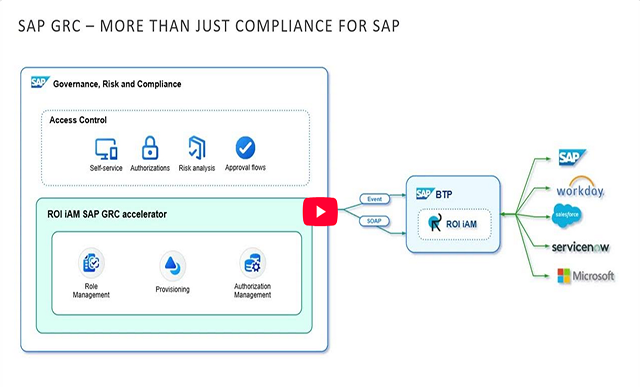
Webinar 2024: 03 ROI iAM SAP GRC ScenariosROIABLE is a provider of SAP expertise in the areas of User access and Workflow automation.
GRC compliance
Part 2: Transforming SAP GRC User ExperienceRaghu Boddu, CEO of ToggleNow, discusses how Digybot transforms SAP GRC access management through natural-language interactions, enabling users to request access efficiently while maintaining robust security standards and ethical AI.
financial reporting
Cutting Through Compliance Noise: How Jabil Tackled SAP RisksWith approximately $28.9 billion in FY 2024 revenue and operations in over 100 global locations, Jabil processes millions of SAP transactions daily. For this Fortune 200 supply chain leader, ensuring Sarbanes-Oxley Act (SOX) compliance across such vast transaction volumes was a major challenge: how to detect genuine segregation of duties (SoD) violations without being overwhelmed […]
SAP GRC Access Control: Safeguarding Data and SystemsAccess control is a fundamental aspect of Governance, Risk Management, and Compliance (GRC) that protects sensitive organizational data and systems from unauthorized access. As the digital landscape grows increasingly complex, mastering GRC access control has become more critical than ever. Organizations rely on robust access control strategies to mitigate risks, ensure compliance with regulations, and uphold organizational security policies.
How Automation Addresses Critical Gaps in SAP GRCSAP GRC Access Control, while effective in compliance and risk management, lacks critical features for automation, which can be addressed through ToggleNow’s intelligent AI agents that enhance log reviews, de-provision dormant roles, improve compliance, optimize resources, and reduce costs.
Optimising Access Management: Ørsted’s SAP GRC MigrationRecognising the critical need for a robust and streamlined access management framework, Ørsted embarked on a pivotal migration project from SAP Identity Management (IDM) to SAP Governance, Risk, and compliance (GRC) for Access Provisioning.
Electronic Export ComplianceExplore how the complicated yet critical issue of ITAR and EAR compliance in the export of technical data can be addressed by SAP GRC Global Trade Services powered by NextLabs Information Risk Management software.
From Chaos to Control – How Jabil Automated User Access Reviews Across Multiple SAP LandscapesClick Here to View Session Deck. If you’re seeking insights into the future of user access governance and the potential of automation within the SAP landscape, this presentation offers valuable observations and actionable takeaways. We delve into the transformative journey of automating SAP user access reviews across a complex landscape of six SAP systems, spanning […]

Related Vendors