

3 minute read
Meet the Authors
Key Takeaways
What you need to know
SAP printing infrastructure is critical for business continuity, impacting logistics, warehousing, and compliance as organizations move to cloud solutions like SAP S/4HANA and RISE with SAP.
The shift to cloud environments necessitates a reevaluation of output management processes, including ensuring secure, timely access to printers, which can no longer rely on traditional network setups.
As organizations adopt new output architectures, executives must prioritize print resiliency in their business continuity planning to avoid disruptions in operations and maintain compliance standards.
For many SAP technology leaders, printing infrastructure rarely tops the modernization agenda. Yet the SAPinsider 2026 session “SAP Printing: The Hidden Backbone of Business Continuity,” led by Jacob Hill and Guy Tucker of LRS, explained how output management will affect how organizations can run logistics, warehousing and compliance in the cloud era.
If SAP cannot print, many critical processes stop. Shipping labels, warehouse pull lists, commissioning and QA documents, delivery notes and customs forms all rely on dependable output at the right device and time. As more organizations adopt SAP S/4HANA, RISE with SAP and SAP BTP, they must rethink how those documents are generated, routed and secured when applications are no longer sitting next to printers on the same network.
Printing Risk in RISE and BTP Landscapes
The presenters urged executives to start by systematically assessing printing dependencies across their SAP landscape. That means asking how many processes would halt if a plant, warehouse or shared services center suddenly could not produce output, and what the downstream impacts would be on production lines or customer deliveries. It also means verifying whether current setups guarantee that each job reaches the right user or endpoint and whether secure methods such as pull print or badge-based release are in place for sensitive documents.
Explore related questions
Ask SAPi
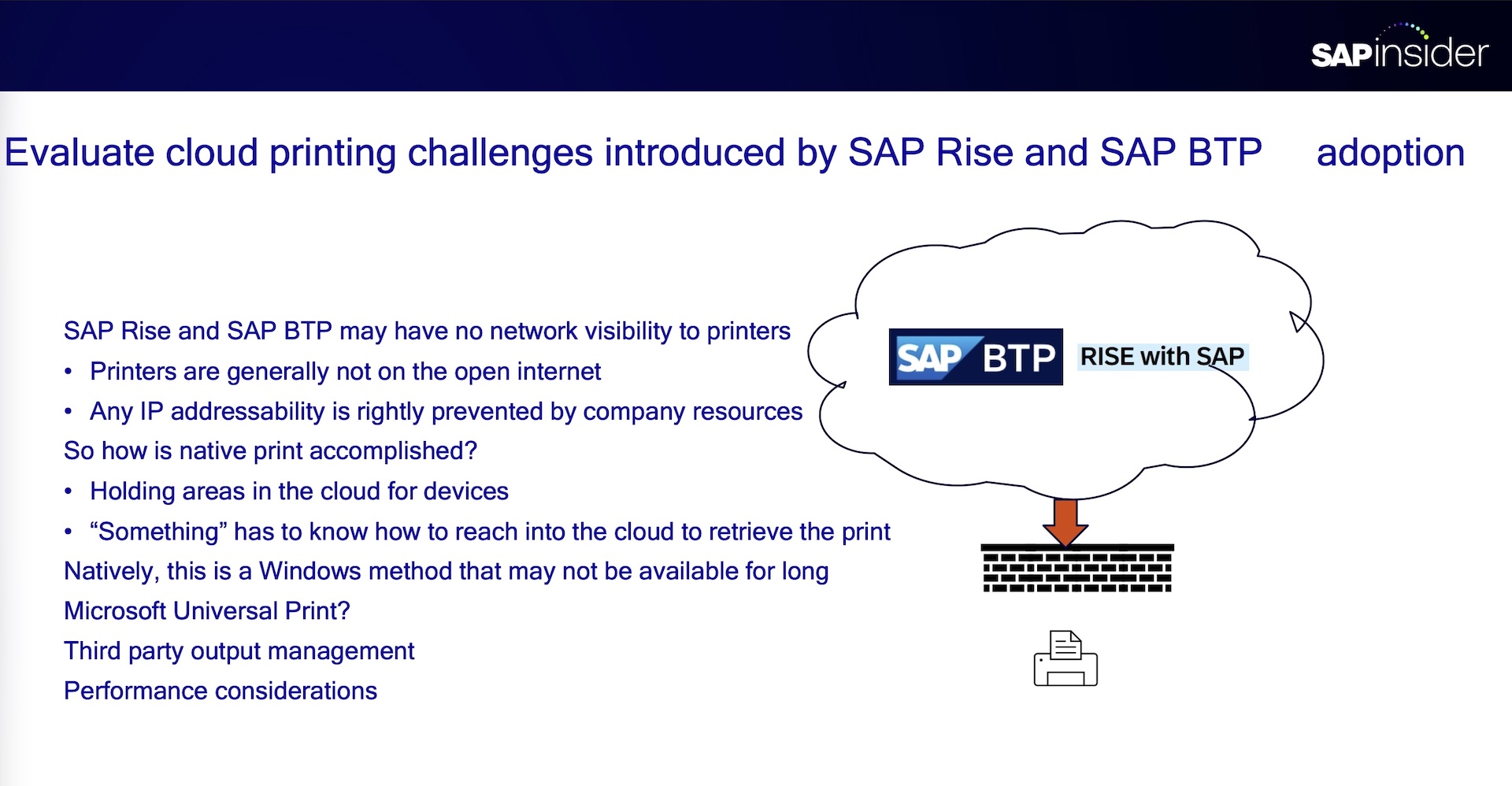
This assessment becomes more complex as organizations move toward RISE with SAP or SAP BTP. In these models, SAP systems often run in provider data centers that have no direct network visibility to on-premises printers, which are rightly protected from exposure to the open internet. Native approaches that rely on Windows print servers or specific network paths may not be available for long as Microsoft promotes Universal Print and its broader Modern Print model. For SAP Basis and infrastructure teams, that means re-evaluating assumptions about “local” printing, device drivers and how jobs traverse firewalls and cloud boundaries.
Reliability is a central concern. Business-critical documents must be delivered on time, recovered quickly after failures and integrated with production lines and warehouse workflows so that delays in printing do not stall operations. The session highlighted that not all disruptions are caused by print server outages; misrouted jobs, driver changes and device failures can have the same operational effect.
Cloud trends add another layer of complexity. Microsoft is advancing security changes such as Windows Protected Print mode, driver auto-updates and reduced spooler authority, while standards bodies promote IPP Everywhere for document printers. Thermal devices, which dominate label and barcode printing in warehouses, are often left outside these standards and may require specialized connectors. CIOs and enterprise architects must factor these shifts into their roadmaps to avoid finding that a critical class of devices no longer functions as expected after an OS or platform change.
Designing Future-Ready Output Architectures
The session offered practical guidance on what a future-ready SAP output architecture should look like. First, organizations should map line-of-sight between SAP applications and printers, considering how that visibility will change as systems move from local data centers to private or public clouds.
Second, leaders should explore how emerging standards and modern print frameworks can be incorporated without compromising reliability. IPP Everywhere, Mopria-based approaches and Microsoft’s Modern Print stack promise more secure, driver-light printing, but they may not yet cover specialized devices such as thermal printers. Executives should push vendors and internal teams to demonstrate how these approaches handle edge cases.
Contingency planning was another key theme. In many SAP shops, recovery from a printing failure remains a manual process that can take hours as multiple teams investigate network paths, server health and device status. The presenters argued for architectures and tools that centralize monitoring, make failures easier to identify and allow day-to-day support to be handled through a single interface, covering tasks such as reprints, diverting jobs to alternate devices and resolving mid-job errors.
Finally, the session emphasized that complacency about printing will become increasingly risky as printer landscapes change. Driver models, security defaults and cloud connectivity patterns are all shifting, and organizations that treat output management as a static concern may discover late in a transformation program that critical workflows no longer function. Technology executives should incorporate print into early architecture workshops for S/4HANA, RISE and BTP, define ownership for output-related risks and ensure that testing covers end-to-end document flows, not just application transactions.
What This Means for SAPinsiders
Print resiliency becomes a core continuity metric. Executives should treat SAP output as part of business continuity planning, ensuring printing strategies keep pace with cloud adoption and do not silently undermine logistics or compliance.
Cloud era demands new output architectures. Enterprise architects must redesign printing for RISE and BTP landscapes, accounting for security changes, standards evolution and constrained network visibility to avoid last-mile failures.
Governed output management reduces operational noise. Infrastructure leaders should centralize monitoring, automate recovery actions and standardize device integration to cut escalations, shorten outages and free teams to focus on higher-value SAP work.
More Resources
See All Related Content


SAP S/4HANA Migration Raises a New Question: Where Should Process Logic Live?anasonic Europe is separating workflow logic from its underlying SAP systems as it moves toward S/4HANA. Its Camunda architecture shows how process orchestration can reduce migration rework while leaving SAP responsible for core transactions and data.
3 minute read

How a Manufacturer Built Global Pricing Control Without Sacrificing FlexibilityA fuel and lubricants manufacturer used Zilliant Price IQ and Price Manager to move from manual pricing toward a globally coordinated pricing model. The approach brought greater consistency to list prices, customer-specific pricing, and spot quotes while preserving seller flexibility.
3 minute read