
4 minute read

Meet the Authors
Key Takeaways
What you need to know
Takeda Pharmaceuticals is moving from SAP ECC to SAP Cloud ERP through RISE with SAP, and SAP supports nearly all its processes worldwide.
Agentic functionality for regulated industries is in development between Takeda and SAP, and Takeda believes the capabilities can scale beyond its own operations.
AstraZeneca's migration to SAP Cloud ERP Private, announced November 10, shows SAP pairing life sciences ERP moves with the customer's plans for AI assistants and agent-based use cases.
Takeda Pharmaceuticals is moving from SAP ERP Central Component (SAP ECC) to SAP Cloud ERP applications through RISE with SAP, SAP reported. The company is also working with SAP on agentic functionality, still in development, for regulated industries, where compliance rules limit how far automation can go.
Roland Straub, Takeda’s global business transformation lead for Supply Chain, said the company decided around 2022 or 2023 to treat data and digital capabilities as central to its strategy. Advances in AI, he added, now give Takeda “a real opportunity” to extend automation and assistance to employees and patients.
Takeda’s Move From SAP ECC Is Under Way
SAP ECC is the earlier-generation ERP suite that SAP S/4HANA succeeds, and SAP Cloud ERP is the integrated set of business applications SAP offers for core processes. RISE with SAP is the program SAP uses to move customers from ECC to cloud ERP. SAP frames the move as a chance to streamline processes and prepare for built-in intelligence.
Explore related questions
Ask SAPi
Takeda has 50,000 employees, and patients in more than 80 countries receive its medicines. Straub described SAP as the system behind nearly all of the company’s processes worldwide, across manufacturing, supply chain, finance, and quality. His priorities for the next phase are bringing the SAP S/4HANA journey to life, using the AI capabilities in SAP Cloud ERP effectively, and deepening the partnership with SAP.
Agentic Functions for Regulated Manufacturing Are in Co-Development
Autonomous Regulated Manufacturing, in SAP’s description, is a set of scenarios that link supply chain, manufacturing, and quality work in life sciences while keeping that work inside compliance boundaries. Straub noted that new agentic functionality in this area is still in development with SAP, and he believes the capabilities “can scale across the industry, not just within Takeda.”
Rebecca Kaufmann, senior vice president and head of Enterprise Process Platforms at Takeda, adds that the company is deploying SAP’s ready-made agents while working with SAP on use cases designed for its industry.
At SAP Sapphire in Orlando in May, SAP Chief Operating Officer Sebastian Steinhaeuser said Takeda is seeing productivity gains of up to 10% from Autonomous Regulated Manufacturing. He also cited up to 25% less revenue lost to stock-outs and up to 5% less safety stock. SAP’s industry page lists related figures as projections from its Global Value Advisory team.
SAP Pairs Cloud ERP Migrations With AI in Life Sciences
On November 10, SAP announced that AstraZeneca is migrating to SAP Cloud ERP Private through RISE with SAP. The full-estate move, part of the Axial Business Transformation Programme, replaces legacy SAP ECC environments. AstraZeneca is looking at SAP’s Industry AI portfolio and Joule, along with agent-based uses in finance, supply chain, and manufacturing.
The pairing follows the RISE with SAP reset announced at SAP Sapphire, which includes a contractual commitment on activating three Joule Assistants within the first year. CEO Christian Klein told the audience that agents deliver no value without process change and user enablement. In regulated sectors such as life sciences, SAP positions the cloud ERP move as the base for agents working across supply chain, production, and quality.
What This Means for SAPinsiders
ERP migration and AI planning now travel together. SAP pairs RISE with SAP migrations with AI adoption, and Takeda lists the AI capabilities in SAP Cloud ERP among its priorities. Customers in regulated industries face the platform decision and the AI roadmap as one program.
Regulated industries test what agents can be trusted with. Takeda and SAP are building agentic functionality, still in development, for work that runs under strict compliance boundaries. Outcomes in a sector like life sciences bear on whether agents can operate inside such boundaries elsewhere.
Customers now help shape vendor industry AI. Takeda’s role in co-development gives it a voice in how SAP’s agents handle the rules of its sector. SAP, in turn, can cite a named life sciences customer when it describes what its agents do in practice.
More Resources
See All Related Content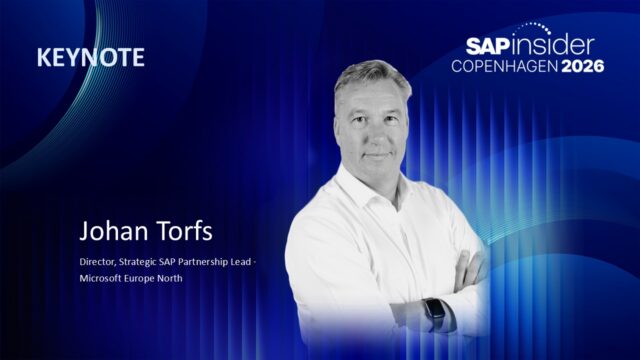
Frontier SAP Pairs Migration With Agentic AI: Microsoft’s Johan TorfsMicrosoft’s Johan Torfs told SAPinsider Copenhagen attendees that SAP migration and agentic AI belong on one roadmap. Frontier SAP, he said, starts with security, governance, and observability, then takes one process to scale.
CIO Program Opens at SAPinsider Copenhagen With Focus on Putting AI Into ProductionThe first European CIO Program at SAPinsider Copenhagen opened with sessions on AI development, SAP’s strategy, hands-on agent building, and sovereign AI. Questions of review, cost, and ownership ran through the day.
4 minute read
How EG Group Upgraded SAP S/4HANA to Remediate Technical Debt & Mitigate RisksEG Group is upgrading its core on-premise S/4HANA system to address technical debt and mitigate operational and security risks due to platform incompatibility, expiring maintenance, and technical obsolescence of deployed SAP components.
1 minute read