

4 minute read
Meet the Authors
Key Takeaways
What you need to know
Frontier SAP, as Microsoft’s Johan Torfs described it at SAPinsider Copenhagen, pairs agentic AI with SAP migration through co-engineered integration.
An organization’s own data, people, and ways of working are its AI advantage, Torfs said, and validation lets that context improve with use.
Torfs advised SAP customers to start with security, governance, and observability, then identify one process to test and bring to scale.
AI is arriving while many SAP customers are still migrating, and Microsoft’s Johan Torfs told SAPinsider Copenhagen attendees what that adds to the job. “It’s not only about how do you migrate what you have today; it’s also how you bring everything together,” he said.
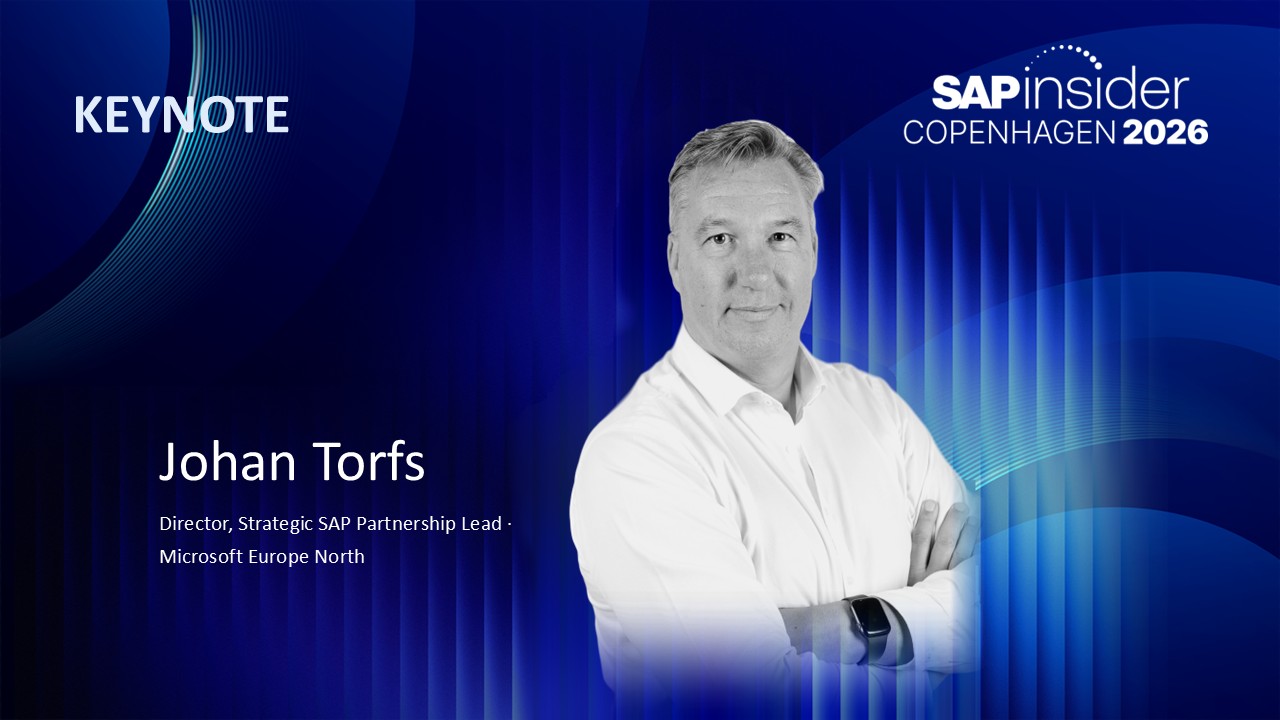
Torfs, strategic SAP partnership lead for Microsoft Europe North, delivered the keynote “Frontier SAP: Reimagining SAP Transformation for the AI Era” on November 18. He described what he calls Frontier SAP, the pairing of SAP migration with agentic AI, and the integration, organizational knowledge, and controls behind it.
What Frontier SAP Adds to a Migration
The cost of standing still was the question Torfs put to attendees. He compared AI to the devices and applications employees already need to compete. Frontier SAP means bringing AI into core processes, he said, and “it’s not a race towards new models and the latest models.”
Explore related questions
Ask SAPi
Earlier platform shifts, from mainframes and the internet to cloud and mobile, left a person asking and software responding. Agentic AI is “a new operating system,” he said, in which people set the boundaries and agents operate inside them.
Three phases mark the journey, he said: people working with an assistant, people leading agents that take on specific tasks, and people setting direction while agents run entire processes and check in as needed. As an example of phase two, he described an agent that emails him at 7:00 a.m. about commitments he has not yet acted on.
An Organization’s Own Knowledge Is Its AI Advantage
In Torfs’s telling, connecting SAP and Microsoft systems lets an organization put its own knowledge behind its AI. He calls that knowledge an organization’s IQ, made up of its data, people, relationships, ways of working, decisions, and expertise, and he said “your IQ becomes a true asset.”
Work IQ, in Torfs’s terms, is the context a person builds up in their work, such as how a manager likes information worded, and Fabric IQ is the data side. Combined with what SAP holds about the business, they feed a learning cycle that starts from shared understanding.
Checking results is what keeps that cycle sound. “The most important step to move to the next one is validation, because you want to validate that it’s correct, and that’s how your system becomes more and more intelligent,” he said.
Integration Runs Through Every Layer of the Stack
Microsoft co-engineers solutions with SAP, Torfs said, and the integration reaches every level of the stack. “This integration, not connectors, but deep integration, is what we bring to market,” he added.
Sign-on is one layer, with employees using the same credentials for workplace tools and SAP. Data is another, linking Microsoft Fabric and Azure Databricks to SAP Business Data Cloud. Agents built in Microsoft’s environment can be connected to agents built in SAP’s, and Microsoft Copilot and SAP Joule exchange requests in both directions.
A recorded Microsoft demo showed what that integration produces. An executive asks Copilot why margin trails target while revenue runs ahead of plan, and Copilot reasons across SAP finance, sales, and supply chain data through Fabric IQ and Teams conversations and documents through Work IQ.
The integration also carries the answer back into SAP. Joule maps each fix to the SAP process where it would run and checks that the process is ready, without releasing any change. Three options follow, and a person approves the recommended one before the actions run in SAP, with the status of each confirmed afterward.
Controls and One Process Come First
Controls come first, Torfs said, and he singled out security. “I want to stress again: security is the fundamental, and at any time, at all times.”
Governance follows, organized department by department. Observability controls cost and tracks who is accessing what. Torfs wants security, governance, and observability to work together as one platform. The day-one opening keynote from SAP’s Jesper Schleimann likewise tied trust in AI agents to central control.
Danfoss, which Torfs cited as an example of security tools working together, uses Microsoft Sentinel for SAP, and Microsoft says it automated 80% of identity incidents. Microsoft runs its own business processes on SAP, Torfs added, including finance, where it reports AI automation saving over 250,000 hours a year.
KONE and EY, which Torfs cited as customers that have taken the journey, each applied AI to a single SAP process. Microsoft credits AI with cutting KONE’s handling time on over 54,000 contracts a year from about 30 minutes to under 10, and EY’s journal approval from 15 minutes to under 60 seconds.
His advice to attendees was to identify one process for AI transformation, test it, and bring it to scale. “If you are on the journey, our advice is start with those fundamentals,” he said.
What This Means for SAPinsiders
Migration and AI arrive as one roadmap. Torfs treated SAP migration and agentic AI as a single effort, which puts identity, data access, and integration choices into the same planning conversation as the migration. Customers choosing an SAP environment are also choosing where their agents will work.
An organization’s own context becomes its AI advantage. Torfs placed an organization’s data, people, relationships, and ways of working at the center of its AI advantage and made validation the step that lets it improve. The advantage rests on how well an organization captures and checks what it learns.
Controls set how far agents run. Torfs put security, governance, and observability ahead of agents, and his demo kept a person approving the actions before they ran in SAP. The share of a process handed to agents follows the strength of those controls.
More Resources
See All Related Content

Bounded Autonomy Is the Best Enterprise AI Can Achieve, Says SAP’s Jesper SchleimannSAP’s Jesper Schleimann told SAPinsider Copenhagen attendees that bounded autonomy is the best enterprise AI can achieve and that organizations stay accountable for the AI they deploy. He also described how defined intent, governed context, and retained learning shape delegation to AI.
5 minute read

AI-Accelerated EPPM Enables Multi-Project Forecasting in SAPPlatinum DB’s AI-Accelerated EPPM adds multi-project forecasting to standard SAP EPPM, using accelerators and AI-assisted engineering built in its own environment. Founder Anthony DeRosa explains how it works and what customers gain.
4 minute read