3 minute read
Meet the Authors
Key Takeaways
What you need to know
Loparex stabilized SAP S/4HANA after a challenging go-live across four production sites.
OTIF improved from below 40% to over 90% through better planning and governance.
Stronger master data and user adoption helped unlock measurable supply chain performance gains.
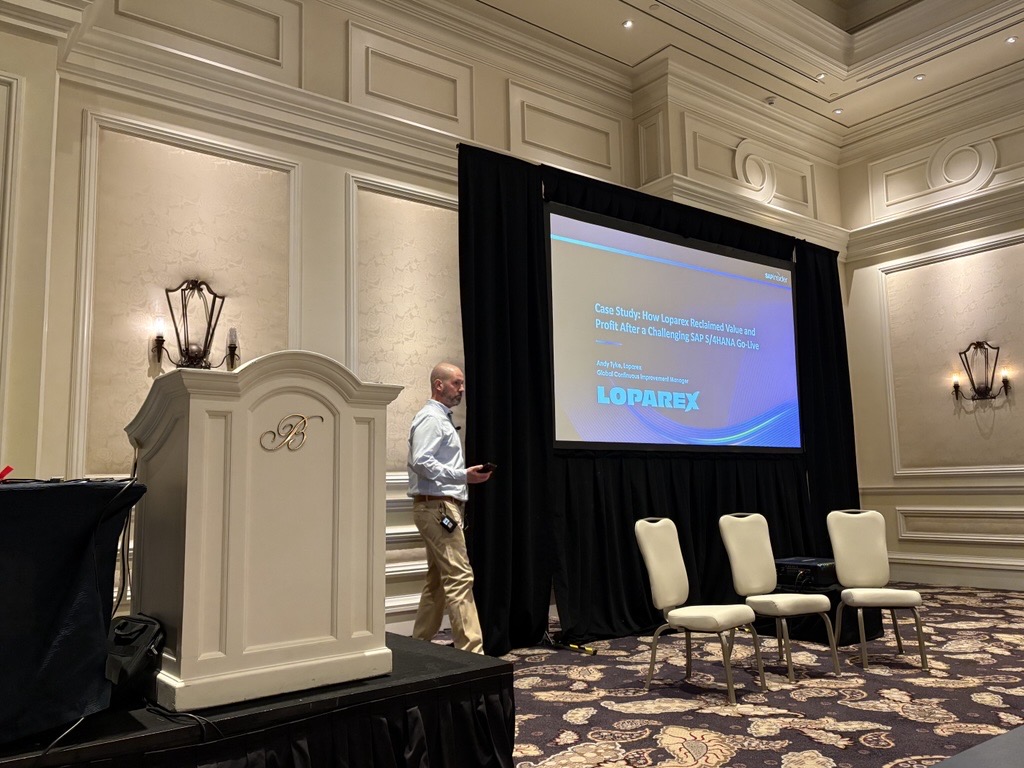
At SAPinsider Las Vegas, Loparex detailed how it stabilized a troubled SAP environment and transformed it into a driver of supply chain performance, customer retention, and workforce productivity.
Loparex is a manufacturer of backing material you peel off products like stickers, labels, and bandages. The company implemented SAP ECC and SAP S/4HANA across four production facilities. Despite deploying advanced capabilities such as Production Planning and Detailed Scheduling (PP/DS), the system initially failed to deliver value.
A Modern SAP Environment, But Limited Usability
Unlike legacy environments, Loparex had access to advanced planning functionality, however adoption was a challenge.
Explore related questions
Ask SAPi
A key issue was that automated overnight batch jobs disrupted production schedules created during the day. Planners did not know why schedules were changing, or how to control the system behavior.
This lack of control led to cascading operational issues. Machines ran out of raw materials, schedules were unreliable, and customer commitments could not be met.
“We would make a schedule, save it, go home, and come back the next day to find it disrupted-and we didn’t even know why,” said Andy Tylke, Global Continuous Improvement Manager at Loparex.
Customer impact quickly followed. Loparex could not confirm delivery dates, and its on-time, in-full (OTIF) performance dropped below 40%. One of its largest customers warned the company it would leave within three months if service levels did not improve.
Stabilizing SAP Through Process, Data, and Governance
To address these challenges, Loparex engaged Reveal to help stabilize operations-focusing less on system reconfiguration and more on how the organization used SAP.
The initial steps included enabling standard SAP transactions that were already available but not activated, and improving data accuracy between SAP and the company’s MES system, Appriso.
At the same time, Loparex introduced a governance hierarchy to break down silos across supply chain, customer service, and operations. Issues that could not be resolved at the individual level were escalated through a structured “action tracker,” ensuring faster and more consistent decision-making.
“Reveal sat with us in our live SAP environment and helped us understand what was actually broken-whether it was people, process, or the system-and how to fix it in real time,” Tylke said.
Teams also began using SAP’s exception management capabilities to identify the highest-impact issues, rather than reacting to problems after they occurred.
Speaking with SAPinsider after the session, Tylke noted that the system itself helped identify where teams were struggling most, with exceptions and alerts highlighting issues such as excess inventory and dead stock.
When asked how Loparex prioritized fixing data, processes, and configuration, Tylke said the team placed little emphasis on system configuration beyond enabling standard SAP transactions that had not been turned on.
Instead, priorities were set through governance, with teams focusing first on sales order confirmation at a departmental level, while individuals concentrated on exception management and improving material master data.
He also pointed to a specific turning point in user adoption. When asked what drove real behavior change, Tylke highlighted the PP/DS planning environment, where overnight batch jobs had previously disrupted schedules and eroded trust in the system.
Once the team understood the settings behind those disruptions and could rely on the planning board, adoption improved significantly.
Tylke emphasized that master data management remains a critical success factor. Asked what he would do differently, he said, “If I could do it again, I would start with better master data management-understanding those fields and standardizing them upfront would have made the implementation much smoother.”
From System Friction to Measurable Performance Gains
As SAP usage improved, Loparex began to see significant operational gains.
- OTIF improved from below 40% to over 90%
- Stock-outs decreased by 77%
- MRP data accuracy reached 97%
The improvements enabled Loparex to retain at-risk customers and rebuild trust in its ability to meet delivery commitments.
When asked by SAPinsider about customer impact, Tylke said, “We had customers ready to leave us because we couldn’t commit to delivery dates-and after stabilizing SAP, we were able to keep those customers and meet our commitments.”
Cultural Shift and Scalable Best Practices
Beyond operational metrics, the transformation drove a notable cultural shift.
The supply chain team, which had been frustrated and overworked following go-live, became more confident and effective as they learned how to use SAP to solve problems.
“We went from people wanting to leave the organization to people wanting to come back because of how well the supply chain team was operating,” Tylke said.
The success was sustained and extended beyond the initial rollout. Loparex replicated the same practices across its European sites following their SAP implementation.
What This Means for SAPinsiders
Post-go-live execution determines ERP success. Implementing advanced SAP capabilities does not automatically deliver value. Organizations must focus on how teams actually use the system after go-live to drive measurable outcomes.
Master data discipline is foundational to performance.
Inaccurate or inconsistent data can undermine even the most advanced planning tools. Establishing ownership and standardization early is critical to avoiding downstream issues.
User trust drives adoption and business results.
When planners cannot rely on system outputs, they revert to manual workarounds. Building confidence in SAP through stable processes and clear governance enables sustained performance improvements.
More Resources
See All Related Content
Acuiti Labs Names the Risk in Airport Billing: The Revenue Visibility GapAcuiti Labs' July 2026 analysis of airport billing names the Revenue Visibility Gap and shows how an integrated quote-to-cash architecture on SAP S/4HANA Public Cloud, SAP Subscription Billing, and SAP CLM closes it, with lessons for any SAP finance team running multiple revenue models.

Abacus Maps the SAP ECC to S/4HANA Decision as AI Reshapes Migration PrioritiesAbacus used a trio of 2026 publications to argue that SAP ECC customers should treat this year as a structured planning window, a position reinforced by SAPinsider research showing AI has overtaken the 2027 deadline as the top migration driver.
3 minute read
Beyond Assessment: How CoreAssess Enables Actionable SAP Clean Core ModernizationYou’ve Completed the Assessment. Now What? The dashboards are clear. The risks are visible. The custom code footprint is mapped. Yet many SAP teams reach this point and pause. Not due to lack of intent, but due to lack of execution clarity. Hundreds of objects need decisions. Effort is uncertain. Architecture choices carry long-term impact. […]
3 minute read

Aatral Technologies Positions SAP ERP as a Strategic Asset for S/4HANA TransitionsAatral Technologies structures its ERP - SAP Services around the gap between keeping ECC operational and positioning SAP ERP for business goals, pairing S/4HANA assessment packages with a governance model that spans implementation, support, and migration.
3 minute read