

3 minute read
Meet the Authors
Key Takeaways
What you need to know
Sagemcom, an internationally renowned French industrial group, replaced OpenText with a certified and scalable SEAL Systems platform for SAP form and print management.
The move was driven by the need for greater reliability, monitoring, and printer-fleet management across its production sites.
SEAL Systems delivers officially certified SAP output management for cloud and on-premises environments, eliminating custom workarounds on the SAP side.
When a French industrial group quietly replaces one enterprise vendor with another, it rarely makes headlines. But the reasons behind Sagemcom’s decision to move its SAP form and print management off OpenText and onto SEAL Systems say something larger about a problem most SAP shops have learned to tolerate: output management is the plumbing nobody thinks about until it leaks.
According to SEAL Systems, Sagemcom, an internationally renowned French industrial group, had been using OpenText servers for SAP form management and SAP print management and chose to modernize to meet the increased industrial requirements of its production sites for reliability, monitoring, and management of its printer fleets. The company is now, in SEAL’s words, relying on a certified and scalable platform featuring solutions from SEAL Systems.
The Overlooked Layer
Strip away the vendor names, and Sagemcom’s story is a familiar one. Documents such as purchase orders, delivery notes, and reports form the foundation of virtually every company, and most of them are generated by an ERP system like SAP. Yet, as SEAL argues, ERP systems offer only basic document-output functions that do not always meet the complex requirements of day-to-day operations. Output becomes an overlooked element that requires manual rework and carries a real risk of errors and compliance issues.
Explore related questions
Ask SAPi
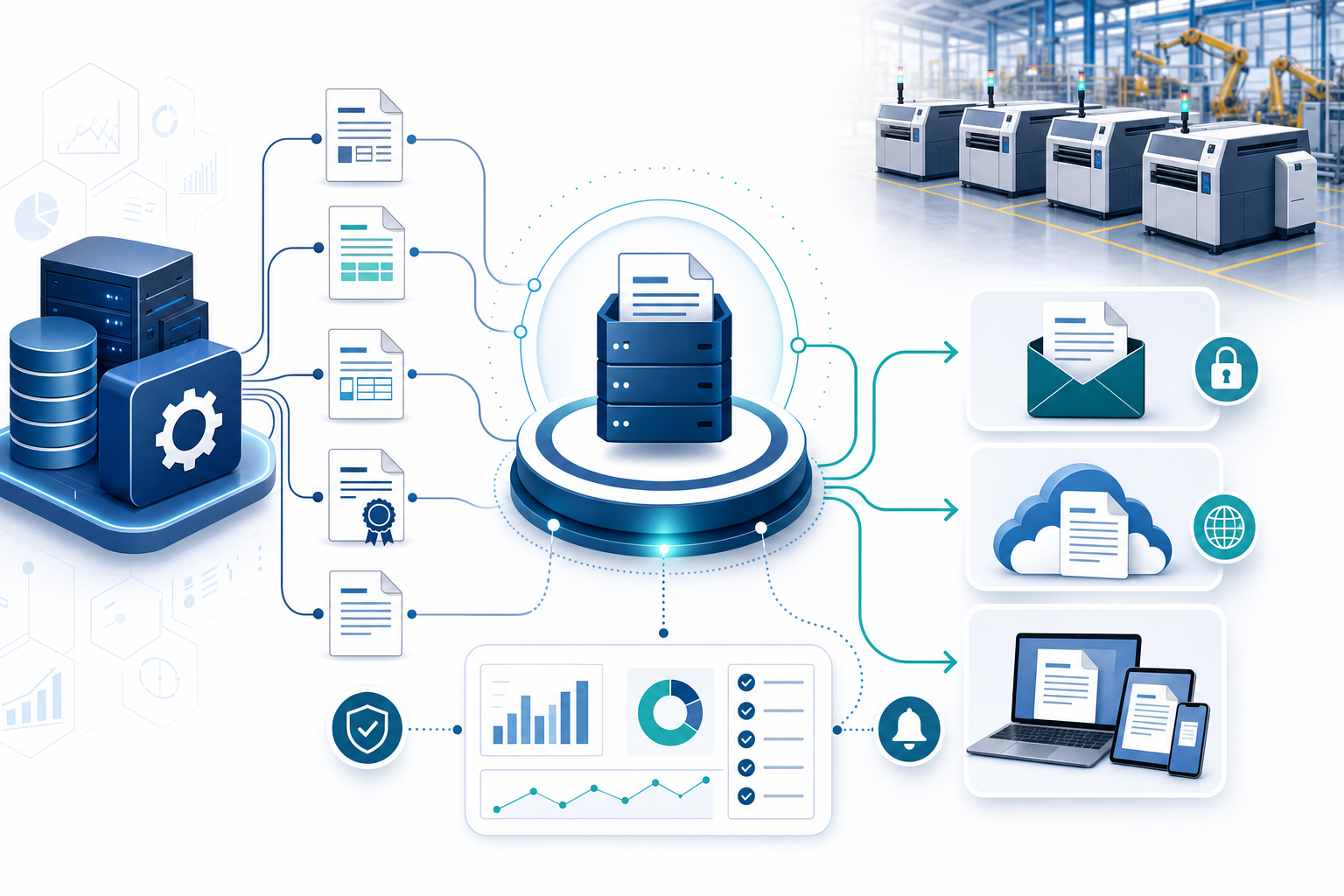
That is the gap a dedicated output management layer is meant to close. Instead of keeping output inside the ERP, SEAL’s pitch is a centralized platform that integrates with existing SAP processes through an officially certified SAP interface, works whether SAP runs in the cloud or on-premises, and removes the need for custom workarounds on the SAP side. For a manufacturer with distributed plants and large printer fleets, that certified integration is the difference between a stable process and a standing risk.
The Real Story
Sagemcom’s stated priorities read like a maturity checklist for industrial output. Centralized control provides transparency even at high volumes, load balancing and failover safeguard business-critical print jobs, and end-to-end tracking answers the questions auditors and operations managers actually ask: when was a document generated, where was it sent, and where was it printed. In a production environment, a delivery note that fails to print is a stopped operation.
This lands against a backdrop of intensifying SAP transformation. SAPinsider’s ERP Migration and Transformation 2026 research found that 82% require integrations between core ERP and line-of-business applications, and that 55% have already deployed SAP S/4HANA or SAP S/4HANA Cloud. As companies move core systems to the cloud, the certified, cloud-and-on-premises output layer that Sagemcom chose becomes a migration enabler rather than a legacy afterthought.
There is also a compliance dimension. SEAL notes that its output processes support compliant sending, including GDPR compliance, automatic stamping of approval information, and version and delta transparency. For regulated manufacturers, output is not just operational; it is evidentiary.
What This Means for SAPinsiders
Treat output management as an SAP S/4HANA migration decision. With 55% of organizations on SAP S/4HANA and 82% needing line-of-business integrations, the moment an organization touches the core is the moment to rethink how documents leave it. Migrating onto a fragile, uncertified output layer introduces old risk into a new system. IT leaders should inventory their current output path before the next SAP S/4HANA milestone and confirm that the interface is SAP-certified for both cloud and on-premises.
Read Sagemcom’s priorities as your own audit questions. Reliability, monitoring, and printer-fleet management are measurable, not abstract. If organizations cannot answer “where was this document printed,” they have a monitoring gap that will surface during an audit or an outage. Enterprise Architects and the QA team should pressure-test their environment against failover, load balancing, and end-to-end tracking, and quantify the cost of a failed business-critical print job.
Fold compliance into the output conversation now. GDPR-compliant distribution, approval stamping, and version transparency are becoming table stakes. Output is often where governance quietly breaks down. SAPinsiders should map their document processes against compliance obligations and close the gaps before regulators or customers do.
More Resources
See All Related Content
SAP S/4HANA Migration Timelines: The Average, the Range, and the Factors Behind BothBenchmark research from SAPinsider, ASUG, and Panorama Consulting puts the typical SAP S/4HANA migration at 15 to 20 months, with scope deciding where a project falls. An average project starting now finishes after mainstream maintenance ends in 2027.

S/4HANA navigation path: Standard project support during and post go-liveMigrating to SAP S/4HANA is a complex, ongoing process that requires careful dual maintenance and robust support for both legacy and new systems, with variations in support models depending on whether a cloud or on-premises approach is taken.
7 minute read

ECC to S/4HANA: Brownfield, Greenfield, or Selective Data Transition?To effectively transition from SAP ECC to S/4HANA, organizations must separately decide on their system transformation approach—whether through system conversion, new implementation, or selective data transition—and their operational model, with RISE with SAP primarily addressing the latter.
8 minute read