

7 minute read

Meet the Authors
Key Takeaways
What you need to know
The focus of ERP migration has shifted from the 2027 maintenance deadline to leveraging generative AI like SAP's Joule, impacting how organizations craft their SAP S/4HANA business cases to emphasize innovation and operational efficiency.
Despite 55% of organizations claiming deployment of SAP S/4HANA, only 34% have fully transitioned, highlighting the importance of a strict sunsetting strategy for legacy systems to avoid operational inefficiencies and security risks.
Global economic volatility is influencing ERP transformation timelines, necessitating agile roadmaps that can adapt to sudden market changes and compliance updates, thereby impacting how IT leaders manage their deployment strategies.
SAPinsider’s newly released ERP Migration and Transformation 2026 Benchmark Report reveals that the motivations, bottlenecks, and realities of moving to SAP S/4HANA have fundamentally shifted over the past 12 months. “The data from our survey of SAP community members paints a picture of organizations balancing the need to update their ERP systems, finding the fastest way of doing that, and also accelerating ways of integrating the promise of generative AI,” says Robert Holland, Chief Research Officer at SAPinsider.
Here are the top five trends that the report uncovers:
1. AI Has Dethroned the 2027 Deadline
For years, the 2027 end-of-maintenance cliff was the key driver of migration to SAP S/4HANA. Not anymore. This year, 43% of organizations cited SAP’s AI announcements as the primary external factor affecting their ERP strategy, surpassing the looming maintenance deadline, which ranked second at 39%.
Explore related questions
Ask SAPi
What This Means for SAPinsiders:
- Stop building an SAP S/4HANA business case solely around IT compliance and the 2027 deadline.
- Shift the narrative to business value by mapping how generative AI—specifically SAP’s co-pilot, Joule—will actively solve an organization’s finance and supply chain bottlenecks.
- Engage line-of-business leaders today to define concrete AI use cases before finalizing your cloud architecture.
2. The Operational Reality Is Not What Was Expected
On paper, adoption looks phenomenal, with 55% of respondents claiming they have deployed SAP S/4HANA or SAP S/4HANA Cloud over the past year. However, the operational reality is much messier. The survey highlights that only 34% of organizations have fully transitioned to the new software.
What This Means for SAPinsiders:
- Do not treat an SAP S/4HANA go-live as the finish line.
- Running parallel legacy systems indefinitely drains an organization’s IT budget, introduces security vulnerabilities, and dilutes the promised performance benefits.
- Enforce a strict sunsetting schedule for legacy ERP instances and relentlessly minimize custom code to maintain a clean core, ensuring faster upgrade cycles moving forward.
3. Global Volatility is Hijacking IT Roadmaps
ERP transformations are subject to many external factors. The SAPinsider report notes that the impact of supply chain disruptions on migration plans has doubled since last year. Moreover, 37% of the respondents surveyed say that changing European compliance requirements are actively dictating their timelines.
What This Means for SAPinsiders:
- Organizations cannot hardcode a five-year ERP roadmap in a volatile market.
- Build agile milestones into deployment contracts to absorb sudden macroeconomic or supply chain shocks.
- Establish a cross-functional governance board that includes executive sponsors so that when budgets freeze or regulations pivot, IT teams can rapidly adjust the project scope without derailing the entire transformation.
4. Cloud is the Gatekeeper to Innovation
The data shows a substantial acceleration toward cloud deployments, with 26% of respondents now using SAP S/4HANA Cloud (Public or Private Edition). However, SAP customers are also realizing that securing traditionally licensed SAP S/4HANA contracts is becoming more difficult, and the move to SAP S/4HANA Cloud ERP often acts as a simpler alternative for them.
What This Means for SAPinsiders:
- If an organization is holding out for a traditional on-premises SAP S/4HANA deployment, re-evaluate its stance immediately.
- Because SAP reserves its premier innovations and generative AI capabilities for SAP Cloud ERP contracts, remaining on-premise means accepting a feature-poor future.
- Assess the architectural benefits of SAP S/4HANA Cloud ERP (formerly RISE with SAP) now to guarantee access to ongoing innovation.
5. The 2027 Talent Bottleneck is Already Here
There are likely between 20,000 and 25,000 legacy SAP ERP customers who have not yet licensed SAP S/4HANA. As these organizations panic and rush to meet the 2027 deadline, the market is heading toward a severe resource bottleneck.
What This Means for SAPinsiders:
- Thousands of SAP customers will be competing for the same limited pool of integration experts over the next 18 months.
- Audit their internal talent immediately, specifically around SAP BTP and cloud integration skills.
- Lock in external system integrators and deployment partners today, before the impending resource crunch leaves a project stalled on the launchpad.
Read the Data: Download the full ERP Migration and Transformation 2026 Benchmark Report by Robert Holland, Chief Research Officer at SAPinsider, to dive into the complete dataset, read unfiltered perspectives from fellow SAP leaders, and get prescriptive actions to secure your transformation journey.
More Resources
See All Related Content
S/4HANA navigation path: Standard project support during and post go-liveMigrating to SAP S/4HANA is a complex, ongoing process that requires careful dual maintenance and robust support for both legacy and new systems, with variations in support models depending on whether a cloud or on-premises approach is taken.
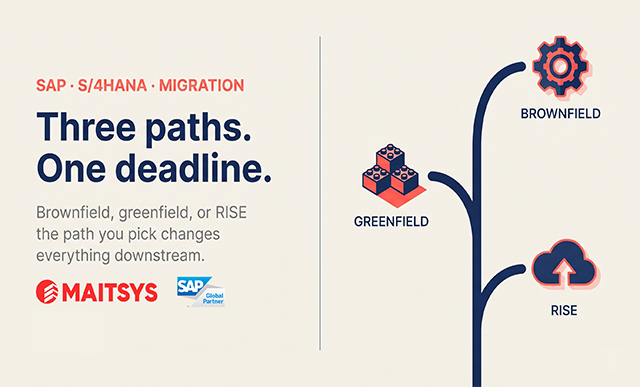
ECC to S/4HANA: Brownfield, Greenfield, or Selective Data Transition?To effectively transition from SAP ECC to S/4HANA, organizations must separately decide on their system transformation approach—whether through system conversion, new implementation, or selective data transition—and their operational model, with RISE with SAP primarily addressing the latter.
8 minute read

Shelf-Awareness: Stabilizing and Unlocking ERP Transformation in Grocery RetailIn the white-paper-shelf-awareness-stabilizing-and-unlocking-erp-transformation-in-grocery-retail, Boston Consulting Group outlines a three-phase framework of Stabilize, Simplify, and Scale with AI to help grocery retailers recover from ERP implementation disruptions and unlock long-term business value. The paper demonstrates how disciplined improvements in processes, data governance, architecture, and operating models can create the foundation for AI-driven inventory management, pricing optimization, and operational excellence
1 minute read