
5 minute read

Meet the Authors
Key Takeaways
What you need to know
Pantheon Inc. is positioning its comprehensive SAP practice as a consolidated option for customers seeking to manage all SAP functional, technical, and regional needs through a single vendor.
With a development team established in 1997 and CRM experience since 2002, Pantheon emphasizes its long-standing technical depth and continuity within the SAP ecosystem.
Consolidating SAP services under one provider like Pantheon can simplify knowledge transfer, potentially reduce the number of vendors to coordinate, and impact staffing strategies for global rollouts.
Pantheon Inc is reasserting its SAP Consulting Practice as a services provider capable of covering an SAP customer’s functional, technical, and regional needs under one engagement rather than several. The company describes its practice as a recognized services leader delivering integrated business solutions to global customers on SAP, built on a combination of technology, operations, and business expertise intended to help organizations extract fuller value from existing SAP investments. Pantheon’s consultant base includes specialists across major SAP modules alongside Advanced Business Application Programming developers and Basis administrators, a pairing the company presents as central to how it maps client business processes to SAP best practices.
One Practice, Full SAP Module Coverage
Pantheon organizes its SAP practice around several core service lines, with SAP Business Intelligence, SAP CRM, and SAP HCM with SuccessFactors chief among them. Additional service lines include functional consulting, SAP development, and global rollout and supply chain management support.
The BI work draws on Business Warehouse on HANA, BW7.5, and S/4HANA, positioned as the foundation for helping customers revamp company-wide BI strategy and build a future-proof BI solution landscape. HCM consulting spans all major SAP HCM modules and SuccessFactors. SCM consulting targets manufacturing, industrial, and logistics companies, pairing domain expertise with SAP product knowledge and a practice-oriented implementation approach.
Explore related questions
Ask SAPi
Grouping these areas under one practice reflects a broader pattern in the SAP market: organizations that split BI, HCM, and CRM support across multiple vendors often consolidate during S/4HANA or BW/4HANA transitions, when template standardization and cross-module data flows become harder to manage across separate contracts.
Long-Standing Technical Depth and Global Rollout Capability
Pantheon traces its SAP development capability back to 1997, when it built a dedicated team to address global customers’ SAP development challenges. The team has built complex application components and reusable objects across multiple platforms and SAP business process areas. Pantheon states it can implement international SAP rollouts quickly and reliably through template-based programs designed to shorten return on investment, with region-specific solutions for North America, LATAM, and APAC.
Pantheon has implemented SAP CRM solutions since 2002, covering full CRM business process rollout alongside standardization and internationalization strategies for customers operating across multiple regions. Together, the 1997 development origin and the 2002 CRM start date give Pantheon a continuity narrative in an ecosystem that includes many newer entrants.
What This Means for SAPinsiders
- Fewer vendors to coordinate across SAP modules. A practice spanning BI, CRM, and HCM under one provider can reduce hand-off friction for teams currently managing separate point-solution vendors. Consolidation of this kind typically simplifies knowledge transfer during system changes.
- Longevity becomes a re-evaluation criterion. A development history dating to 1997 and CRM experience since 2002 give procurement teams a tenure data point when reassessing incumbent versus alternative SAP partners. Buyers weighing continuity against newer entrants gain an additional variable to factor into vendor scoring.
- Rollout template reuse affects staffing plans. Claimed template-based global rollout capability across North America, LATAM, and APAC suggests governance teams could rely on fewer region-specific hires for multi-entity SAP programs. That shifts some staffing decisions from local recruitment toward central program coordination.
More Resources
See All Related Content
SAP Fiori MonitoringThe article discusses the increasing need for structured monitoring of SAP Fiori app usage, highlighting the benefits of the Xiting Fiori App Tracker, which enables organizations to analyze actual app usage, identify unused applications, and optimize their Fiori landscapes for better usability and security.
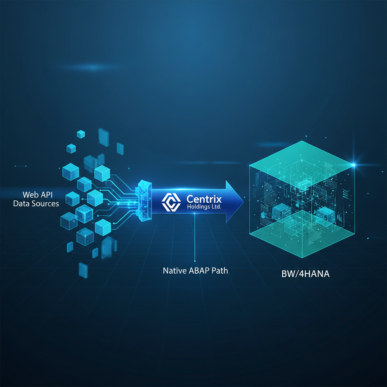
Centrix Consulting Builds Native ABAP Path for Web API Data Into BW/4HANACentrix Consulting built a native ABAP solution for SAP BW/4HANA to integrate external Web API data directly. This custom program feeds an HR KPI dashboard in SAP Analytics Cloud, showcasing a method to bypass traditional middleware for immediate data availability.
3 minute read

Priint Connects SAP Data to Automated Publishing and Document GenerationPriint positions its publishing automation suite, including priint:suite and priint:cloud, as a crucial link between enterprise data systems and various print and digital outputs, reducing manual effort and accelerating time-to-market.
3 minute read