

4 minute read

Meet the Authors
Key Takeaways
What you need to know
Priint's publishing automation solutions integrate enterprise data from PIM, ERP, and DAM systems with print and digital output, eliminating manual re-entry and streamlining workflows for marketing and creative teams.
The priint:suite offers a flexible middleware layer, priint:publishing Hub, which connects diverse data sources to publishing tools like Adobe InDesign, facilitating real-time collaboration and integration.
priint:cloud provides an API-based cloud service for high-volume document generation, supporting both transactional and batch processing while addressing data security concerns through a no-storage design.
Priint has built a family of publishing automation solutions, priint:suite, priint:comet, and priint:cloud, designed to connect structured enterprise data to print and digital output without manual re-entry. The company describes its platform as connecting digital data systems to print production, freeing marketing and creative teams from routine formatting work. Plugins for Adobe InDesign and Illustrator support real-time collaboration and integration into systems such as MDM, PIM, e-commerce, CMS, and DAM platforms. Priint states its goal is to shorten time-to-market for catalogs, price lists, data sheets, and similar materials across both B2B and B2C companies.
A Middleware Layer for Connecting Enterprise Data to Publishing Output
At the center of priint:suite sits priint:publishing Hub, flexible, configurable middleware that allows data from a wide variety of systems to be used for marketing and publishing. Instead of maintaining product content separately in each downstream tool, the Hub pulls from sources such as ERP, PIM, DAM, and CRM systems and feeds that data into output components like Adobe InDesign and Illustrator.
Connection to those source systems happens through a single interface regardless of whether the underlying link is REST, SOAP, or a direct database connection. Priint also supports flat file uploads through XML, JSON, or Excel, giving teams a fallback path when a live connector is not available.
Explore related questions
Ask SAPi
On the collaboration side, priint:planner functions as a web-based component for managing and monitoring print publications. It includes a document manager for handling metadata and complex, multi-part publications, and it applies business-rule-based content checks completed with one click, reducing manual review steps before a document moves forward.
priint:suite is built to reach multiple publication types, from price lists and catalogs to technical sales documents and packaging, as part of a broader product lineup that also includes priint:comet and priint:cloud. SAP customers running ERP, MDM, or PIM systems alongside separate DAM or content repositories often encounter this same integration gap: product data is accurate in one system but has to be manually reformatted before it reaches a catalog, price sheet, or customer-facing document. Middleware layers of this kind are generally built to close that specific gap without replacing the source systems themselves.
API-Based Document Generation for Transactional and Batch Scale
priint:cloud operates as a cloud service that uses a REST API to merge incoming data with predefined templates, producing PDFs such as data sheets, reports, invoices, and personalized correspondence. Any web-connected application can call the service, removing the need for a dedicated design environment to generate a routine document.
Throughput is built around two distinct patterns. priint:cloud can generate single-page documents in under a second for transactional requests, while also handling large batch runs of hundreds of thousands of documents per hour. Processing scales automatically under load, supporting high availability during volume spikes.
priint:cloud does not store customer data or generated documents once a request is complete, which Priint says removes the majority of data security concerns tied to the service. A management web portal handles authoring, templating, and user access separately from the document generation calls themselves.
Enterprises running SAP transactional processes, including invoicing, contract generation, and account statements, periodically evaluate cloud document-generation APIs specifically for handling peak-volume batch periods without adding on-premise infrastructure. Data residency and processing location are a standard part of the security review any SAP team runs before connecting a cloud API to systems holding regulated business data, and a no-storage design is the kind of detail that review would typically examine.
What This Means for SAPinsiders
- Middleware can cut duplicate data entry. Teams currently re-keying product or pricing data across PIM, ERP, and publication tools may see fewer manual reconciliation steps if a single integration layer replaces that duplicated work. Fewer manual touchpoints also reduce the chance of a mismatch reaching a printed catalog or price list.
- Batch throughput claims warrant a capacity comparison. Buyers evaluating document generation for invoice-heavy or contract-heavy periods should weigh Priint’s stated sub-second and batch-volume figures against current infrastructure costs and peak-period bottlenecks. That comparison should include how existing output management handles the same volume today.
- No-storage design shifts the security review. Security and compliance staff assessing a cloud publishing API will still need to confirm data-handling claims directly with the vendor as part of standard risk review. That confirmation typically becomes a documented step in procurement sign-off.
More Resources
See All Related Content

Knoa Connects User-Level Task Mining With SAP Signavio Process IntelligenceA new integration connects SAP UEM by Knoa's user-level data with SAP Signavio Process Intelligence, giving process teams a combined view of how transactions move through SAP systems and how users interact with them.
3 minute read
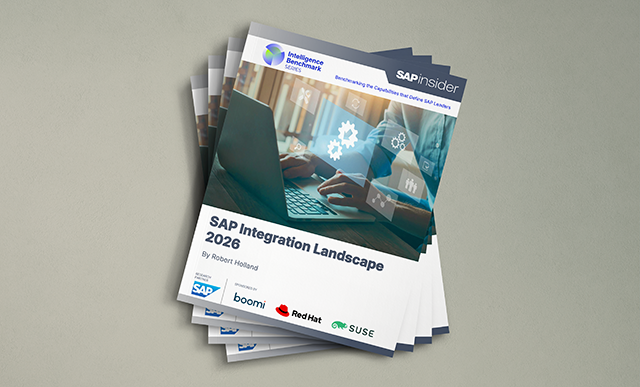
Enterprise Integration for SAP 2026 SAPinsider Benchmark Research ReportEnterprise integration is becoming a strategic platform capability for SAP organizations. As application landscapes expand across SAP and non-SAP systems, businesses increasingly depend on integration to support cloud transformation, operational visibility, analytics, partner connectivity, and artificial intelligence. The question is no longer whether organizations need an integration strategy. It is whether they can translate that strategy into a modern, governed, and scalable architecture.
SAP integration has become strategic, but it is not yet uniformly modern. Organizations are defining enterprise strategies and increasing investment as real-time visibility, cloud growth, SAP transformation, and AI create new connectivity demands. At the same time, legacy middleware, point-to-point integrations, skills shortages, and technical debt continue to limit execution.
This year’s integration research reveals substantial progress at the strategic level. Half of respondents describe their integration strategy as either enterprise-wide or platform-driven and AI-enabled, while only 4% have no formal strategy. Integration is also closely connected to transformation: 46% say it is strategically aligned with, or fully embedded in, broader cloud and digital transformation programs.
Download this benchmark research report to read a deeper analysis and receive insight on your own plans.
- Understand the integration strategies and architectures that organizations are using.
- Explore how organizations are transitioning to real-time and AI-ready integration.
- Learn about the integration challenges that are being created by AI.
- See what SAPinsiders are doing to implement the capacity to execute on integration.
1 minute read

LTM Repositions IT Operations and Transformation Around Agentic AILTM has repositioned its iRun managed operations model and iTransform transformation suite around autonomous agents, outcome-based commitments, and its shared BlueVerse AI layer. The approach changes how SAP teams may evaluate service agreements, delivery models, and governance controls.
3 minute read