

9 minute read
Meet the Authors
Key Takeaways
What you need to know
Conexiom reframes AI order automation for SAP shops, arguing that reading the order is now a commodity and validating it against pricing, part numbers, and units of measure is the work that matters.
SAPinsider research shows only 17% of SAP finance organizations report fully integrated systems and 70% of tech leaders rank operational efficiency as their top priority, making unstructured order intake a live gap upstream of the S/4HANA clean core.
For CIOs, ERP program managers, and enterprise architects, the piece makes AI with control, configurable rules, auditable decisions, and human review only for real exceptions, a written procurement requirement rather than a vendor promise.
Every distributor running SAP has a bottleneck nobody drew on the process diagram. It is not the warehouse. It is not the ERP. It is the inbox.
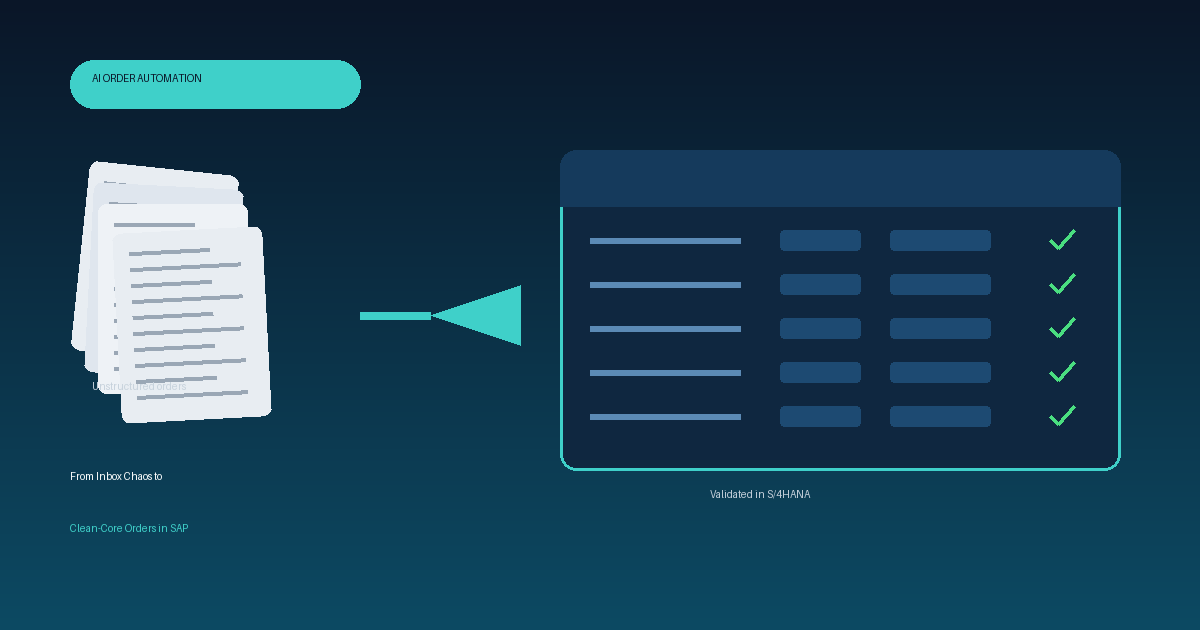
That is the argument Conexiom put forward in a June 2026 blog on AI order automation, and it lands squarely on a nerve for SAP shops. Customers still send orders the way they always have: a PDF stapled to an email, an Excel sheet with their own column names, a photo of a signed form, a few lines of text in the message body. Someone on your team opens each one, reads it, checks the part numbers, corrects the unit of measure, catches any price that does not match the contract, and then enters it into SAP. A few hundred times a day.
Conexiom’s core claim is worth sitting with, because it reframes a decade of automation pitches. Capture, the act of reading the document, has become close to a commodity. Most tools can now extract text from a messy PDF. So the real test is no longer whether software can read the order. It is what the software does after it reads it.
Explore related questions
Ask SAPi
The Job Is Not About Reading the Order
Conexiom breaks order automation into four jobs: capture in any format, validate against business data, correct and transform, then deliver into the ERP as a fulfillment-ready sales order. Most tools, the company argues, do the first job well and the rest poorly, leaving a review queue that hands the real work back to the team.
The distinction that matters to an SAP audience is the validation role. This means checking the raw data against the organization’s reality of customer records, pricing and contracts, part numbers, and units of measure. A capture-only tool will happily pass along a case when the customer meant each. A validation layer catches it before it becomes a wrong shipment.
Conexiom reports its customers typically see manual touches drop by around 85%, errors fall by roughly half, and fulfillment speed improve by about 30%. It processes orders across a library of more than 100,000 trading-partner formats and lists SAP as one of the ERPs it writes to.
SAP Made Your Core Clean, Still…
Here is why this should matter to a CIO, an ERP program manager, or a supply chain lead mid-migration. The whole promise of SAP S/4HANA is a clean core feeding real-time, intelligent workflows. But SAPinsider’s 2026 research shows the reality is messier than the roadmap. In its benchmark report The Office of the SAP CFO and the Future of Finance, based on 110 SAP-using enterprises, 54% had migrated core finance operations to SAP S/4HANA, yet only 17% reported fully integrated systems. Most organizations still operate in siloed or partially integrated environments that limit the value of the investment.
Order intake is exactly where that gap bites. SAPinsider’s SAP Order Management analysis reports that 70% of technology leaders cite operational efficiency and cost reduction as their top 2026 priority, and 40% plan intelligent automation in core ERP processes. A pristine S/4HANA instance does not help if a human is still rekeying a PDF into it and importing their own typos.
There is a governance angle too, and it is the sharpest part of Conexiom’s pitch for regulated SAP environments. The company draws a hard line against uncontrolled AI, which Conexiom calls a black box with no place between the customer and the ERP. Its framing of control is three things: your rules applied consistently, visibility into what the system did and why, and a human in the loop only where judgment is genuinely needed. For an enterprise architect defending clean-core principles and audit trails, that vocabulary matters more than any accuracy percentage.
What This Means for SAPinsiders
Stop grading order-automation tools on capture. Grade them on what lands back on the team. SAPinsider’s data ties operational efficiency to intelligent automation in core ERP, but automation that stops at a review queue only relocates the manual work. When the organization evaluates any tool against its SAP S/4HANA order desk, it should run the ugliest real orders through it, not the clean demo PDF, and ask one question: after it reads this, how many touches still hit the team? If the honest answer is “most of them,” the organization has bought a scanner, not automation.
Treat order intake as the missing integration layer in the SAP S/4HANA program. Only 17% of SAP finance organizations report fully integrated systems, and unstructured inbound orders are a live example of that gap sitting upstream of your clean core. ERP program managers should map where email, PDF, and spreadsheet orders currently enter SAP manually, quantify rekeying hours, and place order capture on the same integration roadmap as other line-of-business connections.
Make AI with control a written requirement, not a vendor promise. For SAP shops in regulated industries, an opaque model between the customer and SAP S/4HANA is an audit liability, and Conexiom is right to call it out. Enterprise architects should demand three things in any order-automation contract: rules the organization configures and owns, a visible and auditable record of every automated decision, and human review reserved for genuine exceptions. Bake those into procurement criteria now, while agentic and AI-driven order execution are still in their early stages, rather than retrofitting governance after go-live.
More Resources
See All Related Content
The Warehouse Already KnowsThe article argues that warehouse systems like SAP often fail to reflect real-world operations, leading to inventory inaccuracies and delays; it highlights the need for a transformation that accurately records floor movements, enables immediate exception resolution, and minimizes unnecessary information for operators, emphasizing that technology should support operational truth rather than creating discrepancies.


SAP Says Supply Chain AI Should Start With the DecisionAt SAP Connect 2026, SAP's new supply chain product chief urged teams to define the business decision and its metric before choosing an AI use case. Bosch, Döhler, and Microsoft described how they apply that approach to supply chain agents.
4 minute read

The Mandatory Transformation Your Business Didn’t Choose Could Be Its Biggest OpportunityThe mandatory migration to S/4HANA, often viewed as a disruption, can be transformed into a strategic opportunity through Lemongrass's Brightfield approach, which integrates AI from the onset to streamline the process, reduce costs, and unlock business value before go-live.
6 minute read