
3 minute read
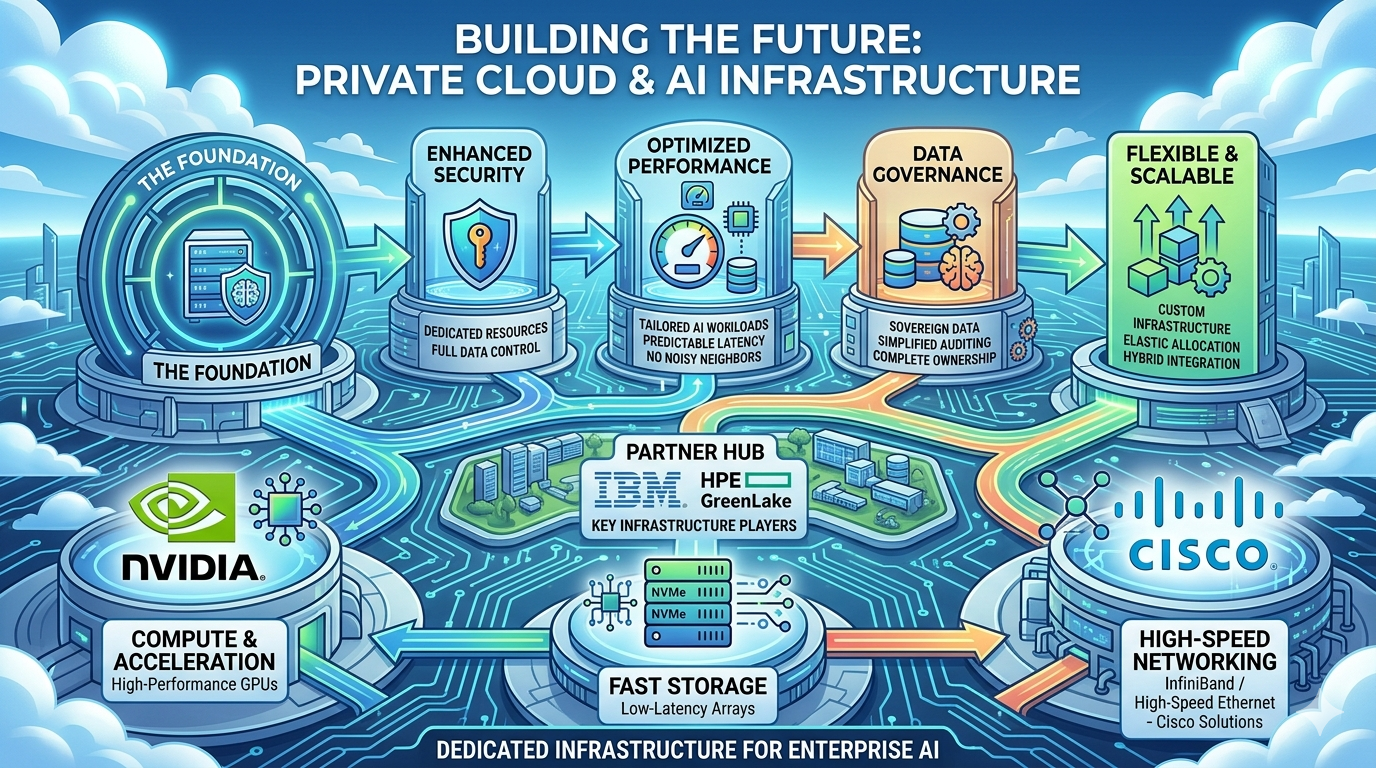
Meet the Experts
Key Takeaways
What you need to know
SAP ECC mainstream maintenance ends in December 2027, so organizations still on ECC must accelerate SAP S/4HANA migration planning now. The infrastructure shift is not a simple upgrade: S/4HANA requires HANA-certified hardware, 1–6 TB RAM nodes, low-latency NVMe storage, and dedicated replication links. This impacts mid-to-large enterprises that need to avoid long procurement delays and complete migrations within an 18–36 month timeline.
Vendor private cloud for SAP S/4HANA, including HPE GreenLake, Cisco Private Cloud, and IBM Hybrid Cloud, can deliver lower enterprise TCO than public cloud. At scale, private cloud reduces SAP HANA infrastructure costs by 30–50%, eliminates data egress charges, avoids noisy-neighbor performance issues, and simplifies support. This matters most for enterprises running full SAP landscapes with production, disaster recovery, QA, development, and sandbox environments.
The S/4HANA infrastructure decision is also an AI strategy decision because SAP Joule, RAG copilots, and custom AI models run best when SAP data, GPUs, and governance controls stay in the same private environment. Private cloud reduces latency, keeps financial and HR data under tighter compliance control, and supports governed AI with platforms like watsonx, HPE AI, and Cisco HyperFabric AI. This especially impacts regulated industries, AI-first enterprises, and companies that want a long-term competitive advantage from enterprise AI.
SAP ECC mainstream maintenance ends December 2027. With less than 30% of organizations globally having completed their S/4HANA journey, the pressure is real — and the infrastructure decision companies make today will shape their cost structure, AI capabilities, and competitive position for the next decade.
Public cloud gets most of the attention. But for mid-to-large enterprises, vendor private cloud — from HPE GreenLake, Cisco, and IBM — is quietly proving to be the smarter, more strategic path. Here is why.
1. The Migration Imperative: What Changes with S/4HANA
S/4HANA is not a database upgrade. It is a full re-platforming onto SAP HANA — an in-memory database that keeps terabytes of financial, supply chain, and operations data in RAM for sub-second analytics. This demands infrastructure that is radically different from the disk-based servers running ECC today.
- HANA-certified hardware only — not every server qualifies. SAP maintains a strict Hardware Directory.
- Massive RAM footprints — a production HANA Scale-Up node typically requires 1–6 TB of memory.
- Low-latency storage — NVM e-class persistence for HANA log and data volumes.
- High-availability fabric — HANA System Replication requires dedicated, low-latency replication links.
Vendor private cloud solves all of this out of the box. HPE, Cisco, and IBM pre-validate and deliver SAP-certified infrastructure as a managed service — removing the 6–12-month infrastructure design and procurement cycle that typically delays migration programs.
Analysis
What this means: S/4HANA migration requires specialized HANA-certified infrastructure with massive RAM (1–6 TB), low-latency storage, and dedicated replication capabilities that differ significantly from legacy ECC systems. Vendor private cloud from HPE, Cisco, and IBM eliminates 6–12 months of infrastructure procurement delays by pre-validating SAP-certified hardware as managed services, accelerating migration timelines for enterprises facing the 2027 ECC deadline.
| THE CLOCK IS TICKING
Organizations that have not started S/4HANA migration planning by mid-2025 are at serious risk of missing the 2027 deadline. Average full-scope migrations take 18–36 months. Private cloud eliminates the infrastructure delay — provisioning in weeks, not quarters. |
2. Infrastructure Cost: Private Cloud Wins at Scale
The most persistent myth in enterprise IT is that public cloud is always cheaper. For SAP HANA at enterprise scale, the numbers tell a different story.
A 2TB SAP HANA production instance on a major public cloud hyperscaler costs approximately $26,000–$32,000 per month — before you factor in disaster recovery, QA, development, and sandbox environments. A realistic SAP landscape requires 4–8x the production instance count. Add data egress charges every time HANA exports to BI tools, data lakes, or integration platforms, and public cloud costs compound quickly.
HPE GreenLake, Cisco, and IBM flip this model:
- Predictable monthly OpEx — 3–5 year as-a-service contracts typically deliver 30–50% lower TCO than equivalent public cloud at enterprise scale.
- Zero data egress costs — SAP HANA to BW/4HANA, Datasphere, or data lake pipelines run entirely on private network fabric.
- No ‘noisy neighbor’ tax — dedicated hardware means consistent HANA performance, not variable throughput driven by shared tenants.
- Vendor-managed refresh cycles — no surprise CapEx spikes when server generations change; the vendor absorbs hardware lifecycle costs.
- Simplified support — single vendor escalation path for infrastructure issues, reducing the complex tri-party blame games between SAP, cloud providers, and the customer.
Analysis
What this means: Private cloud delivers 30–50% lower total cost of ownership (TCO) versus public cloud for SAP HANA at enterprise scale due to predictable OpEx contracts, zero data egress costs, dedicated hardware performance, and vendor-managed lifecycle costs. When accounting for 4–8x landscape environments (production, DR, QA, dev, sandbox), public cloud costs from $26K–$32K monthly per instance compound significantly compared to fixed-price private cloud pricing.
| ROI / Cost Metric | Private Cloud Advantage |
| 5-Year Infrastructure TCO vs. Public Cloud | 30–50% lower at enterprise scale |
| Data Egress Costs (HANA → Analytics / AI) | Eliminated — zero egress on private network |
| HANA Performance vs. Public Cloud Equivalent | 15–40% higher throughput (SAP benchmarks) |
| Migration Program Timeline (Infrastructure Phase) | Weeks to provision vs. months for custom builds |
| Support Incident Resolution Time | Single-vendor escalation; faster SLA compliance |
| AI Workload Cost (GPU adjacent to HANA) | No data movement costs; in-network AI inference |
3. AI: The Dimension That Changes Everything
Here is what most migration discussions miss entirely: S/4HANA is not just a new ERP — it is the data foundation for enterprise AI. SAP Joule, SAP’s embedded GenAI copilot, runs on HANA data in real time. Custom AI models for demand forecasting, cash flow prediction, and predictive maintenance are trained on SAP transactional data. The infrastructure decision you make for S/4HANA is, in effect, your AI infrastructure decision.
Private cloud gives AI a decisive home-field advantage:
- Co-location eliminates latency — SAP Joule and RAG-based AI copilots perform best when the AI engine and the HANA data it queries are in the same low-latency environment. Public cloud routing adds 5–30ms of round-trip latency per query — invisible to humans but catastrophic for real-time AI applications.
- No data leaves your environment — training custom AI models on SAP financial, HR, or supply chain data on public cloud AI services raises serious data governance and regulatory concerns. On private cloud, training data never crosses a network boundary you do not control.
- Dedicated GPU infrastructure — HPE Private Cloud AI delivers NVIDIA H100/H200 GPU nodes as a GreenLake service, collocated with HANA. Cisco Nexus HyperFabric AI provides lossless RoCEv2 GPU networking for distributed AI training. IBM watsonx runs natively alongside SAP data on IBM Power infrastructure.
- Governed AI from Day 1 — IBM watsonx.governance provides audit trails for every AI decision touching SAP financial or HR data — essential for regulated industries.
Analysis
What this means: Private cloud infrastructure provides critical advantages for S/4HANA-based AI workloads: co-located AI engines eliminate 5–30ms latency penalties that impact real-time SAP Joule and RAG copilots, training data never leaves governed environments (critical for regulated industries), and dedicated GPU infrastructure (NVIDIA H100/H200, Cisco HyperFabric AI, IBM watsonx) runs collocated with HANA without data movement costs. This creates a 10-year competitive advantage in enterprise AI governance and performance.
| STRATEGIC INSIGHT
Organizations that deploy private cloud for S/4HANA are not solving a migration problem — they are building the foundation for AI that runs on their own data, in their own environment, under their own governance. That is a 10-year competitive advantage, not a 2-year project. |
4. What HPE, Cisco, and IBM Each Bring
Each vendor has a distinct profile — understanding their strengths helps CIOs match the right platform to their organization’s priorities.
| HPE GreenLake | Cisco Private Cloud | IBM Hybrid Cloud |
| Best-in-class HANA appliance portfolio. True consumption-based billing. HPE Cray AI for large-scale model training. Ezmeral data fabric. | Network-first AI fabric (HyperFabric AI). ACI microsegmentation for SAP security. Intersight cloud-like management. Best for AI at edge and OT/IT convergence. | Power10 for mission-critical HANA. watsonx.ai + watsonx.governance. Cloud Pak for Data. RISE with SAP on IBM PowerVS. Strongest regulated-industry story. |
| Best for: Cost optimization, flexible consumption models | Best for: Network-centric orgs, manufacturing, utilities | Best for: FSI, pharma, public sector, AI-first enterprises |
5. Five Things Companies Should Do Right Now
The organizations that emerge strongest from the S/4HANA era will be those that treat this migration as the foundation for the intelligent enterprise — not just a technical upgrade. Here is the action plan:
- Model your 5-year TCO before committing. Run a rigorous cost comparison using your actual SAP landscape size — include DR, QA, dev, sandbox, and AI compute. Most enterprises are surprised to find private cloud wins decisively at scale.
- Choose AI infrastructure before you choose a migration path. The private cloud vendor you select for HANA is your AI infrastructure partner. Evaluate GPU roadmaps, AI platform software (watsonx, HPE AI, Cisco AI), and data governance tools as part of the RFP — not as a Phase 2 afterthought.
- Activate SAP Joule on Day 1 of go-live. SAP’s GenAI copilot requires no custom development and delivers immediate productivity gains in finance, procurement, and HR. Private cloud ensures the data it queries never leaves your governed environment.
- Clean your data before you move it. S/4HANA’s simplified data model exposes every master data quality problem hiding in ECC. Invest 6–9 months pre-migration in data archiving, duplicate resolution, and master data governance. Migrating bad data to a faster platform is still bad data.
- Treat RISE with SAP as a commercial model, not a cloud mandate. HPE, Cisco, and IBM are all RISE-compatible infrastructure providers. You can adopt SAP’s cloud ERP commercial framework and managed services while keeping your HANA environment on dedicated private infrastructure — the best of both worlds.
The question is not whether to move to S/4HANA.
It is whether your infrastructure will be ready for what S/4HANA enables next.
Private cloud is that foundation.
FAQ
What are the key hardware requirements for SAP HANA that differ from legacy ECC systems?
SAP HANA requires HANA-certified hardware only, massive RAM footprints of 1–6 TB per production node, low-latency NVMe storage for logs and data volumes, and high-availability fabric with dedicated low-latency replication links. These requirements are fundamentally different from the disk-based servers that run ECC today.More Resources
See All Related Content
Three Ways Manufacturers Lose Margin — And How to Stop ItIndustrial manufacturers can report stable overall margins while profit slips away in individual deals, regions, and contracts. Analyses from pricing software vendor Zilliant point to inconsistent pricing, unchecked discounting, and slow cost pass-through as three common sources of that loss.
August 2026: business teams build their own entry formsAugust adds forms to data entry. Power users and administrators build guided forms per table, without code, and the same validation rules apply to every way data enters NextTables. Master data keyed on several fields, drag-and-drop uploads and support for tables other systems write to round out the release
1 minute read
The Industry Context Behind Enterprise AIIndustry AI is defined by the sector knowledge it carries, from terminology and process rules to the systems where work takes place. Three kinds of industry context, meaning, rules, and place, offer a consistent way to evaluate what an Industry AI product actually includes.
3 minute read