
1 minute read
Meet the Experts
Key Takeaways
What you need to know
SAP Sapphire 2026 marked a major shift from traditional ERP to an enterprise AI platform strategy, centered on the Autonomous Enterprise, SAP Business AI Platform, and more than 200 AI agents. This matters because SAP is moving from system-of-record software to AI-driven transaction execution, impacting CIOs, enterprise architects, finance leaders, and SAP customers planning future digital transformation.
SAP's new AI stack combines the SAP Knowledge Graph, Claude-powered reasoning through Anthropic, Joule Work, and the SAP AI Agent Hub to execute business workflows with governance and auditability. This is important for organizations because it enables autonomous finance, procurement, supply chain, HCM, and customer service use cases while still enforcing segregation of duties, compliance controls, and full audit trails.
The biggest adoption factors are clean core, cloud migration, and licensing costs, because SAP's autonomous agents depend on structured data, BTP-based extensibility, and consumption-based AI Units. This affects SAP professionals and existing customers most, especially RISE and on-premise enterprises, since real AI access, interoperability, and commercial viability will depend on modernization commitments made through 2026 and beyond.
SAP Sapphire 2026 in Orlando was not another incremental product update. It was a strategic repositioning — the clearest signal yet that SAP has made a definitive decision to stop being “just an ERP company” and start competing as a business AI platform provider. CEO Christian Klein launched the Autonomous Enterprise vision backed by a unified platform, over 200 specialized AI agents, and a €100 million partner investment fund. The message was deliberate: AI in the enterprise has crossed the line from potential to expectation.
For CIOs, enterprise architects, financial operations leaders, and SAP professionals navigating this shift, the announcements raise as many questions as they answer. What is actually available today? What does this mean for existing investments? What are the true costs? This blog cuts through the keynote energy to give you the operational context you need.
What SAP Actually Announced: The Three-Layer Architecture
Explore related questions
Ask SAPi
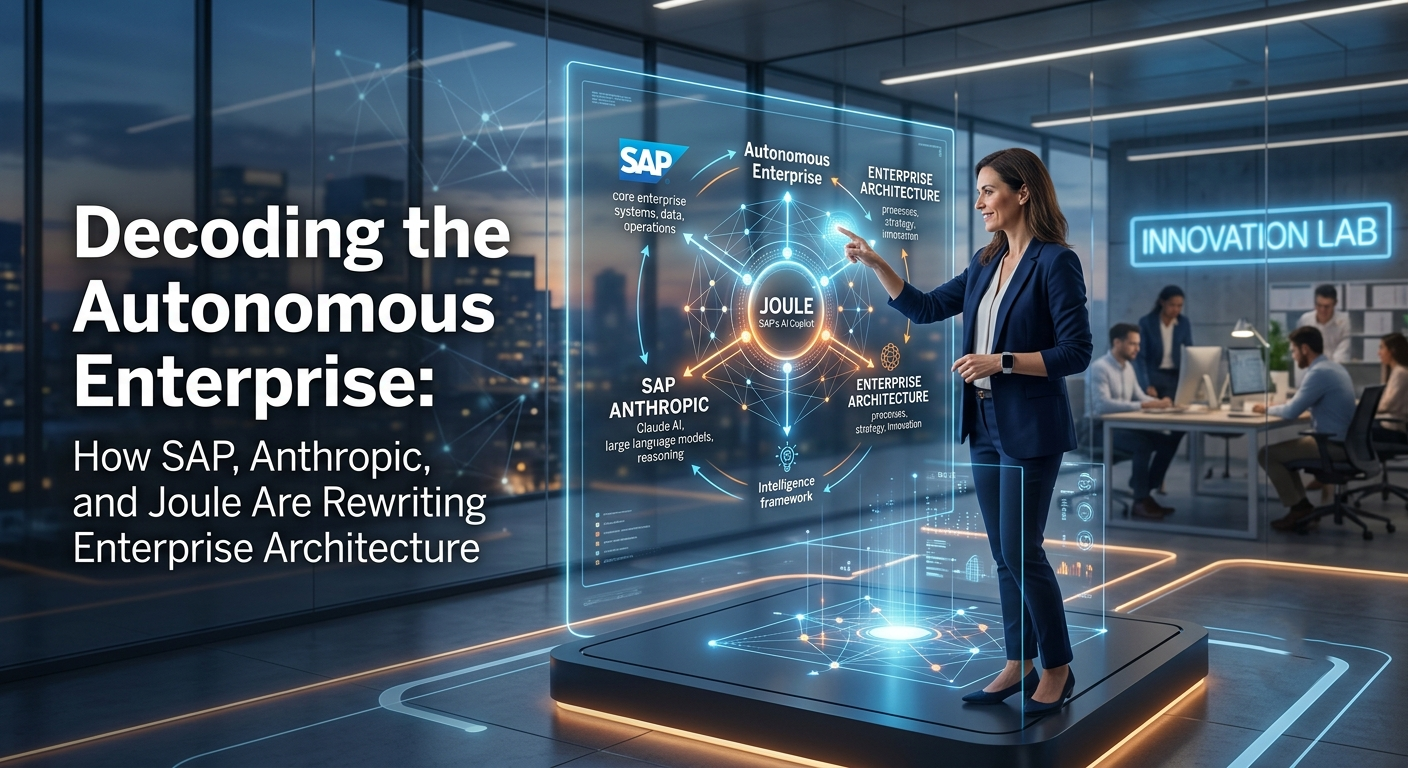
SAP introduced the Autonomous Enterprise as a coherent three-layer strategy designed to move enterprise software from recording what humans do to actively executing work on behalf of the business.
Layer 1 — SAP Business AI Platform
The foundational layer is the SAP Business AI Platform, which consolidates three previously separate investments: SAP Business Technology Platform (BTP), SAP Business Data Cloud (BDC), and SAP’s AI Foundation into a single, governed environment. At the center of this platform is the SAP Knowledge Graph — a structured representation of all business entities, their relationships, and the processes that connect them across an organization’s SAP landscape. The Knowledge Graph is what separates SAP’s AI approach from generic AI tools: instead of reasoning over raw text, Claude-powered agents reason over a structured, business-specific context layer that includes process logic, authorization frameworks, approval hierarchies, and cross-system data relationships. SAP Domain Models, trained on SAP’s own codebase and customer process data, give agents an understanding of enterprise logic that a general-purpose model simply cannot replicate out of the box.
Layer 2 — The Autonomous Suite
The Autonomous Suite is the execution layer. SAP has deployed 224 agents and 51 domain-specific Joule Assistants spanning autonomous finance, spend management, supply chain, HCM, and customer experience. Unlike traditional Robotic Process Automation that follows rigid, linear rules and breaks on exceptions, these agents are designed to reason over context, handle ambiguity, and adapt to dynamic business conditions. The Autonomous Suite was developed under an ISO-certified process specifically designed for SOX audit compatibility — a deliberate signal to CFOs and compliance leaders that governance was not an afterthought. General availability for key suite components is targeted for Q3 2026 and beyond.
Layer 3 — Joule Work
Joule Work is the new user experience layer. Instead of navigating transaction codes or switching between fragmented applications, users describe a desired business outcome in natural language. Joule Work then invokes the appropriate combination of agents, workflows, data, and approvals behind the scenes. It will be available via desktop, mobile, web, Microsoft Teams, and Slack — an intentional design decision to meet users where they already work rather than forcing them into new interfaces.
The Anthropic Alliance: Why Claude Is the Brain of the Operation
SAP announced partnerships with a broad ecosystem of AI vendors at Sapphire 2026, including AWS, Google Cloud, Microsoft, NVIDIA, Mistral AI, and Cohere. However, Anthropic was named as a cornerstone strategic partner alongside NVIDIA and Palantir — a distinction that signals different depth of integration.
SAP has selected Claude as the primary reasoning and agentic capability embedded across its entire AI-enabled solution portfolio, powered by Joule and Joule agents. The choice was not arbitrary. Claude’s strength lies in long-context, multi-step reasoning — exactly what enterprise workflows require when an agent must analyze a procurement exception, cross-reference an approval policy, evaluate supplier history, and determine the correct escalation path without human instruction at each step.
The technical integration is direct. Claude connects into the SAP Business AI Platform and operates with access to the SAP Knowledge Graph, meaning it reasons within the structured business context of a specific organization rather than on generic training data alone. SAP and Anthropic are also co-developing custom agents optimized for highly regulated industries including the public sector, healthcare, and life sciences — where compliance and auditability requirements demand a fundamentally different standard of AI behavior than general enterprise use cases.
For customers asking whether Joule agents are truly different from previous AI features, the Anthropic integration is the clearest answer: these are not content generators or search assistants. They are reasoning systems designed to execute business transactions.
Real-World Use Cases Across Business Functions
The Autonomous Suite spans five core domains, and the use cases SAP demonstrated at Sapphire are concrete enough to evaluate against real operational challenges.
Autonomous Finance
Finance receives the most developed agent coverage: Financial Closing, Financial Planning, Billing, Accounts Receivable, and Tax Compliance. In practice, a financial close agent can analyze reconciliation discrepancies between subledgers, compare against historical clearing patterns, propose journal entries with full reasoning transparency, and route them for human approval — compressing what traditionally takes days of manual investigation into an automated, auditable workflow. New sustainability AI agents, announced at Sapphire and targeting general availability by end of 2026, can cut compliance review hours by 50% and reduce GHS classification effort by 80%.
Autonomous Spend and Procurement
Procurement agents can process purchase orders, assess supplier contracts, dynamically reroute delayed shipments, and automate invoice approval within defined policy boundaries. The combination of SAP Ariba integration and Claude’s reasoning capability means agents can evaluate sourcing decisions against multiple variables simultaneously — price, risk, ESG compliance, and lead time — rather than following single-variable rules.
Supply Chain, HCM, and Customer Experience
Supply chain agents handle order rerouting and logistics optimization. HCM agents manage complex employee leave requests and HR compliance inquiries, drawing on SAP SuccessFactors data. Customer experience agents embedded in SAP Service Cloud accelerate case resolution by combining customer history, product data, and resolution patterns. SAP also launched Industry AI at Sapphire, introducing seven autonomous industry-specific scenarios with dedicated data models, process logic, and AI capabilities — including asset management for manufacturing and offshore wind turbine downtime management in partnership with RWE.
Interoperability: Can These Agents Work with Oracle, Salesforce, and Workday?
This is the question every enterprise architect is asking, and the answer is more nuanced than SAP’s keynote suggested.
SAP has implemented the Model Context Protocol (MCP), an open standard that allows AI agents to securely discover and interact with external tools and data sources. Through MCP, SAP is enabling bidirectional interoperability — a Joule agent in an SAP application can call out to a non-SAP system, retrieve data, and incorporate it into a multi-step workflow, and conversely, a non-SAP AI agent can call into SAP via an MCP server. SAP has also announced agent-to-agent integration between Microsoft 365 Copilot and Joule, allowing AI systems from both companies to coordinate workflows across business applications.
SAP’s new SAP AI Agent Hub, built on LeanIX and targeting GA in Q3 2026, extends governance to both SAP and non-SAP agents. It provides a central command center for managing agent risk, defining architectural boundaries, setting compliance rules, and verifying which agents are permitted to operate — and it will be included in the SAP Business AI Platform at no additional charge. SAP CTO Philipp Herzig confirmed this at Sapphire, positioning Agent Hub as the governance layer of record for the broader enterprise agent ecosystem, not just SAP’s own agents.
The practical limitation is depth. Native SAP-to-SAP integrations will always carry more context fidelity than cross-system MCP connections. For organizations running heterogeneous estates with Oracle ERP, Salesforce, or Workday alongside SAP, the near-term reality is that agents will perform most powerfully within the SAP application boundary, with cross-system orchestration maturing through 2026 and 2027 as the MCP integration layer is hardened.
Governance and GRC: When AI Executes Transactions
The governance implications of agentic AI are significant and deserve more attention than they typically receive in AI adoption conversations. When AI shifts from generating recommendations to executing transactions — posting journal entries, creating purchase orders, approving invoices, updating employee records — the traditional controls architecture of SAP GRC must adapt.
SAP has made a deliberate architectural choice to enforce existing security protocols and segregation of duties rules natively within the platform. If an autonomous agent initiates a procurement request, it cannot also autonomously approve the corresponding invoice if those actions violate the organization’s SoD matrix — the same rule applies to the agent as it would to a human user. Every AI-initiated action generates a complete audit trail within SAP Cloud ALM, giving internal auditors and regulatory bodies full visibility into the reasoning, data sources, and decision logic behind each autonomous action.
The SAP AI Agent Hub adds another governance layer: organizations can define architectural boundaries specifying which agents are authorized to operate in which systems, at what confidence thresholds, and under what escalation conditions. Agents that fall outside defined parameters are routed for human review rather than executing independently. This is not autonomous operation without oversight — it is supervised autonomy, where humans define the rules and review exceptions rather than executing every transaction manually.
The Data Prerequisite: Why Clean Core Is Not Optional
No amount of AI investment will produce reliable autonomous operations on top of fragmented data, heavily customized legacy code, or unsupported ERP versions. This is the part of the Autonomous Enterprise conversation that gets overshadowed by keynote excitement and deserves direct attention.
SAP’s autonomous agents require access to real-time, semantically structured enterprise data to reason accurately. Custom ABAP modifications that bypass standard SAP data models, legacy SAP BDC (Batch Data Communication) scripts that push data outside standard API channels, and on-premise ERP landscapes with aging integration layers will all limit agent effectiveness — not because the AI is weak, but because the data context the AI needs to reason correctly is incomplete or inconsistent.
SAP’s Clean Core strategy, which prescribes keeping the ERP core as close to SAP standard as possible and extending functionality through approved Side-by-Side and BTP-based extensions, is the architectural prerequisite for reliable autonomous operation. SAP evolved its extensibility model in 2025 to a four-level A-to-D maturity framework specifically to give organizations a structured path to Clean Core without requiring them to strip all customization simultaneously.
On the migration side, SAP and Palantir expanded their partnership at Sapphire 2026 to deliver AI-powered data migration tooling designed to accelerate the move to SAP Cloud ERP. These tools use Palantir’s AIP to automate system analysis, map legacy data structures to clean core standards, automate code remediation, and accelerate testing — with SAP claiming the tooling can reduce overall ERP migration effort by more than 35%. Accenture was named as the global strategic services partner for joint customer deployments of this migration capability.
Licensing and Cost: What You Actually Need to Know
Licensing is where the gap between keynote vision and commercial reality is most pronounced. SAP’s message at Sapphire was generous with product announcements and measured with pricing detail. Here is what the market currently understands.
What Is Included
Joule Studio 2.0, the development environment for building enterprise AI agents, was announced as available at no charge with a one-time no-charge offer through year-end 2026. The SAP AI Agent Hub is included in the SAP Business AI Platform at no additional charge. Baseline conversational Joule capabilities are generally included with current SAP cloud subscriptions — RISE with SAP customers receive 2,500 Joule messages per Full Use Equivalent (FUE) per contract year at no incremental cost.
What Is Metered
Advanced agentic capabilities — the multi-step, autonomous workflows powered by Claude — draw on metered AI capacity expressed as AI Units, SAP’s consumption-based vehicle for Business AI capabilities. The critical nuance is that AI Units are not fixed in current RISE contracts. Organizations that signed RISE agreements in 2023 or 2024 will likely find that the AI capabilities now presented as part of RISE require separate AI Unit allocations that were not in scope at signing. Enterprises facing RISE renewals in 2026 are entering a materially different commercial environment than historical benchmarks suggest.
What Requires Separate Negotiation
Specific AI use cases — Document Information Extraction, Business Entity Recognition, and advanced domain-specific agent packs — are separately priced and must be negotiated independently. BTP AI Core and AI Launchpad infrastructure, which underpins much of the advanced Joule capability, carries costs that SAP’s AI proposals frequently understate. RISE with SAP bundles embedded Joule but does not include sufficient BTP headroom for enterprise-scale AI workloads by default.
The Access Gate
Joule and AI agent enablement is tied to cloud adoption. As of Q1 2026, Joule is exclusive to RISE with SAP and GROW with SAP customers. Classic on-premise S/4HANA installations have no native Joule access. SAP COO Sebastian Steinhaeuser confirmed at Sapphire that SAP will enable the majority of tools on-premise for ECC customers who have already committed to a modernization journey — but access to AI innovation requires a demonstrated RISE migration commitment, not simply existing as an SAP customer.
What This Means for SAP Professionals and the Workforce
The Autonomous Enterprise does not eliminate the need for SAP expertise. It radically changes what that expertise looks like.
SAP consultants who understand business process deeply — how a financial close actually works, what makes a procurement cycle compliant, where supply chain dependencies create risk — become more valuable, not less. These professionals are now responsible for defining the rules under which autonomous agents operate, designing escalation frameworks, validating AI-generated outputs, and identifying process edge cases that the agents have not yet encountered.
Functional analysts will shift from configuring system behavior to governing AI behavior: setting agent confidence thresholds, reviewing audit trails, designing the exception-handling workflows that activate when agents fall outside defined parameters. Basis administrators and technical architects will need to extend their expertise into BTP, AI Core, MCP server governance, and the security architecture required for agent-to-agent communication.
The new skills demand that SAP professionals develop competency in: AI governance frameworks, SAP Knowledge Graph data modeling, Joule Studio agent development, Clean Core extensibility patterns, and the commercial mechanics of AI Unit consumption management. The five-year horizon is one where the most effective SAP professionals are not those who execute transactions, but those who design, govern, and continuously improve the systems that execute transactions autonomously.
The Honest Assessment: Vision vs. Available Reality
SAP’s Autonomous Enterprise is the most coherent AI strategy SAP has put on stage — and it is genuinely differentiated by the depth of business context embedded in the platform. The combination of the SAP Knowledge Graph, Claude’s reasoning capability, Clean Core data architecture, and enterprise-grade governance is a credible foundation for autonomous enterprise operations.
The gap between vision and current availability is real and must be planned around. Joule Work and full Joule agent-to-agent capabilities are targeting GA in late 2026. The AI Agent Hub is targeting Q3 2026. Full Autonomous Suite coverage across all five domains is a multi-year buildout. MCP-based cross-platform interoperability is maturing, not complete. And the commercial model — AI Units, RISE requirements, BTP infrastructure costs — demands careful evaluation before organizations commit to enterprise-wide AI agent deployments.
The organizations that will capture early value from the Autonomous Enterprise are those that treat it as an architectural commitment rather than a feature upgrade: invest in Clean Core now, modernize data architecture through SAP Business Data Cloud, build governance frameworks before agents go into production, and negotiate AI licensing terms that reflect the consumption realities of autonomous workflows — not the baseline Joule message counts SAP originally bundled.
The Autonomous Enterprise is not something you buy from a single vendor. It is something you architect — deliberately, with the right partners, on a data foundation disciplined enough to support it.
More Resources
See All Related Content



The Industry Context Behind Enterprise AIIndustry AI is defined by the sector knowledge it carries, from terminology and process rules to the systems where work takes place. Three kinds of industry context, meaning, rules, and place, offer a consistent way to evaluate what an Industry AI product actually includes.
3 minute read