
3 minute read

Meet the Authors
Key Takeaways
What you need to know
Enterprise IT leaders should thoroughly vet SAP partners' claimed experience and expertise with documented project history to avoid costly implementation failures.
For specialized sectors like Utilities and Telecom, prioritize partners with deep industry-specific knowledge and proven success in complex SAP environments.
Always request concrete operational details on how partners apply advanced technologies like AI and RPA to ensure they align with project-specific needs and risks.
BI Solutions Inc., a Plano, Texas-based SAP consulting firm founded in 2005, is positioning itself as an alternative for Utilities and Telecom organizations that have grown wary of failed SAP implementation projects. The company competes on value and invites SAP buyers frustrated by prior partner performance to consider an alternative built on tenure and certification rather than the lowest bid.
A Boutique Model Built on Experience and Certification
BI Solutions traces its founding to 2005 and operates out of Plano, Texas. The firm holds minority-owned certification from NMSDC and CPUC, a credential that some public sector and utility procurement processes weigh when qualifying vendors. Most of the company’s associates, BI Solutions says, have more than a decade of experience and function as subject matter experts within their practice areas.
The company describes its pricing philosophy directly. It competes on value rather than price, aiming to supply high-quality resources at a cost that BI Solutions says delivers value to customers. That stance contrasts with generalist SAP integrators that emphasize headcount or hourly rate over senior staffing continuity across long implementation cycles.
Explore related questions
Ask SAPi
Across the SAP partner ecosystem, enterprises are increasingly weighing consultant tenure and vendor certifications as they plan migrations ahead of the eventual end of mainstream ECC maintenance. Buyers evaluating partners for S/4HANA work often weigh documented experience against sticker price, since rework on a stalled migration tends to cost far more than the original engagement fee.
Countering Armchair Experts in Utilities and Telecom
BI Solutions identifies Utilities and Telecom as its focus industries, sectors where SAP landscapes typically carry complex asset management, metering and billing processes layered on top of core financials and logistics. The company says it applies artificial intelligence and robotic process automation to unlock value for customers. However, its public materials do not detail how those tools integrate into a given engagement.
The company frames its pitch around a broader critique of industry practice. BI Solutions states that customers are “fed up with armchair experts” in the industry, pointing to “too many failed projects and too much time and money wasted.” It adds that customers want their projects done right the first time rather than repeated, and that a market exists for what the company calls true experts.
AI and RPA tools are commonly discussed across the SAP partner community as aids for migration testing, data reconciliation and cutover validation, tasks that grow more complex in Utilities and Telecom environments carrying high transaction volumes and regulatory reporting requirements. Against that backdrop, a sector-focused partner’s claim to apply automation tooling reads as consistent with where the broader implementation market is heading, even when the operational detail behind the claim is not public.
What This Means for SAPinsiders
Experience claims deserve documented proof. SAP buyers should ask any partner, including BI Solutions, to substantiate tenure and subject matter expertise with named project history before treating years of experience as sufficient qualification alone.
Sector focus narrows the shortlist. Utilities and Telecom organizations gain a partner claiming industry depth. Still, procurement teams should confirm that focus against the actual scope and complexity of their own asset, metering or billing footprint.
Automation claims need operational specifics. SAP program teams should press for concrete detail on how artificial intelligence and RPA are applied to migration testing or reconciliation work before building those tools into a project’s risk or timeline assumptions.
More Resources
See All Related Content
M-Files Extends Its Content Platform Into SAP Document ManagementM-Files has developed an SAP ERP integration plugin that allows administrators to import SAP data directly into the M-Files platform or use it as a content repository for SAP document management, facilitating more efficient enterprise search and organization while linking multiple data sources into a unified content layer.

The Cloud MES Foundation Shapes Whether SAP’s Manufacturing Agents Can Work as IntendedSAP validated 20 delaware-developed agentic AI use cases built with Joule Studio on SAP BTP, four of them aimed at the shop floor. SAPinsider research suggests the harder question for manufacturers is whether the SAP Digital Manufacturing, data, and governance foundation underneath those agents is ready.
4 minute read
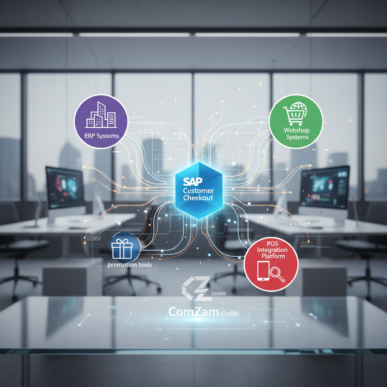
ComZam GmbH Builds Integration Layer to Connect SAP Customer Checkout with ERP and Webshop SystemsComZam GmbH offers an integration platform connecting point-of-sale systems with ERP and webshop platforms. This solution helps retailers running SAP Customer Checkout unify operations, manage inventory, and handle promotions, leveraging over 12 years of specialized SAP expertise.
2 minute read

Effective SAP Custom Code Remediation: What You Need to KnowAs enterprises face the impending end of support for SAP Business Suite 7, the need for effective custom code remediation during the transition to SAP S/4HANA has become critical to ensure compatibility, performance, and operational reliability while minimizing conversion risks and paving the way for future modernization.
9 minute read