

2 minute read
Meet the Authors
Key Takeaways
What you need to know
Manufacturing agent adoption remains an early signal: manufacturing performance and quality use cases appear in only 7% of SAP Business Data Cloud production or planned initiatives.
The readiness of the Shop Floor Intelligence, Operation Intelligence, Work Center Readiness, and Quality Review Agents depends on SAP Digital Manufacturing maturity, governed shop-floor data, and SAP S/4HANA integration.
SAP Business Data Cloud research points to higher-value agentic workflows in high-frequency, human-intensive processes, with stronger outcomes tied to verified data foundations and early architecture planning.
When SAP validated 20 Delaware-developed agentic AI use cases built with Joule Studio on SAP Business Technology Platform (BTP), the recognition traveled well beyond a partner announcement. The portfolio was featured during SAP Sapphire, including visibility in SAP CEO Christian Klein’s keynote and on SAP’s partner AI video wall. Four of those agents speak directly to the shop floor: the Shop Floor Intelligence Agent, Operation Intelligence Agent, Work Center Readiness Agent, and Quality Review Agent.
That story is now moving from the keynote stage to the workshop room with SAP’s Autonomous AI for Manufacturing Workshop series. This full-day hands-on event, running through Pittsburgh, Chicago, Atlanta, and Houston, put delaware in front of manufacturers with a session titled “Real Options for Enabling Digital Manufacturing: Turning Insights into Measurable Outcomes.”
The session explored how AI is being embedded across planning, production, quality, maintenance, and supply chain operations, and how manufacturers can connect enterprise strategy with shop floor execution through SAP Cloud ERP, SAP BTP, SAP Business Data Cloud (BDC), and SAP Business AI.
Explore related questions
Ask SAPi
The sequence matters because validation at Sapphire showed what the agents can do. In contrast, the workshop conversation is about whether the underlying landscape is ready. For most manufacturers, that second question is the harder, yet more important one.
Validation Is Not Production Readiness
The market is still in its nascent stage. SAPinsider research shows that 47% of organizations are still experimenting with AI, while only 6% have reached autonomous, adaptive AI. In SAP BDC production and planned use cases, agentic workflows appear in 24% of initiatives, but manufacturing performance and quality use cases appear in only 7%.
Against those numbers, Delaware’s four manufacturing-facing agents are best understood as a roadmap signal. The Shop Floor Intelligence Agent and Operation Intelligence Agent provide contextual insights that help operations teams identify issues, monitor performance, and respond proactively, while the Work Center Readiness Agent and Quality Review Agent extend that intelligence into readiness checks and quality review. Together, they illustrate how agentic AI can operate as an intelligence layer above manufacturing execution processes.
The Agent Is Not the Foundation
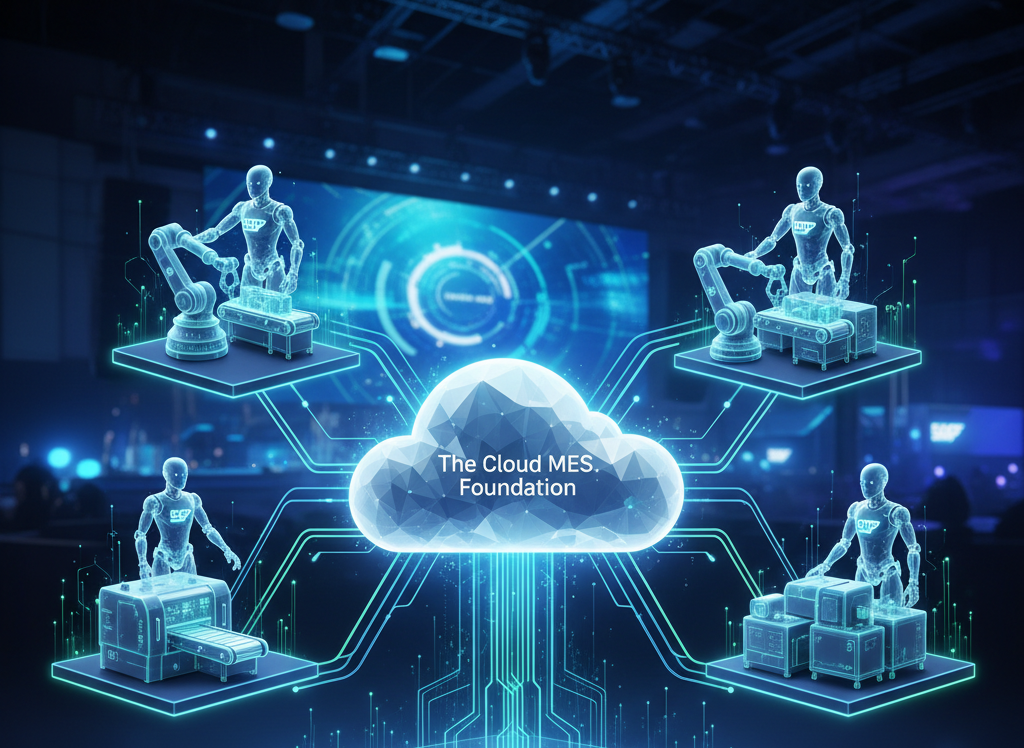
An intelligence layer needs something reliable to sit on. SAP Digital Manufacturing is the cloud-based MES that connects business systems with shop-floor equipment, linking SAP S/4HANA, business processes, and machine-level activity while providing real-time operational visibility. Without that governed operational layer, a manufacturing agent can only reason over data that may be incomplete, late, or untrusted.
SAP’s own workshop agenda makes the same point. Clean, semantically enriched data covering BOMs, routings, and production orders are the prerequisite for trustworthy AI agents. delaware’s SAP Digital Manufacturing work reinforces it in practice, with capabilities such as:
- End-to-end traceability
- In-process and goods-receipt quality recording integrated with SAP S/4HANA Quality Management
- Business continuity during ERP outages
These are not adjacent features. They determine whether a Quality Review Agent or Shop Floor Intelligence Agent returns insight the business can act on.
SAP’s autonomous enterprise framing keeps people in control of direction, judgment, and accountability, while agents perform multi-step tasks across SAP and third-party systems. In manufacturing, the MES and governance layer is where those guardrails become operational.
The Adoption Barrier Is Architectural
SAPinsider research suggests the main constraint is related to the readiness of the landscape underneath the agents:
- Legacy data and applications remain the top AI adoption barrier at 53%.
- Security and privacy risks are cited by 60%.
- Seamless integration with existing systems, applications, and workflows is the highest-rated provider selection priority at 61%.
That frames manufacturing agent adoption as an architecture question before a modeling one. A manufacturer that connects validated agents to an incomplete MES foundation risks accelerating decisions on data it cannot yet trust. Autonomous action on poor inputs can increase operational risk precisely because it moves faster than manual review.
delaware’s broader approach reflects this sequencing. Its AIDA platform maps strategically important economic outcomes to SAP AI workflow automation opportunities, connecting value-chain behavior to SAP processes, data foundations, AI capabilities, and governance controls. This aligns with SAP BDC research indicating that value depends on real-time, governed data, and that early partner involvement in architecture, roadmap, use-case, and industry model development is associated with stronger time-to-value.
How SAP Practitioners May Read the Signal
For manufacturers weighing what Sapphire’s validation showcase and the workshop series mean for their own roadmaps, the research points to foundation readiness as the pacing factor:
- Enterprise architects: The maturity of SAP Digital Manufacturing and SAP S/4HANA integration should sit alongside any evaluation of the Shop Floor Intelligence, Operation Intelligence, Work Center Readiness, or Quality Review Agents.
- CIOs: Read SAP validation as a roadmap signal rather than a deployment trigger. MES readiness, data governance, and integration work are where production ROI tends to originate.
- SI and GSI leaders: Evaluate AI and automation for manufacturing through architecture readiness, governed data, and focused pilots rather than broad agent deployment.
The organizations most likely to move from experimentation to value are those already addressing the data, MES, and governance foundation.
What This Means for SAPinsiders
Manufacturing agent adoption remains an early signal. The 7% figure for manufacturing performance and quality in SAP Business Data Cloud production or planned use cases provides a baseline for tracking whether manufacturing-facing agents move from roadmap discussion to scaled operation.
MES and S/4HANA integration shape readiness. The readiness assumptions behind the Shop Floor Intelligence, Operation Intelligence, Work Center Readiness, and Quality Review Agents are closely tied to SAP Digital Manufacturing maturity, governed shop-floor data, and SAP S/4HANA integration.
Focused agentic workflows align with the research. SAP Business Data Cloud research points to higher-value agentic workflows in high-frequency, human-intensive processes, with stronger outcomes associated with verified data foundations and early architecture planning.
More Resources
See All Related Content
Where Rules-Based Automation Ends and AI-Driven Automation BeginsRules-based automation stops or escalates when inputs vary, while AI-driven automation tries to interpret them. Most enterprise processes are combining the two, with AI handling interpretation and rules keeping control of records.
SAP EPPM-Plus Turns Capital Governance Into an Operating ProcessData center programs force projects to compete for the same capital, engineering talent, and delivery capacity. Platinum DB Consulting's SAP EPPM-Plus turns capital governance into a repeatable process that links project intake, stage-gate approvals, FP&A planning, and SAP Project System execution.
3 minute read


SAP Support Deadlines Companies Should Be Planning for NowSAP's 2027 maintenance date leads to two planning horizons, 2030 and 2033, each with its own conditions. This article explains what each horizon requires, which SAP systems it covers, and how a lifecycle map keeps every system on schedule.
3 minute read