



Mar 16-19, 2026Las Vegas, Nevada, NV
SAP Development Tools
Featured Insiders
Upcoming Events
SAPinsider Las Vegas 2026
Related Vendors

What Are SAP Development Tools
Today’s developers face the challenge of developing and rolling out software, with high software quality and mitigation of risks associated with the rapid development and deployment of applications. Submitting an IT ticket and waiting for months or even weeks for application updates is no longer acceptable in most companies.
An SAPinsider benchmark report on Application Strategies and Development for SAP S/4HANA and Cloud found that the top driver for application strategy is the need to maintain or improve business processes rapidly to support changing needs (50%). The next most important driver is the continued demand for SAP and non-SAP applications that connect to core SAP (36%).
What Are SAP Development Tools
Today’s developers face the challenge of developing and rolling out software, with high software quality and mitigation of risks associated with the rapid development and deployment of applications. Submitting an IT ticket and waiting for months or even weeks for application updates is no longer acceptable in most companies.
An SAPinsider benchmark report on Application Strategies and Development for SAP S/4HANA and Cloud found that the top driver for application strategy is the need to maintain or improve business processes rapidly to support changing needs (50%). The next most important driver is the continued demand for SAP and non-SAP applications that connect to core SAP (36%).
Understanding this burgeoning need for application development, SAP has bundled several tools under the name SAP Extension Suite, which is part of the SAP Business Technology Platform (SAP BTP).
To deliver the value proposition, SAP Extension Suite includes components such as SAP AppGyver for low-code development, SAP Business Application Studio for extending business applications, SAP Conversational AI for voice and bot applications, SAP Mobile Development Kit (MDK) for mobile applications, SAP native SDKs for iOS and Android, as well as the SAP Fiori design system and design platform for pre-built common applications for thousands of use cases.
This article, Extend Your Core Business Applications and Drive Your Business Forward with SAP Extension Suite,outlines the various ways in which SAP Extension Suite provides extensibility and walks through the various steps in the process of utilizing it.
ABAP code forms the bulk of the legacy customizations and extensions. As part of SAP BTP, ABAP environments provide ways to use the ABAP RESTful Application Programming Model (RAP), leveraging SAP HANA, SAP Fiori, and a cloud-optimized ABAP language with a clear set of released standard application programming interfaces (APIs). Developers can utilize a development toolset that enables tight integration with Git-enabled lifecycle management that includes ABAP editors, dictionaries, UI painters, and function, class, and web app builders.
Skills are always a major issue in application development. SAP Extension Suite offers different technologies and programming languages through various options and runtime environments available on SAP BTP: ABAP environment, Cloud Foundry runtime, and Kyma runtime.
There is a range of applications that are possible in today’s platforms. Companies like ServiceNow and Pillir.io provide a significant set of prebuilt apps in their low-code platforms. Consultants such as Cognizant, cbs Consulting,Capgemini, and TechMahindra can provide the expertise to drive innovation.
10 results
Ensuring Compliance in a Complex Regulatory Environment with SAP Workflow ToolsFeb 26, 2025 — In today’s rapidly evolving global landscape, regulatory requirements are becoming increasingly complex. Organizations operating across different regions and industries face a multitude of compliance obligations, from data protection mandates like the General Data Protection Regulation (GDPR) in the EU to financial accountability laws such as the Sarbanes-Oxley Act (SOX) in the U.S. and global […]
3 minute read

Utilize SAP Build Code For Building Faster And More Flexible SolutionsDec 5, 2023 — Click Here to View Session Deck. Dive into SAP Build Code tailored for SAP developers, aimed at both amplifying efficiency and upholding system integrity to create high-quality business applications. Discover a comprehensive suite of development tools, frameworks, services powered with generative AI. You will: Revolutionize your development process with SAP Build Code featuring built-in guidance […]
1 minute read

Understand the Potential of SAP Build Apps and SAP Build Work ZoneDec 5, 2023 — Click Here to View Session Deck. Learn how to leverage SAP Build Apps and SAP Build Work Zone to visually build apps and business sites that seamlessly integrate with SAP solutions, such as SAP S/4HANA, SAP SuccessFactors, and other third-party solutions. You will: Utilize SAP Build Apps to design user-centric and feature-rich solutions for web […]
1 minute read

How can SAP’s Cloud Application Programming Model (CAP) Give Developers Super-powers?Jul 22, 2022 — CAP accelerates application development on SAP Business Technology Platform (BTP) because the framework takes care of the basics. That leaves you free to concentrate on the business logic of the task at hand. By deploying your custom applications to BTP you can keep your core ERP system ‘clean’ and ready for upgrades.
1 minute read

Instill Operational Agility Into Your Organizational FabricOct 28, 2021 — Companies face an onslaught of marketplace volatility, requiring an approach that balances people and technology. The market landscape is in a state of rebuilding. Raw material shortages, supplier insolvencies, and a host of other issues pose challenges to companies and their supply chains. Those enterprises that have adapted have one thing in common — operational agility. The ability to leverage their SAP solutions and partner applications with transparency and real-time decision-making keeps them on a growth trajectory.
SAPinsider sat down with Peter Rifken, Principal Solutions Consultant for Quickbase, a no-code operational agility platform, to share his thoughts on the concept of operational agility, particularly as it pertains to supply chain strategies.
In his role, Rifken says he sees companies fall into one of two buckets: reactive or proactive. Within a reactive enterprise, outside forces dictate how the organization responds, whether it’s spikes in customer orders, supply chain shortages, or equipment breakdowns. However, proactive companies look to the future to identify risks and work backwards to better prepare for what that potential future brings.
“Proactive companies often realize that it’s the coordination of people and resources at the very edge of the business — with the teams closest to the actual problems — that are most critical to solving both day-to-day challenges and preparing for the risks down the line,” Rifken says. “And we think of operational agility as the ability to handle the day to day but also have the preparation in place for the bigger risks in the future.”
Process improvement and team coordination has a significant impact on agility. Rifken suggest practical steps teams can take to begin the process of operational agility.
Read this article and learn:
- How to measure an organization’s operational agility by examining three areas of the business;
- How to balance core systems and large migrations, such as SAP S/4HANA, while enabling those at the edge of the business to innovate and self-serve;
- What the citizen development movement is and how nearly anyone can automate anything in both a self-service and governed way;
- About a supply chain use case featuring a company that utilizes its SAP solution to track purchase order requisitions and supplier defects.
9 minute read
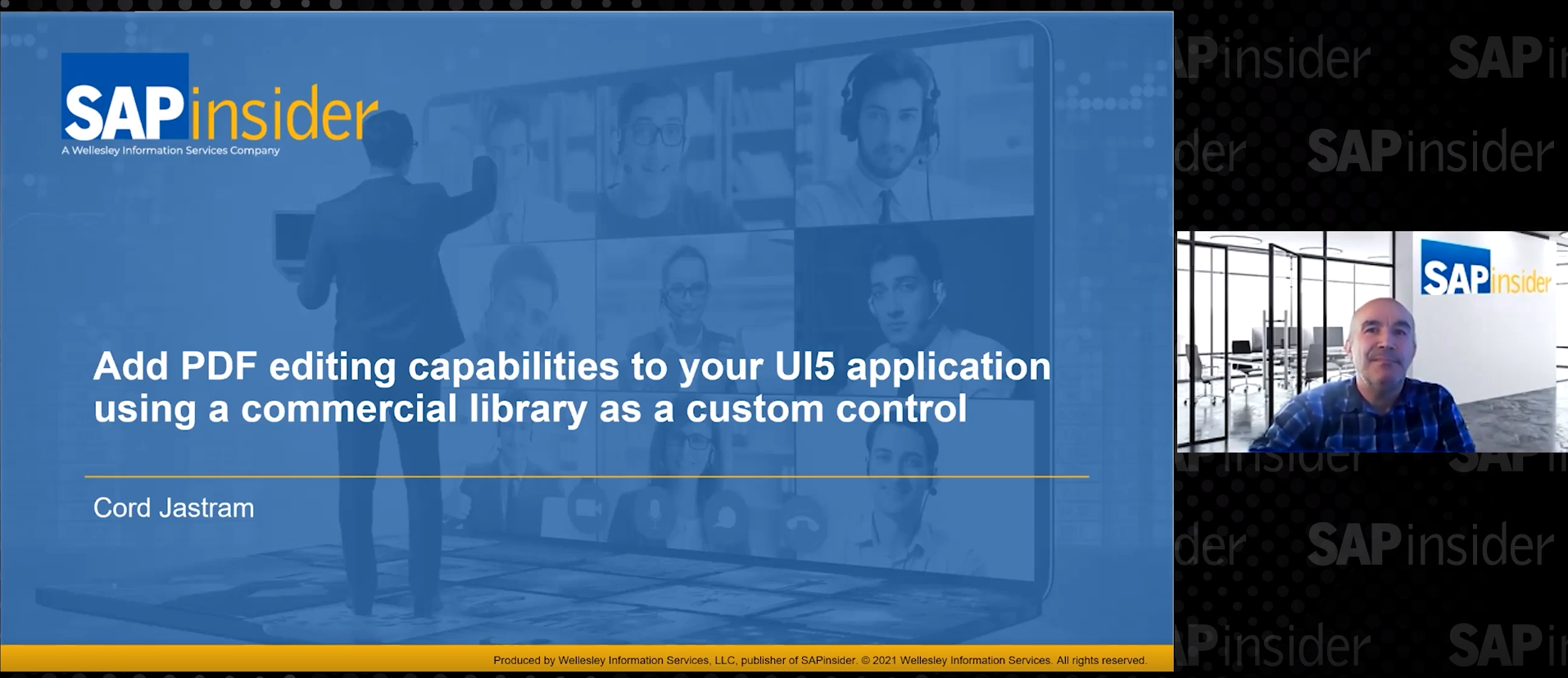
Add PDF editing capabilities to your UI5 application using a commercial library as a custom controlMay 12, 2021 — UI5 offers a large set of controls but sometimes nevertheless a feature is missing. However, UI5 has a sometimes-overlooked feature: custom controls which allow you to develop your own UI5 control. In this session I wrap a commercial web control as a UI5 custom control in order to add advanced PDF editing features to my UI5 application. I will present a full-blown application and show some important aspects of the frontend and the backend coding.
Key takeaways:
-Learn the basic steps for creating a UI5 custom control
-Explore in detail how you can wrap a commercial library in such a way that it plays nicely with your UI5 application including configuring the control in XML views and data binding via OData services
-See a live demo of a UI5 application which can handle PDF forms an annotations
1 minute read

Embracing Open TechnologyAug 24, 2017 —
Developers play a crucial role in helping SAP customers succeed. To help both SAP and non-SAP developers create and innovate successfully with SAP software, openness is at the core of SAP’s software development strategy. Learn how SAP is supporting and working in partnership with developers to help businesses run better, and how the 2017 SAP TechEd events are designed to be both relevant and accessible to the developer community.
3 minute read

A New Development Platform for Native SAP HANA ApplicationsApr 26, 2016 —
Developers have several options for developing applications and business content on SAP HANA, such as the ABAP 7.5 stack and the analytics applications supported by SAP Business Warehouse (SAP BW) powered by SAP HANA. But if you’re looking to move beyond dashboard scenarios and don’t want to base that development on SAP NetWeaver stacks, your options grow more limited. For that reason, support package stack (SPS) 11 for SAP HANA was released in Q4 2015 to enable Java- or JavaScript-based native applications developed specifically for SAP HANA. Discover how you can take advantage of this new development environment to use open source standards and a microservices-based approach while remaining tightly integrated with SAP HANA.
16 minute read
How to Select the Right Mobile Solution Architecture for Your Use CaseOct 12, 2012 — Understand the main mobility architecture paradigms currently supported by the Sybase Unwired Platform, and the advantages and drawbacks of each. Get a high-level view of the architecture and basic steps for implementing each. Key Concept A mobile business object is a method of encapsulating business data so that it can be used across multiple kinds […]
24 minute read