Topics

Explore critical topics shaping today’s SAP landscape—from digital transformation and cloud migration to cybersecurity and business intelligence. Each topic is curated to provide in-depth insights, best practices, and the latest trends that help SAP professionals lead with confidence.

Regions

Discover how SAP strategies and implementations vary across global markets. Our regional content brings localized insights, regulations, and case studies to help you navigate the unique demands of your geography.

Industries

Get industry-specific insights into how SAP is transforming sectors like manufacturing, retail, energy, and healthcare. From supply chain optimization to real-time analytics, discover what’s working in your vertical.

Hot Topics

Dive into the most talked-about themes shaping the SAP ecosystem right now. From cross-industry innovations to region-spanning initiatives, explore curated collections that spotlight what’s trending and driving transformation across the SAP community.

Topics

Explore critical topics shaping today’s SAP landscape—from digital transformation and cloud migration to cybersecurity and business intelligence. Each topic is curated to provide in-depth insights, best practices, and the latest trends that help SAP professionals lead with confidence.

Regions

Discover how SAP strategies and implementations vary across global markets. Our regional content brings localized insights, regulations, and case studies to help you navigate the unique demands of your geography.

Hot Topics

Dive into the most talked-about themes shaping the SAP ecosystem right now. From cross-industry innovations to region-spanning initiatives, explore curated collections that spotlight what’s trending and driving transformation across the SAP community.

SAP Finance

SAP Finance is the suite of SAP solutions designed to support financial operations across planning, accounting, reporting, risk and treasury. As organizations modernize their ERP environments, SAP Finance capabilities embedded in SAP S/4HANA have become central to how enterprises manage the financial close, compliance and real-time analytics. SAPinsider covers SAP Finance topics including financial transformation, IFRS compliance, treasury and SAP S/4HANA Finance deployment.

What is SAP Finance?

SAP Finance refers to the financial management capabilities built into SAP S/4HANA, including general ledger accounting, accounts payable and receivable, asset management, cost controlling, treasury and financial planning and analysis (FP&A). The SAP Universal Journal, which is the foundational ledger in SAP S/4HANA, consolidates financial and management accounting into a single source of truth. SAP Finance is deeply integrated with operations, enabling organizations to connect financial outcomes to procurement, supply chain and workforce data in real time.

What use cases does SAP Finance address?

  • Financial close acceleration: Organizations use SAP Finance capabilities including SAP S/4HANA and SAP Group Reporting to reduce the time required for period-end close, eliminating manual reconciliations through the Universal Journal and automated intercompany processes.
  • FP&A and financial planning: SAP Analytics Cloud and SAP S/4HANA Finance support integrated financial planning, enabling finance teams to connect budgets, forecasts and actuals in a single platform with scenario modeling and AI-assisted planning.
  • Compliance and regulatory reporting: SAP Finance tools support IFRS, GAAP and local statutory reporting requirements, with automated ledgers and disclosure management capabilities that reduce manual effort in regulatory submissions.
  • Treasury and cash management: SAP Treasury and Risk Management supports cash positioning, liquidity forecasting and financial risk hedging, giving treasury teams real-time visibility into cash flows across the enterprise.

What does SAPinsider research say about SAP Finance transformation?

SAPinsider research shows that finance transformation remains one of the top drivers for SAP S/4HANA adoption, with organizations prioritizing faster close cycles, improved reporting accuracy and better support for regulatory compliance. Studies highlight the importance of the Universal Journal as a foundation for connected finance and the growing role of AI and automation in streamlining financial processes. Explore the latest SAP Finance research and practitioner resources at SAP Finance.


Why SAP Users Are Rethinking Tax Engines for SAP S/4HANA—Insights from VertexAs SAP organizations modernize with S/4HANA and clean core principles, tax engines are becoming strategic integration points whose legacy limitations can create compliance, operational, architectural, and cost risks, making modernization or replacement increasingly important.
Stablecoins
Kyriba Pushes Treasury Toward AI-Orchestrated Liquidity, Stablecoins, Embedded InvestingAt KyribaLive 2026, Kyriba announced AI-orchestrated treasury upgrades and collaborations with Circle, J.P. Morgan Asset Management, and AFP to bring USDC settlement, embedded money market investing, stablecoin education, and advanced liquidity and FX planning into governed treasury workflows, signaling a shift from visibility tools to execution infrastructure under tighter controls.
Finance team working at laptops, representing SAP BRIM payment reconciliation and accounts receivable clearing.
Why SAP BRIM’s Reconciliation Gap Needs a Specialist FixAcuiti SmartMatch helps SAP finance teams address a reconciliation gap in SAP BRIM environments, where complex billing models can make payments harder to match to invoices automatically.
Looking up at tall office buildings in fog, representing executive accountability and enterprise pricing control.
Why C-Suite Ownership Has Not Fixed SAP Pricing ControlZilliant research shows that pricing accountability has moved to the C-suite, but SAP pricing control still depends on the workflows where prices are created, adjusted, approved, and applied.
Joule Is Now the Front Door to Your Business What SAP Sapphire 2026 Means for Customers Vendors and PartnersIf you attended SAP Sapphire 2026 or followed the announcements from Orlando, you heard a lot of bold language about the Autonomous Enterprise, AI agents, and the future of business software. Beneath the keynote energy, there are concrete announcements with real implications for every SAP customer, every vendor operating in an SAP-connected supply chain, and […]
data
Post-Acquisition Finance Integration is the Barrier to Value CreationAs M&A activity drives increasingly complex multi-system finance environments, the article argues that CFOs must lead post-acquisition integration by aligning data, centralizing cash visibility, standardizing internal money movement, simplifying the system landscape, and applying governed AI and automation to reduce risk, improve control and unlock deal value.
Jeremy Barnum, CFO of JPMorgan Chase with Christian Klein, CEO of SAP on stage at SAP Sapphire 2026.
How JPMorgan Chase Is Rebuilding Finance from the Inside Out with SAPAt SAP Sapphire 2026, JPMorgan Chase CFO Jeremy Barnum and SAP CEO Christian Klein outlined how the bank is modernizing its general ledger and deploying AI agents to catch errors before they post.
People meeting near transparent glass in an office building, representing discussions over modernizing B2B payment and SAP invoice-to-cash workflows.
How B2B Payments Are Becoming Part of SAP Invoice-to-Cash WorkflowsB2B payments remain a source of cash-flow drag for SAP customers that still rely on manual invoice-to-cash processes. Worldpay’s approach connects payment choice, reconciliation, and receivables visibility to how companies collect cash and support buyers.
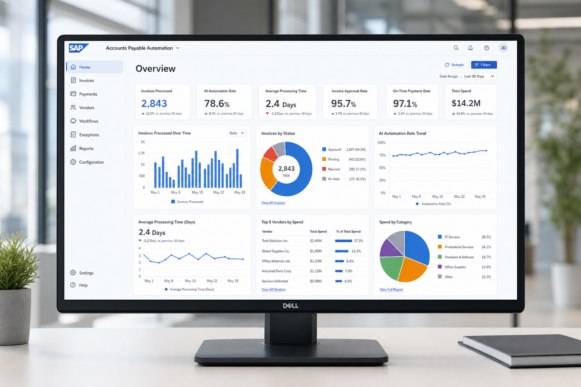
Dashboard displaying accounts payable automation metrics integrated with SAP S/4HANA Cloud ERP.
Why AP Can’t Be an Afterthought in An SAP Cloud ERP MigrationAs the 2027 maintenance deadline approaches, finance teams must adopt a clean core strategy to ensure accounts payable operations remain uninterrupted during complex SAP S/4HANA migrations.
Research Shows Property Tax Compliance Costs Six Figures Annually for Most Large EnterprisesAvalara’s research finds that large enterprises face six-figure annual property tax compliance costs, heavy manual workloads, frequent audits and widespread penalties or missed savings, making ERP-integrated automation an urgent priority to reduce risk and improve strategic decision-making.

Related Vendors