

2 minute read

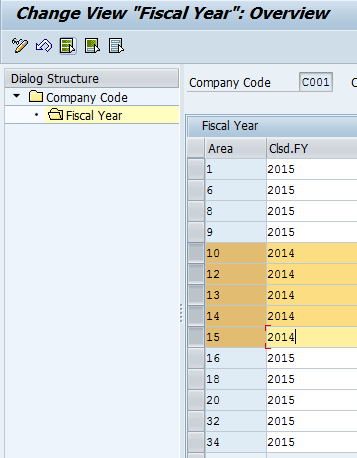
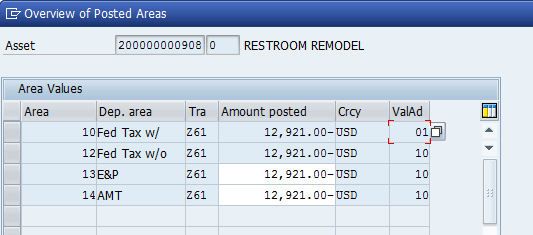
Learn the steps necessary to open the prior fiscal year and allow tax depreciation adjustments to individual asset records in SAP Asset Accounting (FI-AA).
More Resources
See All Related Content
SAPinsider 2025 Benchmark Study: Tax Technology in SAP EnvironmentsThis year’s tax technology report highlights global AI and automation practices, including regional insights. Respondents throughout the year shaped this global view of tax technology and automation in SAP® environments.
Tax and finance leaders in SAP environments are continuing digital transformation initiatives globally. Benchmarking against industry-wide global tax automation practices offer an opportunity to measure an organizations’ existing path and celebrate or take course correcting action where needed. Across the globe tax technology adoption (e.g., intelligent mapping, RPA, AI, and Machine Learning) is accelerating. This is good news. AI and automation adoption in tax is paramount to removing blockers that slow business value creation. Value creation today is dependent on high-performing ecosystems, a web in which tax plays a key role in ensuring an organization’s high performance.
Fueled by unique challenges, automation and AI adoption priorities differ by region. Europe, Middle East, and Africa (EMEA) lead in adoption to address strategic transformation (63%) and ESG requirements. Asia Pacific, Australia, and New Zealand (APC & ANZ) are advancing integration and compliance capabilities (43%). North America (NA) and Latin America (LATAM) are using AI and automation to drive efficiency, and audit readiness. These differences highlight how important it is for tax automation and AI adoption paths to be regionally specific.
Read the full report for details and more findings on AI and Automation in Tax including, approaches to tax process automation, tax technology innovation strategies, use of AI, ML, RPA, and intelligent mapping, and improvements experienced from adopting AI and automation

SAPinsider Research Webinar: Tax Technology in SAP EnvironmentsTax and finance leaders running SAP are moving from fragmented, spreadsheet‑driven tax activities to integrated, AI‑enabled tax operations that are tightly aligned with SAP S/4HANA roadmaps and global compliance demands. By standardizing on end‑to‑end tax automation, central data governance, and embedded tax engines, leading organizations are decoupling tax logic from SAP core systems, improving audit readiness, and creating scalable tax platforms that can keep up with rapid regulatory change.
In this SAPinsider webinar session, learn how benchmark leaders are architecting tax technology across SAP ECC, SAP S/4HANA, SAP BTP, and key third‑party solutions to support direct and indirect tax, e‑invoicing, and global reporting without over‑customizing SAP. The speakers walk through concrete SAP scenarios showing how intelligent mapping, AI‑driven anomaly detection, and cloud‑based tax engines are being used to maintain clean tax data, automate calculations and filings, and provide real‑time visibility to tax, finance, and IT stakeholders.
Watch this webinar to:
- Discover how an end‑to‑end tax automation layer can accelerate SAP S/4HANA projects by isolating tax rules and compliance logic from the SAP core, reducing upgrade risk, technical debt, and manual work.
- See practical, SAP‑centric use cases where integrated tax workflows, AI, and analytics improve user experience, shorten close cycles, and strengthen compliance across regions facing diverse e‑invoicing, ESG, and indirect tax requirements.
- Learn lessons from SAPinsider’s 2025 benchmark on how peers are funding tax technology, managing integration challenges, closing skills gaps, and using the DART model to prioritize next‑step investments in AI, data quality, and third‑party solutions like Avalara, Vertex, and others.
1 minute read

Empowering Tax Leaders: A Checklist for Early Digital Transformation InvolvementThis article outlines actionable steps for tax leaders to ensure their department's strategic involvement in digital transformation initiatives, emphasizing alignment with organizational goals, early advocacy, technology integration, and continuous evaluation to enhance compliance and ROI.
2 minute read