

3 minute read
Meet the Authors
Key Takeaways
-
Adoption of SAP Cloud ERP Private is accelerating as the 2027 end-of-maintenance deadline for legacy systems approaches, with 30% of organizations fully live on the solution, marking a sharp increase from 19% last year.
-
Smaller organizations are moving faster in adopting SAP solutions, with 26% fully live compared to 14% of larger enterprises, which tend to be in planning or exploration phases due to longer decision cycles.
-
Generative AI is significantly influencing ERP decisions, with 43% of organizations reporting its impact in 2025, a notable increase from 14% in 2023, highlighting the growing role of technology in migration planning.
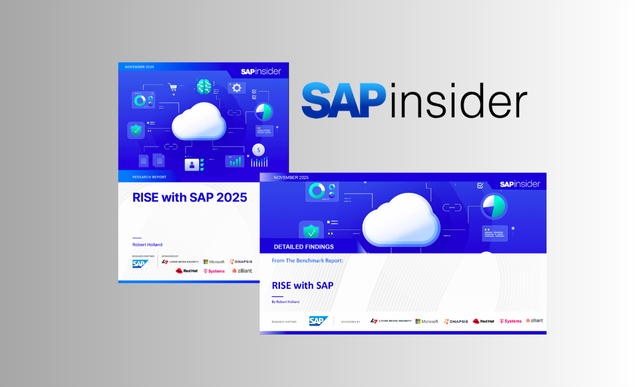
A new SAPinsider benchmark report, RISE with SAP 2025, shows adoption of SAP Cloud ERP Private, formerly known as RISE with SAP, accelerating as the 2027 end-of-maintenance deadline for legacy systems approaches.
Still, Robert Holland, vice president and research director at SAPinsider, wrote, “The RISE with SAP package is seeing varied adoption rates.” He notes, “Smaller organizations (under $2 billion in revenue) are currently twice as likely to be live on the solution compared to larger enterprises, which are predominantly in the planning or exploration phases.”
Holland explained that SAP is driving adoption through its deployment assistance, but holdouts continue to assess cost and business value. On Tuesday, January 13, 2026, at 2 p.m. ET, Holland will address these findings in the webinar, RISE with SAP 2025: Adoption, AI, and Security Insights, providing expert analysis and guidance for the 2027 deadline.
Explore related questions
What the RISE with SAP 2025 Report Reveals About Migration
The study of 122 SAP professionals shows a clear acceleration in cloud ERP adoption, with organizations across industries moving quickly toward either SAP S/4HANA Cloud Private Edition or SAP S/4HANA Cloud Public Edition. Meanwhile, generative AI is influencing decisions for 43% of respondents, with security gaps and a shortage of skilled migration resources posing challenges.
Adoption Accelerates Across Industries
Legacy SAP ECC and Business Suite use has fallen below 50% for the first time, while those who have fully transitioned to SAP S/4HANA Cloud Private Edition rose to 30% in 2025 from 19% last year. Overall, 73% of organizations are at some stage of the transition, from planning to full implementation, across industries.
Organizational Size Shapes Migration Pace
Smaller organizations (under $2 billion revenue) are moving faster, with 26% fully live versus 14% of larger enterprises, which are more likely to be in the planning or exploration phases (35%) due to longer decision cycles and complex IT landscapes, reflecting longer decision cycles and more complex IT landscapes.
Generative AI Influences Decisions
Generative AI capabilities, particularly SAP’s generative AI assistant Joule, are becoming a strategic factor in migration planning. In 2025, 43% of respondents said AI influenced their ERP decisions, up sharply from 14% in 2023. Adoption is driven not only by AI but also by SAP’s dedicated migration support (51%) and license conversion credits (40%), highlighting the importance of commercial incentives alongside technology.
Challenges Remain
Organizations report that remediating custom code, cleaning data, and securing business-unit support are the top obstacles they face in the transition. Cost and unclear business value are the main barriers for non-adopters, each cited by 43% of respondents. Security compliance gaps persist: only 62% of live users rigorously follow shared responsibility guidelines, and just one-third conduct regular monitoring and auditing.
Cloud Infrastructure and Migration Strategies
Microsoft Azure is the preferred cloud service provider for larger enterprises, while smaller organizations are more likely to select AWS. Hybrid and phased migration approaches remain common, but confidence in moving all SAP workloads to the cloud is growing, rising from 13% in 2024 to 20% in 2025. This reflects greater trust in cloud ERP’s ability to handle complex landscapes.
Learn More About How Peers Are Preparing for the 2027 SAP Deadline
With adoption accelerating, smaller organizations moving faster, and larger enterprises still in planning or exploration phases, benchmarking your own migration plans is critical.
During the upcoming research findings webinar, Holland will unpack the report’s findings and offer guidance that can inform organizations’ own ERP transition planning and governance before the 2027 end-of-maintenance deadline.
- Identify the factors driving organizations to speed up adoption of SAP Cloud ERP Private, and how adoption patterns vary across different company sizes.
- Examine how SAP support, access to new capabilities, and the growing influence of generative AI are affecting technology decisions.
- Assess the challenges organizations report as most difficult, including data quality issues, custom code remediation, and gaining business alignment.
- Review how companies are structuring strategy teams, involving executive leadership, and addressing anticipated resource constraints.
- Understand the actions organizations can take now to support ERP transformation and sustain innovation over the long term.
The session will provide actionable insights for aligning strategy with operational realities, reducing risk, and accelerating transformation across complex IT landscapes.
What This Means for SAPinsiders
- SAP S/4HANA Cloud Private adoption is accelerating rapidly. The SAPinsider benchmark report shows legacy SAP use has dropped below 50% for the first time, while 30% of organizations are fully live. This milestone shows most enterprises are moving to modern ERP, creating urgency for remaining organizations to accelerate their own migrations.
- Benchmarking is essential during periods of technology change. Insights into adoption rates, generative AI influence, and security compliance help organizations prioritize workloads, allocate resources, and anticipate obstacles, strengthening governance ahead of the 2027 end-of-maintenance deadline.
- Benchmark with industry leaders. Engaging with peers and experts enables organizations to assess their ERP migration strategies against industry best practices. This comparison highlights gaps, informs resource allocation, and strengthens execution, helping companies protect ROI and maintain competitiveness during rapid cloud transformation.
More Resources
See All Related Content
ENGIE elevates its billing process with SAP S/4HANA®ENGIE transformed its billing and customer care processes by migrating from a legacy SAP ERP system to a new SAP S/4HANA Utilities solution with the help of TCS, resulting in enhanced user experiences, improved operational efficiency, and a significant reduction in digital carbon footprint.

Prysmian unifies and manages 300,000+ SKUs across global marketsDiscover how Prysmian creates accurate, reusable product content for use across regions and standards with Inriver, laying out the foundation for a more sustainable future for Prysmian. Summary Prysmian Group unified product data for more than 300,000 SKUs across 50 countries using Inriver as its Product Information Management backbone. By centralizing operational and commercial product […]
2 minute read

Wolters Kluwer Survey Shows How the CFO Role Is Expanding Beyond FinanceA new Wolters Kluwer survey finds the CFO role expanding beyond traditional finance responsibilities. As organizations adopt integrated planning platforms and AI-driven analytics, finance leaders are taking on broader roles in enterprise planning, technology initiatives, and investment decisions.
4 minute read

Why Indirect Tax Became a Real-Time SAP Constraint in 2025—and Why 2026 Is the Turning PointIn 2025, the transition of indirect tax into real-time operational processes within SAP emphasized the critical need for tax accuracy to ensure smooth transaction workflows and regulatory compliance, compelling organizations to rethink tax management strategies and adopt external tax engines for effective adaptation to rapidly changing regulations.
6 minute read