Meet the Experts

Work with experienced cloud partners to drive the success of broader cloud initiatives
Ensure that cloud projects have small, realistic milestones to demonstrate the value of the project in achievable steps
Utilize the capabilities available in packages like RISE with SAP/SAP Cloud ERP Private to help drive the cloud transformation of SAP workloads
SAPinsiders have been moving to the cloud for over a decade but the transformation process is far from complete. In addition, most organizations take a unique path to the cloud. Some started with a lift and shift of older on-premise systems to infrastructure-as-a-service environments, while others may have directly moved to SAP S/4HANA or even RISE with SAP/SAP Cloud ERP Private. Some started their remediation processes for data and code early, while others have done it following the move to SAP S/4HANA, or even after the move to RISE with SAP. What this has made clear is that, while establishing and maintaining cloud architecture for SAP is on nearly everyone’s roadmap, most organizations are still in the middle of that transition.
What is clear from this data is that leaders have generally made more progress in their adoption of cloud technologies than either cloud beginners or the hybrid majority. However, that is not true in every instance. For example, more than two thirds (69%) of leaders are already using SAP Business Technology Platform (BTP), but this is only slightly more than the hybrid majority (60%) or cloud beginners (57%). This difference is more marked with the adoption of SAP S/4HANA Cloud which is being used by 62% of leaders, 51% of the hybrid majority, and only 23% of cloud beginners.
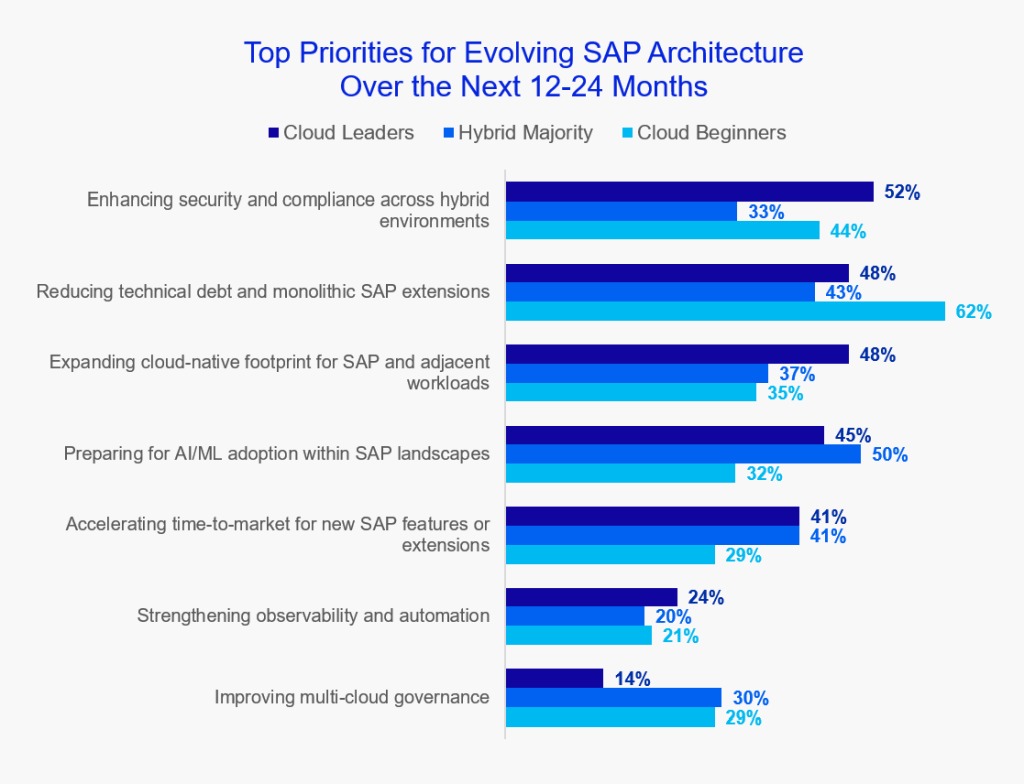
This year’s research also explored the cloud or hybrid cloud platforms actively in use in SAP environments, the top priorities for evolving SAP architecture over the next 12-24 months, the impact of adopting cloud or hybrid cloud architecture in transforming SAP workloads, and the challenges encountered when adopting cloud or hybrid cloud architectures for SAP workloads.
The findings indicate that SAPinsiders will not be able to continue to run legacy applications forever. And with the end of 2027 just over two years away, that change will likely come first with the need to move to SAP S/4HANA Cloud through the auspices of a RISE with SAP/SAP Cloud ERP Private contract. SAPinsiders must be prepared for this change, and should follow the guidance of cloud leaders in making this possible.
Download the benchmark report to read the full data analysis and receive recommendations for your own plans.
– Understand the benefits experienced from adopting cloud or hybrid cloud architecture for SAP or SAP-adjacent systems.
– Explore the impact of adopting cloud or hybrid cloud architecture in transforming SAP landscapes.
– Learn about the factors impacting cloud or hybrid cloud architecture strategy for SAP workloads.
– See what SAPinsiders need to do to be successful in their cloud transformations.