Learn about the new functionality of report RFUMSV25 and the prerequisite configuration steps to complete in order for the new functionality to work correctly. New in RFUMSV25 is that it now also can transfer a deferred acquisition tax and a reverse charge tax to their destination tax codes.
Key Concept
Value-added tax (VAT) is a common tax system in the European Union. Most of the time, you can reclaim the VAT from the tax authorities as soon as the purchase invoice has been received. At the same time, as soon as a sales invoice has been created, you must pay the VAT to the tax authorities.
A deferred value-added tax (VAT) is a special VAT that you need only when reporting to the tax authorities after the related invoice has been paid. Until a couple of years ago handling of deferred VAT in an SAP system was not possible for a reverse charge VAT and acquisition VAT. At the end of 2013, SAP developed new functionality to also handle reverse charge and acquisition VAT correctly. I explain how use this functionality.
In the article “Set Up Tax Codes to Properly Report Deferred VAT,” I explain in detail the processing of a deferred VAT. In this new article I assume that the reader has knowledge of the deferred VAT process. I include some parts of the first article here for your convenience.
The principle of deferred VAT is that it is only to be reported as soon as the invoice has been paid. Deferred VAT is only applicable for purchasing.
A reverse charge VAT and an acquisition VAT consist of two parts. One part is a sales VAT, meaning this VAT amount is to be paid to the tax authorities, and the other part is a purchase VAT, meaning this VAT amount can be reclaimed from the tax authorities. Both parts are equal, so nothing is to be paid or received.
In a simple example, assume a purchase invoice has an amount of €1,000 and the VAT percentage of acquisition tax is 20 percent. An amount of €200 is to be paid and an amount of €200 is to be received from the tax authorities.
Authorities use a reverse charge VAT as a means to prevent tax fraud. An acquisition VAT is used for all cross-border goods or service movements within the European Union.
Note
The terms VAT and tax are used both in this article. For this article there is no difference between VAT and tax.
The VAT Return Process
Periodically, you need to report the VAT to the tax authorities. This can be monthly or quarterly, depending on the country and the company size. The standard report for most EU countries is RFUMSV00. For some other countries (e.g., Germany or Portugal), there is a country-specific report. For the periodic VAT, running report RFUMSV00 or the country-specific reports is sufficient. The report to the tax authorities does not include invoices having a deferred VAT code.
In the case of a deferred VAT, however, you must report the VAT to the tax authorities as soon as the invoice has been paid. Because the standard VAT report doesn’t report deferred VAT codes, you first need to transfer the tax code from a deferred VAT code to a normal VAT code. You can complete this process by executing program RFUMSV25. I show you the new functionality of program RFUMSV25 in detail.
Set Up VAT Codes
You can maintain the settings for a VAT using transaction code FTXP. You can find the transaction in the customizing menu by following menu path Financial Accounting > Financial Accounting Global Settings > Tax on Sales/Purchases > Calculation > Define Tax Codes for Sales and Purchases. In the popup screen (not shown), you must enter the country and the tax code. After you press the Enter key, the screen shown in Figure 1 appears.
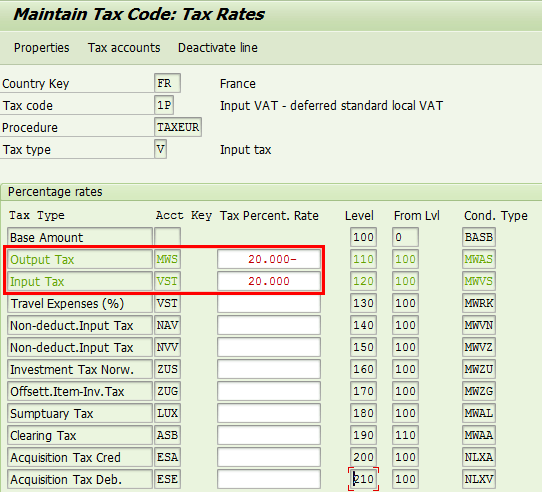
Figure 1
The deferred VAT code
For deferred taxes you need to define two codes. One code is the deferred VAT code, as shown in Figure 1, and the other code is the destination tax code (Figure 2). Figure 1 shows an example. Code 1P is the deferred tax code, and code 2A in Figure 2 is the destination tax code.
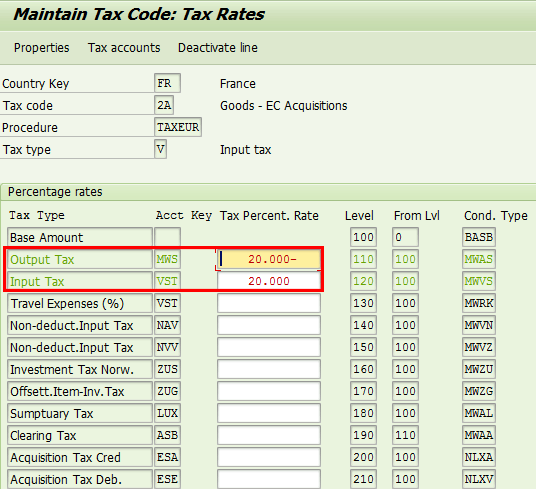
Figure 2
The destination tax code
In Figures 1 and 2 for each code you can see two lines with a percentage. These lines are the two parts of the VAT. It is important that the two tax codes are set up the same (i.e., using the same transaction keys and percentage). In Figures 1 and 2 the transaction keys used are MWS and VST.
After you click the properties button at the top of the screen in Figures 1 and 2, a pop-up screen appears in which you can enter the properties of the tax code. In my example, VAT code 1P has target code 2A. Figure 3 shows the properties of deferred tax code 1P.
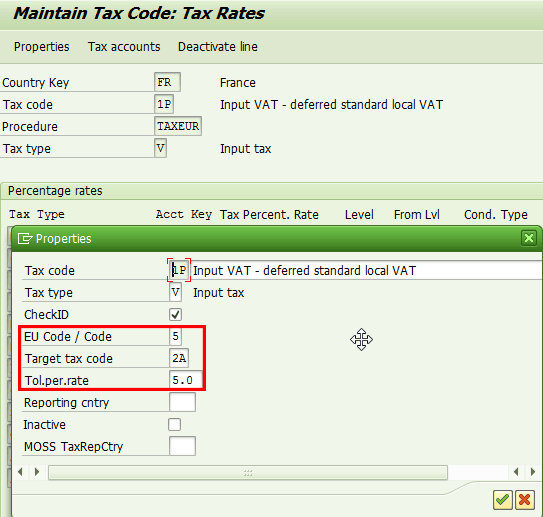
Figure 3
Properties of deferred tax code 1P
Figure 4 shows the properties of destination tax code 2A. You can see that it is important that both EU codes are the same. In this example code 5 is used to indicate that the EU code is the same for both tax codes.
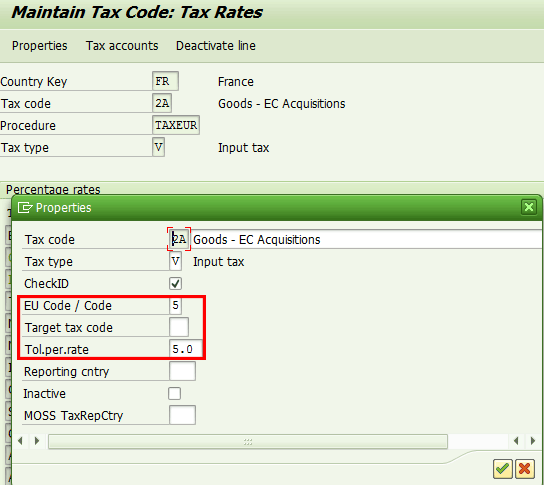
Figure 4
Properties of destination tax code 2A
In Figures 1 and 2, after you click the Tax accounts button at the top of the screen, a pop-up screen appears in which you can enter the general ledger (G/L) accounts used for the tax posting. Figure 5 shows the G/L account for deferred tax code 1P.

Figure 5
G/L account for deferred tax code 1P
Figure 6 shows the G/L account for destination tax code 2A. The setup of the G/L accounts is discussed in the next section.
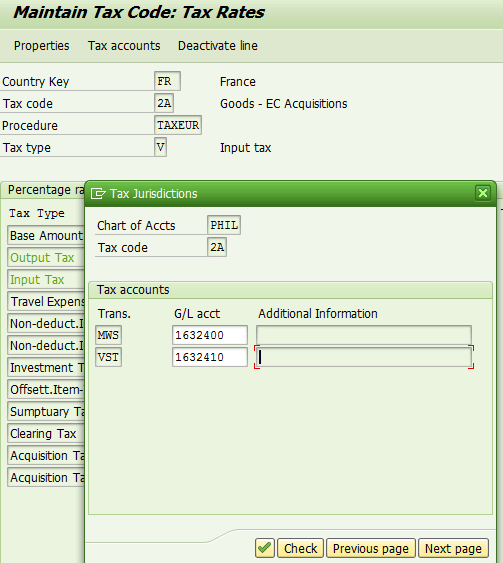
Figure 6
G/L account for destination tax 2A
G/L Accounts Maintenance
Besides correct configuration of the tax codes it is also important to set up the G/L accounts shown in Figures 5 and 6 correctly. G/L account maintenance is part of master data maintenance.
G/L accounts are maintained using transaction code FSS0. Figure 7 shows the screen that appears after you execute transaction code FSS0. In this screen you enter a number in the G/L Account field and a code in the Company Code field.
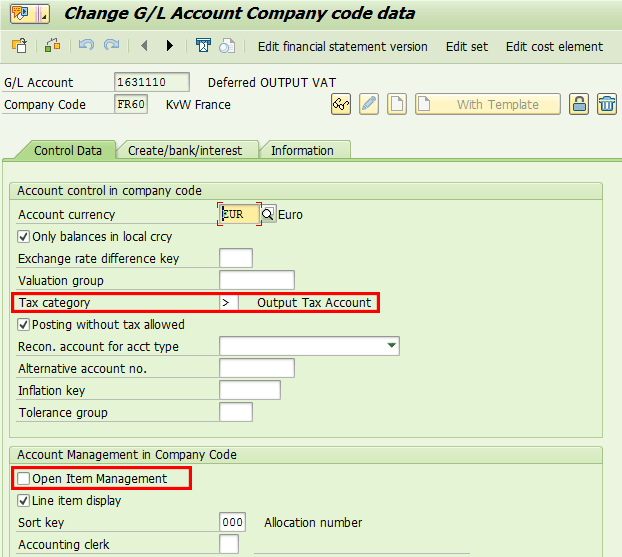
Figure 7
G/L account details for VAT code 1P (output tax account)
Figures 7 and 8 show the details of the G/L accounts used for VAT code 1P. The accounts used for VAT code 2A should be set up the same way.
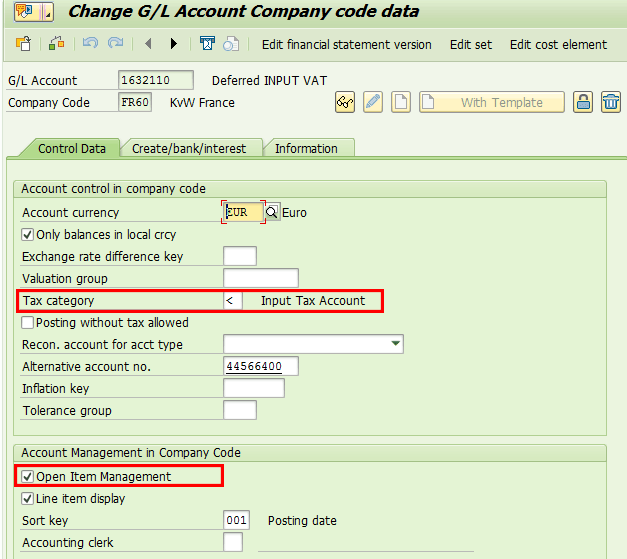
Figure 8
G/L account details for VAT code 1P (input tax account)
It is crucial to enter the correct tax category in the accounts. In the Tax category field in Figure 7, the account used for the posting of the output VAT part (transaction key MWS) must be the larger than symbol (>). The account used for the posting of the input VAT (transaction key VST) must be the less than symbol (<) as shown in Figure 8.
In the Account Management in Company Code section of Figure 7, the account used for the posting of the output VAT must not be marked as open item managed (i.e., the Open Item Managed check box is not selected). The account used for the posting of the input VAT must be marked as open item managed (i.e., the Open Item Management check box is selected) as shown in Figure 8.
Running Program RFUMSV25
Program RFUMSV25 automatically makes the transfer posting for tax on sales or purchases. It first creates a log of the cleared invoices posted with deferred tax within the period. The program takes the tax amounts with their tax bases from the document tax items. Customer or vendor data and the respective clearing date are taken from the offsetting items.
To run program RFUMSV25 execute transaction codes SA38 or SE38. You can also start the program directly using transaction code S_ALR_87012360 and following menu path Accounting > Financial Accounting > General Ledger > Reporting > Tax Reports > General > Deferred Tax > Deferred Tax Transfer.
Figure 9 shows the selection screen of program RFUMSV25.
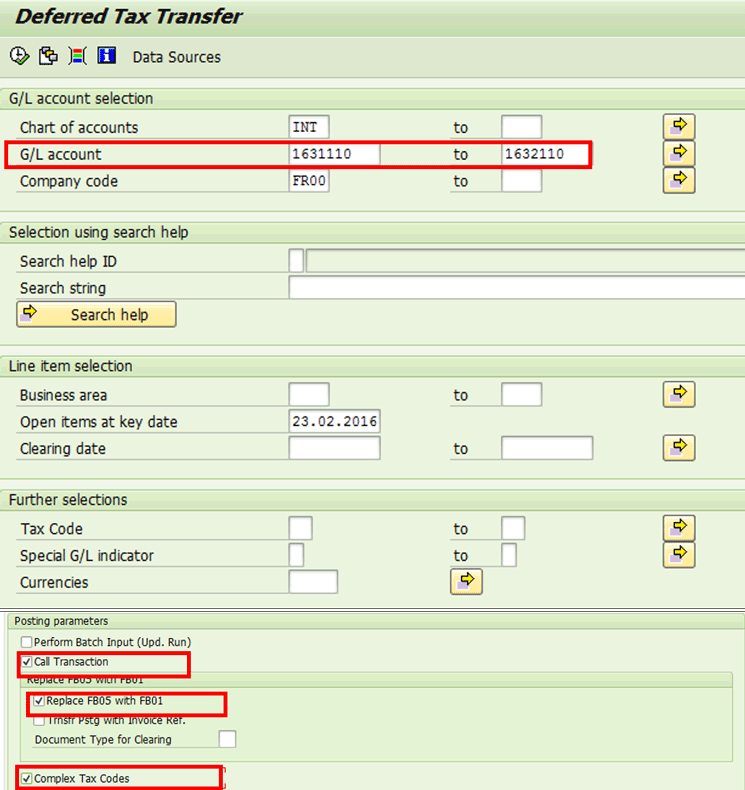
Figure 9
The selection screen of the RFUMSV25 program
For the transfer of the deferred tax, you need to make the following selection options:
- Select the G/L accounts used to post the deferred tax.
- Select the Call Transaction check box. This indicator must be set to be able to select transaction code FB01 instead of transaction code FB05.
- Select the Replace FB05 with FB01 check box. The consequence of this indicator is that the clearing of the original tax posting is done in two steps. First, a posting is made with transaction code FB01 and then in a second step, a clearing document is created.
This way of processing is required for the reverse charge and acquisition tax.
- Select the Complex Tax Posting check box to indicate that you want to process reverse charges. If not set, then the deferred tax will not be processed correctly.
Once all these settings are done, you can execute the report.
Figure 10 shows an example how the result of the report may look. At the bottom of the screen you can see both the deferred tax code (1P) and the destination tax code (2A).

Figure 10
Result of report RFUMSV25
Figure 11 shows an example of a posting created by the report RFUMSV25. The financial document is displayed with transaction code FB03. The accounts used for the posting are the accounts shown in Figures 5 and 6.
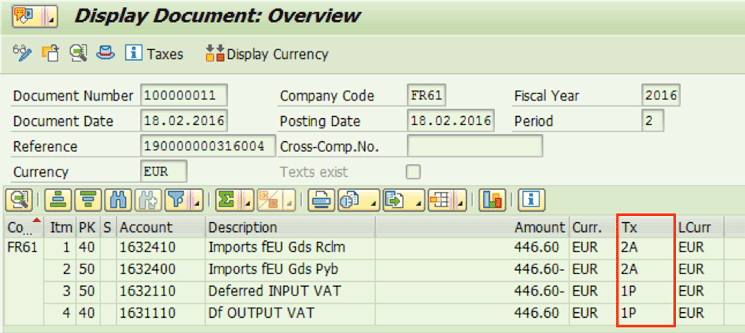
Posting generated by the RFUMSV25 report
Kees van Westerop
Kees van Westerop has been working as an SAP consultant for more than 25 years. He has an MBA degree in mathematics and a degree in finance. Kees has been concentrating on the financial modules, especially in general ledger accounting, cost center accounting, and consolidation. He also has a great deal of experience with rollouts of kernel systems and integrating finance and logistics.
You may contact the author at keesvanwesterop@hotmail.com.
If you have comments about this article or publication, or would like to submit an article idea, please contact the editor.