

3 minute read

Meet the Authors
Key Takeaways
What you need to know
NetApp has expanded its partnership with Google Cloud, utilizing Gemini Enterprise internally to validate a data-in-place AI architecture for complex enterprise operations.
Google Cloud NetApp Volumes (GCNV) is shifting from a mere migration landing zone to an active AI engine, allowing SAP organizations to query core transactional data directly without fragmented ETL processes.
This architectural evolution empowers SAP Center of Excellence leaders to securely deploy workflow-specific AI agents while maintaining strict enterprise governance and data sovereignty.
Prevailing wisdom among SAP organizations migrating to the cloud often treats data infrastructure and artificial intelligence (AI) as two distinct phases. First, the organization must move the large, complex SAP S/4HANA workload to the cloud. Eventually, the team figures out how to extract, transform, and load (ETL) the data into a separate repository to train AI models.
This multi-step, fragmented approach is becoming obsolete. On April 22, 2026, NetApp announced a significant expansion of its partnership with Google Cloud, revealing that it has adopted Google Gemini Enterprise internally to drive its own AI-driven operations across product development and sales.
While vendor adoption of its partner’s AI tools is standard industry news, the underlying architecture driving this adoption has critical implications for SAP professionals. Through this collaboration, NetApp is effectively validating the concept of data-in-place AI. This architectural approach allows enterprises to run advanced generative AI directly against their core transactional data without moving it.
Explore related questions
Ask SAPi
The Eradication of ETL for SAP Workloads
The foundational value proposition of Google Cloud NetApp Volumes (GCNV) has been its ability to help enterprises migrate mission-critical SAP S/4HANA and legacy ERP workloads to the cloud without refactoring applications. It provided the familiar enterprise-grade file storage that SAP environments demand, delivered as a native cloud service.
However, the April 2026 announcement also signals a shift from treating GCNV as a landing zone for migrations to treating it as an active AI engine. This means that data stored on NetApp infrastructure can be directly queried and used by AI models, as Google Cloud NetApp Volumes is tightly integrated with Google’s Vertex AI and Gemini platforms.
For SAP Center of Excellence (CoE) leaders, this eradicates the traditional ETL bottleneck. When SAP operational data, ranging from supply chain inventory levels to financial forecasting, resides on NetApp Volumes within Google Cloud, business analysts can leverage Gemini Enterprise to build custom AI agents that query that data securely and instantly, without duplicating it into a separate data lake.
Security and Sovereign AI
This data-in-place model is heavily dependent on enterprise-grade governance. Generative AI is only as useful as the data that feeds it, but exposing core SAP ERP data to large language models (LLMs) poses immense security and compliance risks.
NetApp’s internal deployment of Gemini Enterprise highlights how organizations can utilize Google’s secure AI framework to build workflow-specific agents—such as AI assistants for sales or coding copilots—while maintaining strict access controls. When combined with NetApp’s recent sovereign cloud announcements, highly regulated SAP customers can now deploy localized AI agents against their ERP data without risking data exfiltration or violating residency mandates.
What This Means for SAPinsiders
Organizations should bridge the AI-storage gap through data-first initiatives. SAP Basis and architecture teams should evaluate Google Cloud NetApp Volumes not just as a migration tool for SAP S/4HANA, but as a strategic data foundation for AI. Assess whether the organization’s current cloud storage architecture enables it to point Vertex AI or Gemini directly at SAP data stores without costly, insecure ETL processes.
Pilot workflow-specific agents. Rather than attempting broad, generic AI deployments, SAP business leaders should identify specific bottlenecks in sales, procurement, or product workflows. Organizations can use Gemini Enterprise’s pre-built connectors to link SAP data with Google Workspace tools to build targeted AI agents that prove immediate ROI.
Data governance for AI should be strictly enforced across the organization. As businesses connect SAP data to LLMs, organizations must ensure their underlying storage layer supports enterprise-grade security. SAP security architects should mandate that any AI initiative use centralized governance frameworks to audit and secure AI agents that access sensitive ERP data.
More Resources
See All Related Content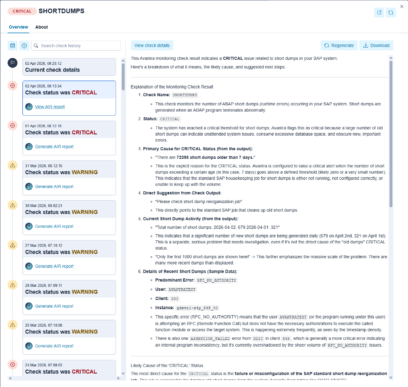
Stop Guessing, Start Fixing: AI Root Cause AnalysisAvantra 26 and Avantra AIR use AI grounded in SAP operations expertise and a proprietary knowledge graph to continuously detect issues, explain root causes in human-readable reports, reduce alert noise, and recommend next-best actions that speed resolution, prevent outages, and lessen reliance on SAP experts.

TCS Moves Global Payroll to SAP Cloud ERP Private, Cuts Processing Time 30–40%TCS completed a multi-country payroll migration to SAP Cloud ERP Private on AWS, consolidating operations across 56 countries with 30–40% faster processing, zero disruption, and full data integrity across 20-plus interfaces.
3 minute read

AI Ambitions Are Running Into Frontline Data ProblemsRFgen connects frontline work with SAP and other ERP systems through mobile data collection, offline sync, and guided workflows. Its platform helps SAP teams capture cleaner point-of-work data for analytics, automation, and supply chain AI.
3 minute read
What Joule Means for the Future of RetailSAP’s Joule is an AI copilot for retail that streamlines decision-making and workflows across assortment, demand and inventory planning, customer experience, and order management, but retailers must weigh cloud migration, change management, pricing, and the early-stage maturity of some features before adoption.
2 minute read