
4 minute read
Meet the Authors
Key Takeaways
What you need to know
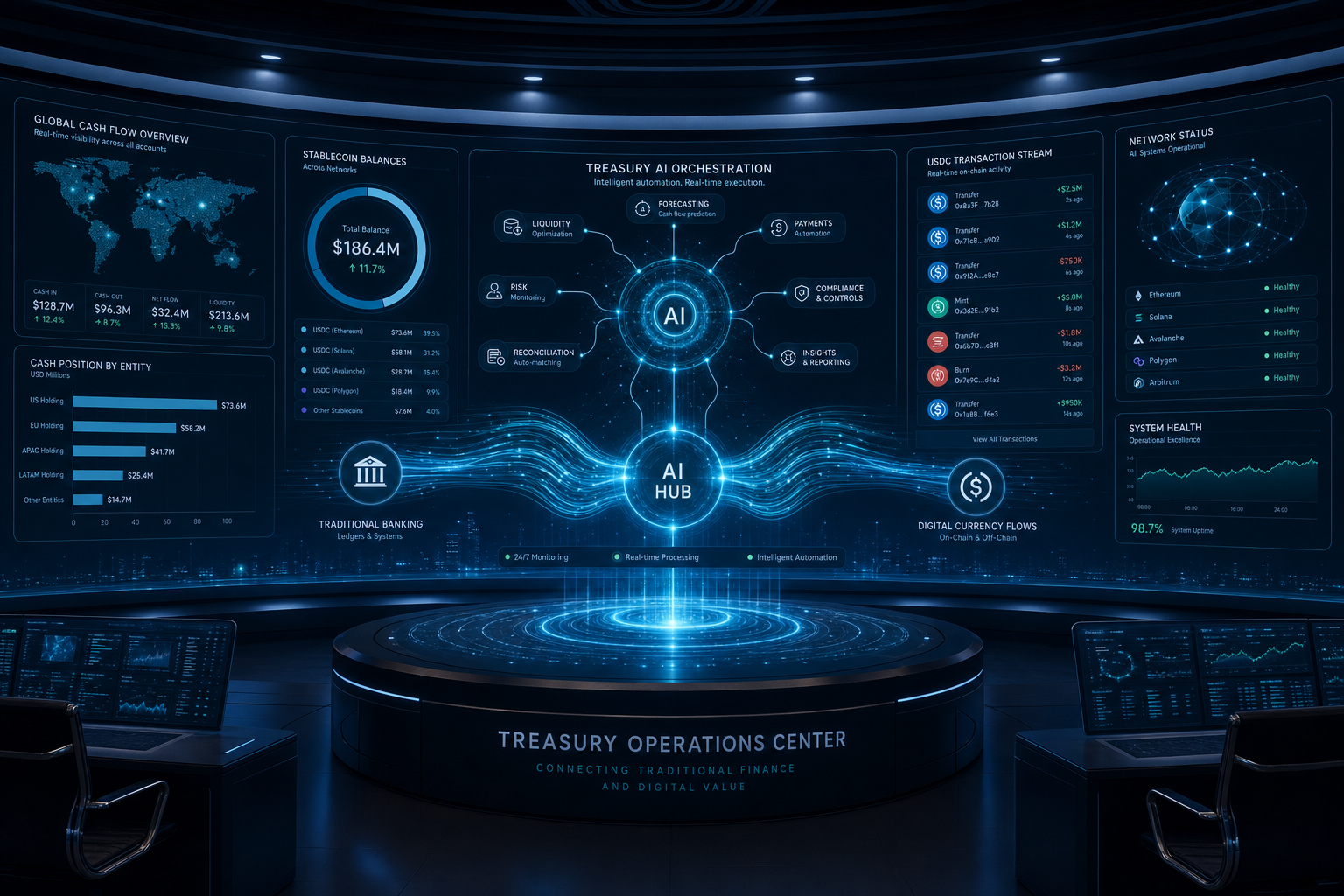
Kyriba and Circle are embedding USDC stablecoin capabilities directly into the Kyriba treasury management platform, enabling corporate treasury teams to handle stablecoin-based liquidity, cross-border payments, and intercompany settlement inside existing controls, approvals, and audit workflows.
This matters because USDC settlement can reduce multi-day payment delays, improve 24/7 liquidity access, and lower cash-in-transit and FX exposure, while Kyriba’s Trusted Agentic AI adds policy-based orchestration, continuous monitoring, and traceable execution for governed treasury operations.
The collaboration mainly impacts enterprise treasury, finance, and SAP leaders that manage cash positions across multiple entities, because it shows that stablecoin adoption is moving into core treasury systems rather than separate digital asset tools, making embedded digital dollar infrastructure a practical path for working capital and liquidity management.
Kyriba and financial technology company Circle are bringing USDC capabilities directly into Kyriba’s treasury management platform, a move designed to make stablecoin-based liquidity and settlement usable inside the controls, approvals, and workflows corporate treasury teams already rely on.
The announced collaboration embeds USDC, issued by Circle through regulated entities, into Kyriba’s platform and pairs it with Kyriba’s Trusted Agentic AI (TAI). The companies said the integration will support intercompany liquidity management, 24/7 liquidity access, and policy-driven liquidity decisions without requiring new systems or major infrastructure changes.
Stablecoins have promised faster settlement and programmable liquidity for years, but corporate adoption has been slowed by questions around controls, custody, auditability, systems integration, and policy alignment. Kyriba and Circle are positioning this collaboration as a way to bring those capabilities into mainstream treasury operations rather than forcing teams to manage them through separate rails.
Explore related questions
Ask SAPi
Stablecoins Move Inside the Treasury System
The collaboration targets several sources of treasury friction, particularly in cross-border and intercompany payments. Kyriba said embedded USDC capabilities can help settle eligible cross-border and intercompany payments in near real time, reducing multi-day settlement delays, cash-in-transit, and FX exposure.
The platform will also allow treasury teams to manage stablecoin balances alongside traditional cash positions inside Kyriba. That is an important design choice for multi-entity treasury operations, where visibility, reconciliation, and control across cash positions often matter as much as payment speed.
Circle and Kyriba emphasized 24/7 liquidity access, including outside traditional banking hours. For treasury teams managing global entities and time-zone differences, that could make stablecoin settlement more relevant to real operating needs, especially when intercompany funding or liquidity movements do not fit neatly inside bank cutoff windows.
AI Orchestration Adds the Governance Layer
Kyriba’s TAI is the orchestration layer behind the announcement. Per the companies, TAI continuously monitors USDC positions and liquidity conditions, identifies when action is required, and supports treasury teams with policy-based orchestration inside predefined approval frameworks.
The platform supports intelligent decisioning and execution workflows, but actions remain tied to policy, approvals, and traceability. From payment initiation through settlement and audit logging, transactions are routed through existing approval structures. The companies also said no customer data is stored externally or used for model training.
Governance is central to the announcement. Corporate treasury teams cannot treat stablecoin payments as a standalone innovation experiment if they affect intercompany liquidity, FX exposure, settlement timing, or working capital. Kyriba is using TAI to push stablecoin execution as part of controlled treasury operations, with the same audit and policy expectations that apply to traditional payments.
Melissa Di Donato, chair and CEO at Kyriba, said treasury teams have been waiting for a way to access digital currency speed and efficiency without compromising governance and control. “By embedding USDC into Kyriba’s TAI agentic orchestration layer, we’ve eliminated that trade-off,” she said.
Market Signals Strengthen the Timing
The companies also pointed to rising enterprise demand for stablecoin infrastructure. USDC in circulation reached $75.3 billion at the end of 2025, up 72% year over year, while quarterly on-chain transaction volume reached $11.9 trillion, up 247% in a single year, according to the announcement.
Kyriba said greater regulatory clarity and growing enterprise familiarity with stablecoins are helping organizations move from exploration toward practical implementation. Its own platform footprint gives the collaboration a broad potential entry point: Kyriba is used by more than 4,000 customers globally, including many Fortune 100 enterprises, and operates across a broad ecosystem of banking partners.
The adoption route for stablecoins is shifting. Rather than asking treasury teams to experiment outside core systems, vendors are starting to embed digital dollar capabilities into the platforms where liquidity, payment policy, approval workflows, and audit trails already live.
What This Means for SAPinsiders
Stablecoin adoption is moving into governed treasury operations. The Kyriba-Circle collaboration puts USDC inside treasury workflows rather than treating it as a separate digital asset channel. For SAP and finance leaders, the key issue becomes how stablecoin settlement fits into cash visibility, intercompany funding, approval controls, and audit requirements.
AI orchestration can make liquidity decisions more actionable. Kyriba’s TAI layer monitors USDC positions and liquidity conditions, then supports policy-based decisions inside existing approval frameworks. That points to a broader shift in treasury technology, where AI is expected to guide and coordinate execution, not just surface reports.
ERP and treasury platforms are becoming the adoption path for digital money. Circle brings the digital dollar infrastructure, while Kyriba brings the enterprise treasury workflow and customer base. This model could shape how stablecoins enter corporate finance—through trusted systems, embedded controls, and operational use cases such as intercompany payments, cash positioning, and cross-border liquidity.
More Resources
See All Related Content
Data Before Deployment: What the PwC and Palantir Alliance Signals for SAP TransformationPwC and Palantir expanded their alliance on September 3, 2026, with ERP modernization as a priority area and data readiness positioned as the gate before SAP migration begins. SAPinsider research shows why that sequence matters, with 75% of organizations rating harmonized data as critical to SAP S/4HANA plans and only 34% fully transitioned.

NVIDIA Launches New Security Platform for AI Agents as SAP Builds OpenShell Into Joule StudioNVIDIA's Open Agent Safety Platform places enforceable runtime boundaries around AI agents. SAP is embedding the platform's OpenShell runtime in Joule Studio, and deeper links to enterprise authorization, IAM, and audit controls are still under development.
3 minute read