
1 minute read
Meet the Authors
Key Takeaways
What you need to know
Generative AI is fundamentally redefining SAP extension development, moving the primary IT bottleneck from initial code creation to downstream lifecycle management and governance.
As vibe coding commoditizes basic application generation following SAP Sapphire 2026, traditional low-code platforms must evolve into governed execution environments to protect the clean core.
SAP developers are transitioning into enterprise architects, requiring a stronger human element focused on process mapping, security, and orchestrating complex AI-generated workflows.
SAP Sapphire Orlando 2026 wrapped up last week, and the overarching message from SAP leadership emphasized that Autonomous Enterprise is here to stay. SAP unveiled its unified Business AI Platform, introducing deep agentic AI integration designed to optimize the world’s most critical business workflows securely and at scale.
However, beneath these announcements and major technology partnerships lies a structural shift for IT teams. In fact, for SAP professionals, the conversation has pivoted from how fast they can write code to how they govern the incoming flood of AI-generated enterprise applications.
The Death of Traditional Low-Code
Generative AI has rewritten the math on SAP extension development. Therefore, generating the first iteration of an application or workflow is no longer the primary bottleneck for IT departments. Instead, the friction has moved downstream.
Explore related questions
Ask SAPi
In a highly relevant podcast, Neptune Software highlighted that the traditional concept of low-code is effectively obsolete. The premise of this discussion was striking. If AI can instantly generate functional code from natural language (a trend increasingly referred to as vibe coding), then using low-code platforms purely as visual shortcuts is no longer a strategic advantage.
The discussion also pointed out that AI acceleration does not eliminate enterprise complexity, and instant code generation does not inherently solve complex SAP integration, data security, or long-term lifecycle management. Moreover, the volume of applications business units can now request poses risks that could create unprecedented levels of architectural debt if left unchecked.
The Human Element in an AI-Driven Landscape
This technological pivot brings an essentially human challenge to the forefront. As AI output increases, the complexity of enterprise architecture rises, changing the daily lives of SAP professionals. Developers are evolving from software builders into high-level architects and quality controllers, responsible for validating, orchestrating, and securing AI-generated solutions.
For IT leadership, this means navigating a sudden surge in application delivery capabilities while ensuring teams maintain a clean core strategy. The human element is now centered on strategic orchestration, including managing the critical intersection between SAP’s core ERP systems, external AI agents, and non-SAP environments. Additionally, professionals must now focus on process mapping, governance, and understanding the nuanced business implications of the workflows they approve, rather than on writing boilerplate integration scripts.
How Neptune Bridges the Execution Gap
To survive this architectural shift, organizations need more than intelligent code generators. The Neptune Software podcast advocates an enterprise software approach that transforms from simple productivity tools to governed execution platforms.
Neptune is helping SAP users navigate this transition by providing a controlled abstraction layer. Rather than replacing developers, Neptune’s platform unifies AI, low-code, and pro-code into a single, structured model. This architecture allows IT departments to safely leverage the speed of AI generation while enforcing the rigorous governance, security, and middleware integration required by mature SAP environments. By bridging this gap, Neptune enables enterprises to modernize and scale their extension development without compromising the stability of their core SAP systems.
What This Means for SAPinsiders
Organizations must shift focus from creation to governance. AI has commoditized basic code generation. This means that what used to be an IT team’s primary bottleneck is now lifecycle management. Therefore, SAPinsiders must pivot their strategy toward implementing governed execution platforms rather than seeking faster development tools.
Generative AI is redefining the role of developers. Organizations must seek to prepare their IT teams for a significant transition. They must upskill developers from traditional coding tasks to become solution architects and quality controllers who audit AI outputs and manage complex SAP system integrations.
A controlled abstraction layer must be adopted today for a successful AI transition. IT teams should consider implementing an architecture that unifies disparate development methodologies to maintain a clean core while scaling AI-driven application delivery. For SAPinsiders, this means using platforms that provide structural guardrails, enabling their business to innovate at the speed of AI without accumulating technical debt.
More Resources
See All Related Content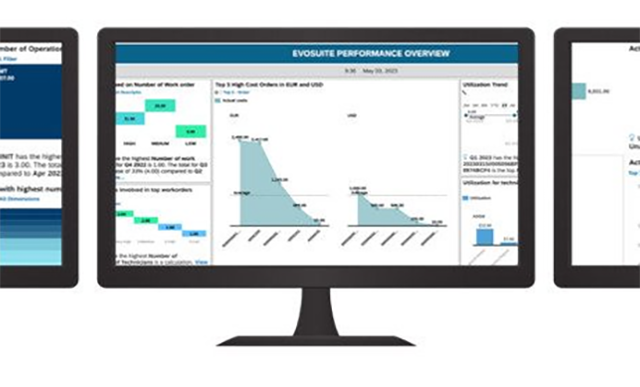
SAP Analytics CloudEvoSuite - Performance Overview demonstrates how organizations can unlock the value of maintenance data by combining SAP EAM information with AI-powered analytics in SAP Analytics Cloud. The solution delivers out-of-the-box reporting and operational insights that help improve maintenance planning, workforce utilization, equipment management, and cost control.