Management
Companies that invest in SAP ERP systems expect to realize every advantage offered by such a robust suite of technology. However, buying, customizing, and implementing the technology itself is not enough. Companies must find ways of teaching users how to get the most out of the system.
That is a lesson Tyson Foods learned well after upgrading its SAP system several times over the past decade. Plant and operations managers were happy with the system, but felt they were not capitalizing on all its capabilities.
“Their users could not pull out the information that they needed to see. And they knew there were more bells and whistles in SAP that would help them to manage the company at their locations, but they didn’t know how to do it,” says Andrea Wallace, senior training manager/Accounting Systems, Tyson Foods.
The solution was to create a Center of Functional Excellence that focuses heavily on empowering employees to get the most out of the SAP system. The center now manages an internal Web site devoted to SAP ERP and SAP Financials help topics and offers e-Learning training sessions customized to specific roles within the company. The result is fast, accurate training for SAP users that reduces the need for expensive outside training consultants or a learning management system (LMS).
Long History with SAP
As the world’s largest processor and marketer of chicken, beef, and pork, Tyson Foods runs a complicated business spanning more than 300 facilities in more than 80 countries. Tyson Foods has run its financials on SAP since implementing its first SAP system in 1998.
The company upgraded that system to SAP R/3 4.6B in 1999, and performed a company-wide reimplementation when it moved to SAP ERP 2004 in January 2006. In May of that same year, Tyson Foods upgraded to SAP ERP 6.0.
In preparation for the upgrade, Wallace and her team members began reviewing the company’s existing training materials — which consisted of PDF documents explaining various financial functions within SAP, but were not specific to the needs of Tyson Foods.
“When we went live in 1998, we had outside consultants come in and give us generic training materials. All we had were hard copies of the manuals. We trained 2,000 users in a few weeks, with about 25 of us, and that was the only training we had. Everyone had another full-time job. Once the project was over, we went back to our full-time jobs of using SAP,” says Wallace.
Eventually it became clear that the initial training sessions were not enough, as SAP users had difficulty figuring out how to perform certain tasks. On the advice of a public accounting firm, Tyson Foods made the decision to retrain the users.
The first step was to create the Center of Functional Excellence, which comprises three teams — the operations team, the systems and procedures team, and the training team. Wallace and one other employee were tasked with creating new training materials for SAP Financials users.
“Both of us had been trainers during the original rollout, and I had worked in the systems and procedures department. We started by looking at what the end users needed and working with our financials applications team, IT, and the business process owners in these modules and asked them about their best practices and what transactions and reports their people needed,” says Wallace.
The Tyson SAP Support Site
The training team realized that providing hard copies of SAP training manuals was an inefficient resource for end users. So the team created an internal Web site — the Tyson SAP Support site — to host digital versions of those materials. The home page of the site is shown in Figure 1.
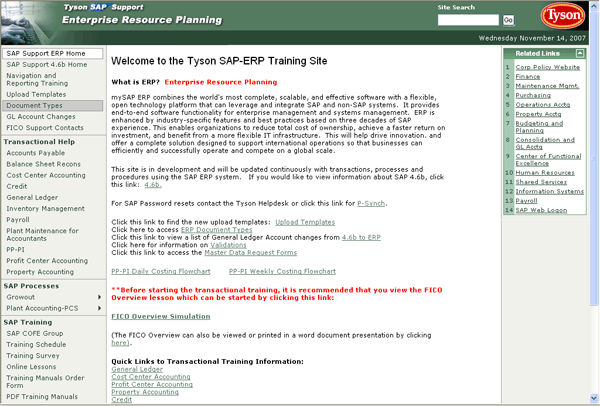
Figure 1
The Tyson SAP Support site home page
The Tyson SAP Support site is home to the following support tools:
- Upload templates. These Microsoft Excel-based templates were created in-house to allow users to easily upload spreadsheet information into the SAP system.
- ERP document types. A link from the home page lists all SAP ERP document types used at Tyson Foods, along with an explanation of how to use each document type.
- Changes to SAP accounts. This section offers an easy guide to changes in SAP Financials as a result of the upgrade from SAP R/3 4.6B to SAP ERP (Figure 2). Several account numbers were eliminated or changed during data scrubbing in preparation for the upgrade.

Figure 2
Account changes from SAP R/3 4.6B to SAP ERP
- Validations. End users can view Tyson’s customized validations by following a menu on this link.
- Master data request forms. By following a link from the main support site, users can access the SAP system’s collection of master data request forms. For example, users fill out a form to create a new SAP General Ledger (GL) account, as shown in Figure 3.

Figure 3
A master data request form
- SAP processes. This section offers instructions for managing processes, both within the SAP system and legacy financial systems.
- Corporate policy Web site. This link leads end users to Tyson Foods’ up-to- date corporate policies, with links to new or updated policies.
- Internal controls. This section enumerates and explains the corporate controls that are enforced on the company’s processes to meet internal or external regulations, requirements, and policies.
- Master data controls. This link offers explanations of Tyson Foods’ strict controls on master data within the SAP system.
Tyson e-Learning Tools for Self-Training
The training team also augmented its online training and tracking tools with Info Pak, a training materials authoring tool from RWD Technologies. The team used the tool to create a series of role-specific training materials that can be used to help with transactions or for employee self-advancement.
The Info Pak training documents, available through the Tyson SAP Support site, are divided into three categories, according to Wallace:
- Work instructions. These are Microsoft Word documents offering step-by-step instructions for specific transactional processes in the SAP ERP system. There are 380 of these documents available.
- Exercises. Available as Microsoft Word handouts or within a training client, the 75 exercises can be used to test end users after a training session.
- Simulations. Using voice-over recordings and an auto-play client, users can view or participate in simulations of transactional processes. Employees can access 400 different simulations.
Figure 4 illustrates a list of transactions and the training documents associated with them.
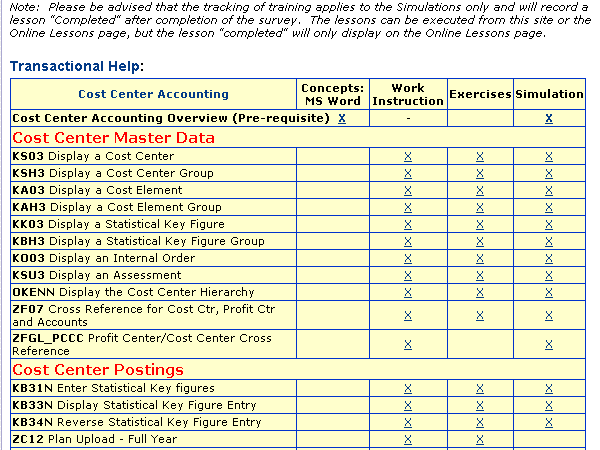
Figure 4
Training documents for various types of transactions
Once the site was live, Wallace and the training team embarked on a “road show” to demonstrate the capabilities of the new site. The team spent about a week at several locations training users to navigate the site.
Tyson Foods also offered in-person training at its corporate headquarters in Springdale, Arkansas. However, an increase in travel costs eventually reduced the company’s ability to fly employees to the company headquarters. Wallace says the simulations the team authored using Info Pak greatly reduced the company’s reliance on travel.
“Everything we teach in the instructor-led situations we put on the Web site in the form of simulation. That worked out perfectly — it helped cut costs, and managers were happy that their people could get their training without the help of a super user, which are our complex controllers,” says Wallace. “The trick is not just that our training is online, along with our best practices for transactions, but that we use the audio to say what our instructor would deliver in the classroom. So they’re getting everything they would in the classroom except the interaction with each other and the instructor.”
The simulations were especially useful in early 2008, when the training team was required to focus all of its resources on the company’s Mexico division, which was in the process of upgrading to SAP ERP 6.0. That project required the full efforts of the training team, leaving domestic users with only the support Web site to aid them.
The success of the online training materials surprised Wallace. While the training team planned to use the materials simply to augment classroom training, the materials themselves proved far more flexible than they had imagined.
“We thought we would have end-user classroom training and use the Web site just for support, but it turns out the super users we trained use the site for new user training as well,” says Wallace.
The primary benefits of the online training materials are the reduction in travel costs and the promotion of best practices. Wallace also highlights the site’s ability to help employees boost their own careers through advanced training.
“As an example, if I’m a purchasing clerk and I’m just curious about the SAP system, I can go in and take all the financial training. I can take an online training class, do the exercises, and possibly enhance my job skills,” she says.
The public materials on the site are carefully vetted to ensure the security of the SAP system (payroll procedures, for example, are available only to the appropriate personnel). However, even generic information customized by Tyson Foods offers employees the ability to gain skills outside their normal work environment.
Employees can also use the site to register for in-person training sessions and to order printed copies of training materials, as shown in Figure 5.

Figure 5
Ordering printed training materials
Measuring Success
To track the success of the online training initiative, the training team loaded reporting tools into the Training and Events Management component of SAP HR. There the group can monitor the number of employees taking each training course and conduct surveys to gauge employee response to the training.
Employees can also track their own training accomplishments through the support site by entering their SAP HR personnel ID numbers.
Managers can use the information stored in the SAP HR application for employee or team reviews, tracking Scorecard KPIs, which may be tied to bonuses, and to monitor Continuing Professional Education (CPE) credits.
Lessons Learned
Now that the Tyson SAP Support site is a well-established tool for online training, Wallace highlights three lessons she learned from the experience:
- The importance of understanding the audience. The major issue with past training programs at Tyson Foods was that many employees would leave the training with knowledge of SAP, but questions about how to perform their duties within the system.
Outside trainers lacked a sufficient understanding of Tyson Foods or the industry to effectively guide employees. The solution is to focus in-person training and simulations heavily on the duties required of employees at Tyson Foods.
“If the trainer doesn’t know the process well, I’ll put the subject matter expert there to answer any questions. My goal is to not go away with a parking lot full of questions unanswered,” says Wallace.
- Training employees just in time boosts retention. One of the keys to successful training is to avoid training employees too soon. The longer the gap between training and on-the-job use, the more likely employees are to forget what they learned.
- Keep materials up to date. To build employee trust in your training materials, it is critical to keep them up to date, according to Wallace.
“You can lose their confidence very easily if they go to the Web site and the information is outdated or incorrect,” she says.
Tyson Foods keeps its materials current by embedding steps into the process of altering a transaction. When the SAP Financials IT team makes changes to a transaction, it notifies the training team. The training team then updates the relevant procedures and republishes the associated documents to the Web site.
By updating these procedures, Wallace’s team is also creating the documentation of the change — a necessary action that many IT and functional teams dislike performing.
Bringing Online Training to Other Applications
The Tyson SAP Support site has proven so effective for those working in SAP Financials that Wallace hopes to bring the model to other SAP applications as well.
“I would love to take this company-wide. We are already beginning to help other areas use this tool and perhaps making this the standard for Tyson,” says Wallace.
The support site is also likely to go international in the future, as support for Tyson Foods’ plan to expand its SAP ERP footprint in other countries. Tyson Mexico already has 300 users, so the training team will soon provide a Spanish version of the training materials for a Spanish language support site. Wallace hopes to do the same for future expansion to China, Brazil, and India.
Davin Wilfrid
Davin Wilfrid was a writer and editor for SAPinsider and SAP Experts. He contributed case studies and research projects aimed at helping the SAP ecosystem get the most out of their existing technology investments.
If you have comments about this article or publication, or would like to submit an article idea, please contact the editor.