

3 minute read

Meet the Authors
Key Takeaways
What you need to know
Scope change by what must stay stable: define which SAP data and processes carry revenue and compliance weight before deciding what can be released independently.
Fund rehearsal as a deliverable: Tirlán's sub-five-hour S/4HANA conversion followed two full test cycles and a dress rehearsal, and 78% of organizations in SAPinsider's 2026 benchmark rank minimal disruption as a requirement.
Treat the storefront choice as an architecture decision: the value of Vercel templates or SAP's composable storefront depends on SAP Commerce Cloud remaining the trusted source for price, availability and order data.
Two SAP announcements landed within a day of each other this week, and on the surface they share nothing. One describes a partnership between SAP Commerce Cloud and Vercel, the front-end cloud company behind Next.js. The other reports that Tirlán, Ireland’s leading farmer-owned co-operative, established an independent SAP landscape in nine months after separating from Glanbia. One is about storefronts. The other is about a corporate divestment in a perishable supply chain.
Read together, they describe the same architectural idea. In both cases, value came from deciding what must stay stable, isolating what needs to move, and rehearsing the change before it reached production. That pattern deserves attention because it runs counter to how many SAP programs are still scoped.
Decoupling Experience From System Of Record
The SAP and Vercel arrangement divides responsibilities cleanly. SAP Commerce Cloud continues to manage catalogs, pricing, inventory, customer accounts, orders, and fulfillment. Vercel runs the customer-facing experience and gives teams the infrastructure to build, review, release and operate it. SAP sums up the operating model in one line: teams can change the storefront without changing everything behind it at the same time.
Explore related questions
Ask SAPi
The practical consequence is release independence. A commerce team entering a new market can design and ship a localized storefront while SAP Commerce Cloud keeps product data, prices, and order processes consistent. Vercel generates a preview deployment for every change, so developers, marketers and business teams review a working version against live SAP Commerce Cloud services before release. Vercel is also building Next.js storefront templates connected to product discovery, cart, checkout and customer journeys.
SAP positions this as an option rather than a replacement. The SAP-managed composable storefront remains for organizations wanting a closely integrated experience, while the Vercel templates serve teams building differentiated experiences on their own cadence.
Separation At Enterprise Scale
Tirlán faced a harder version of the same problem. A non-negotiable divestment deadline required a clean break from Glanbia’s systems. At the same time, milk kept moving through a tightly regulated production environment where any disruption carries immediate commercial and compliance consequences. The program migrated SAP S/4HANA, SAP Business Warehouse on HANA, SAP Ariba, and SAP SuccessFactors, and analyzed more than 30 billion records, selectively removing data to leave an independent foundation. The SAP S/4HANA conversion was completed in under five hours, and the HCM conversion in 15 minutes.
That cutover speed was earned earlier. SAP Services created a copy of the existing environment so the team could test and time every step, then ran two full test cycles and a comprehensive dress rehearsal. Noel Liston, IT Transformation Manager at Tirlán, credited that preparation with keeping employees on systems they already knew and customers served without interruption.
The Common Thread
What links a storefront partnership to a dairy divestment is a shared answer to a question every enterprise architect eventually faces: how does an organization change quickly without breaking the processes that protect revenue and compliance?
Both cases answer it the same way. SAP remains the system of record for the data and processes that carry commercial and regulatory weight. The layer that needs to change is separated so it can move on its own timeline. And the release is treated as something to rehearse: preview deployments in the Vercel model, timed dress rehearsals at Tirlán.
SAPinsider research shows why this resonates. In the ERP Migration and Transformation 2026 benchmark, 78% of respondents named minimal disruption to operations during the move to SAP S/4HANA as a requirement, and 82% cited integration between core ERP and line-of-business applications. The same study found that 55% of organizations have deployed SAP S/4HANA but only 34% have fully transitioned, a gap that reflects how hard it is to change core systems while the business keeps running. SAPinsider’s analysis of the SAP Engagement Index UK reached a parallel conclusion: disconnected customer experience is now a data and architecture problem, and ownership is shifting toward enterprise architects rather than front-end teams alone.
The lesson from Vercel and Tirlán is that decoupling does not mean loosening governance. Separation was possible in each case because the core was disciplined enough to be trusted on its own.
What This Means for SAPinsiders
Scope change by what must stay stable. CIOs and enterprise architects should define which SAP data and processes carry revenue and compliance weight before deciding what can be released independently. Tirlán’s 30-billion-record classification and the Vercel model’s clear ownership boundary both started there.
Fund rehearsal as a deliverable, not a contingency. ERP program managers should explicitly budget for environment copies, timed test cycles, and preview deployments. Tirlán’s sub-five-hour conversion followed two full test cycles and a dress rehearsal, and 78% of organizations in SAPinsider’s 2026 benchmark rank minimal disruption as a requirement.
Treat the storefront choice as an architecture decision. CX leaders weighing the Vercel templates against SAP’s composable storefront should bring integration and data teams in early. The value of either option depends on SAP Commerce Cloud remaining the trusted source for price, availability, and order data.
More Resources
See All Related Content
CACI Grows Its Federal Portfolio While Building a Compliance-Ready Path to SAP CloudCACI is expanding its federal portfolio with new contracts and showcasing significant gains in ERP modernization for the U.S. Marine Corps. Their affiliate, SAP NS2, provides a CMMC Level 2 certified path for secure SAP cloud adoption by federal agencies.
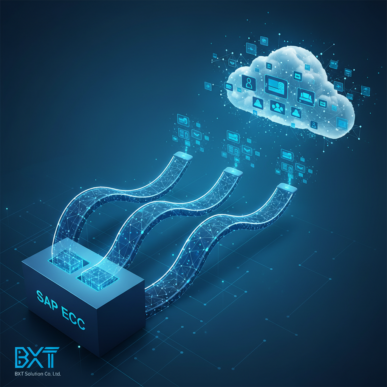
BxT Solution Builds Three Distinct On-Ramps for SAP ECC Customers Weighing Cloud ERPBxT Solution helps SAP ECC customers migrate to cloud ERP with three distinct on-ramps: SAP Cloud ERP Private, SAP Cloud ERP Public, and S/4HANA Conversion. Their structured approach ensures tailored solutions and a smooth transition for businesses weighing their options.
3 minute read

NTT DATA Turns Its Own HR Systems Into an SAP Business AI Proving GroundNTT DATA is leveraging SAP SuccessFactors, Business Data Cloud, and Joule to overhaul its global HR systems. This internal deployment showcases its SAP expertise and provides a real-world proving ground for AI-driven HR transformation solutions, following its 2025 move to SAP Cloud ERP Private.
3 minute read

C2B Consulting Frames Its SAP Practice Around Full Portfolio CoverageC2B Consulting, established in 2004, frames its SAP practice around full portfolio coverage. The firm offers solutions spanning core ERP, HR, customer experience, supply chain, and analytics, providing comprehensive support for diverse enterprise needs and simplifying vendor selection.
2 minute read