6 minute read
Meet the Authors
Key Takeaways
-
SAP leaders at SAPinsider Las Vegas outlined a process-first approach to enterprise AI strategy.
-
Organizations must move beyond AI experimentation to embed intelligence across core business processes.
-
True value from AI comes from reimagining workflows, not just automating existing ones.
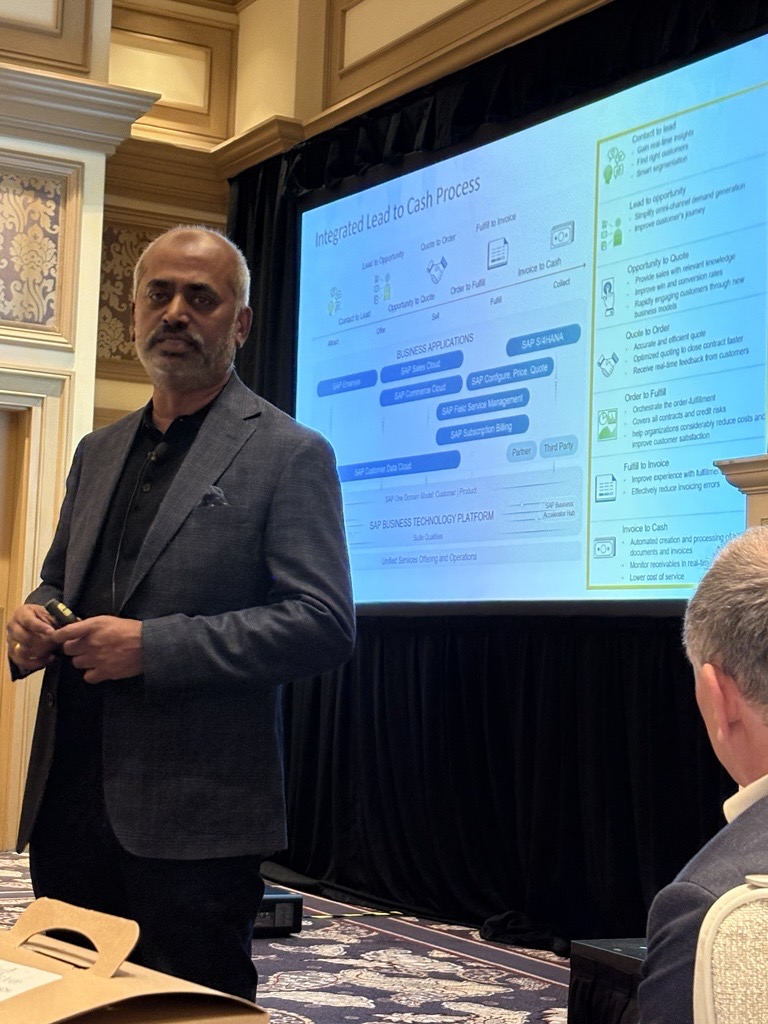
At SAPinsider Las Vegas, Ranjeet Panicker, SVP and Head of Business Transformation & Architecture – Americas at SAP, and Brian Schniers, Chief Enterprise Architect at SAP, reframed one of the most common questions organizations are asking today: not whether to adopt AI, but where it actually belongs across the enterprise – and how to make it work at scale.
Their message was clear: most organizations don’t have an AI problem – they have a strategy problem.
From AI Curiosity to Business Strategy
Despite widespread interest in AI, many enterprises are still operating in an exploratory mode, experimenting with tools, pilots, and isolated use cases.
Explore related questions
As Panicker explained during the session, the typical starting point is flawed. Business leaders often ask, “How do we add more AI?” The better question is: what problem are we trying to solve?
This shift from technology-first to outcome-first thinking formed the foundation of the session’s framework for enterprise AI.
Why Most Transformations Haven’t Delivered the Full Value
A key insight from the session was that many organizations have already modernized their systems, moving from legacy ERP to platforms like SAP S/4HANA, but have not fundamentally changed how their business operates.
While these transformations delivered faster systems, improved user experience, and cleaner data, they often did not reimagine core business processes.
As a result, organizations are now running modern platforms with largely unchanged workflows, limiting the value they can extract from AI.
Capability vs. Process: Where AI Strategy Begins
Panicker emphasized the importance of distinguishing between business capabilities, the outcomes the business wants to achieve, and business processes, the steps taken to achieve those outcomes.
Most AI initiatives focus on optimizing processes. However, the session made clear that true AI strategy starts at the capability level, defining what the business should achieve before redesigning how it gets there.
This distinction becomes critical when deciding where AI can drive meaningful impact.
SAP’s View: AI Embedded Across the Stack
From an SAP perspective, enterprise AI is structured across three layers: applications, data, and AI.
The applications layer includes core systems such as SAP S/4HANA and other line-of-business applications. The data layer provides unified access through SAP’s business data cloud. The AI layer includes Joule as a copilot, embedded AI within applications, and an AI foundation for custom use cases and agents.
The goal is to move beyond standalone tools and embed intelligence directly into business processes.
One of the most telling moments in the session came from audience interaction: while most attendees reported using AI in their personal workflows, only a small fraction were using AI within core business processes.
This gap highlights where enterprises stand today. AI is widely adopted as a productivity tool, but not yet integrated into enterprise operations.
From Use Cases to Value Streams
Rather than approaching AI as a collection of disconnected use cases, the session introduced a more structured method.
Organizations should start with end-to-end value streams such as lead-to-cash, source-to-pay, and record-to-report. From there, they should identify key business capabilities, map personas involved, analyze pain points, and overlay AI opportunities across the entire workflow.
This approach shifts AI from experimentation to enterprise-wide orchestration.
A Practical Path Forward: Balancing Clean Core with AI Innovation
The discussion also touched on the evolving relationship between clean core principles and AI-driven customization.
While clean core encourages standardization, SAP is expanding flexibility in extensions and enabling custom AI through foundation layers. This allows organizations to innovate without compromising upgradeability.
The session concluded with a clear recommendation: start small, but start strategically.
Organizations should focus on one end-to-end process, define desired business outcomes, map stakeholders and workflows, identify AI opportunities, and build a business case tied to measurable value.
What This Means for SAPinsiders
AI strategy must start with business outcomes. Organizations that anchor AI in clearly defined capabilities will avoid fragmented investments and instead align initiatives to measurable business value across processes.
Process redesign, not automation, drives real value. Simply accelerating existing workflows limits impact. The real opportunity lies in rethinking end-to-end processes to enable touchless, intelligence-driven operations.
ERP modernization alone is not transformation. Moving to SAP S/4HANA creates a foundation, but without reimagined processes, enterprises risk underutilizing both their platform investment and emerging AI capabilities.
More Resources
See All Related Content
RoguePilot: Exploiting GitHub Copilot for a Repository TakeoverA vulnerability in GitHub Codespaces allows for passive prompt injection via GitHub issues that can lead to full repository takeover by exfiltrating the GITHUB_TOKEN secret through manipulated instructions automatically processed by GitHub Copilot.

Improving Supply Chain Resilience in 2026 with AI, SustainabilitySAP is making agentic AI and sustainability the twin pillars of its 2026 supply chain roadmap, positioning them as prerequisites for resilience rather than side projects. For technology executives, that means redesigning day-to-day procurement and supply chain work around AI-driven decisions, automated workflows and emissions-aware planning. Agentic AI Reshapes Supply Chain Operations SAP argues that […]
3 minute read

SAP Labs and IMDA Launch Talent Program to Train Enterprise AI Engineers in SingaporeSAP Labs East Asia Singapore is partnering with Singapore’s Infocomm Media Development Authority (IMDA) to hire and train 50 AI scientists and machine learning engineers, strengthening the region’s role in SAP’s global enterprise AI development strategy.
2 minute read