

5 minute read

Meet the Authors
Key Takeaways
What you need to know
Adsotech’s six-phase SAP data governance roadmap moves organizations from isolated cleanup projects toward sustained ownership, monitoring, and error prevention.
SAP teams can use phased data quality improvements to reduce rework and identify master data problems before an SAP S/4HANA migration reaches cutover.
Connecting SAP data quality metrics to operational failures can help leaders detect emerging risks before they disrupt orders, payments, reporting, or financial close.
Most SAP data projects begin with a crisis: a blocked shipment, an unpostable invoice, report values that don’t agree, or an SAP S/4HANA migration grinding to a halt on unreliable data. Adsotech published a six-phase SAP data governance roadmap designed to move organizations past that pattern, from reactive fixes to strategic control.
Adsotech is an independent third-party vendor serving the SAP market, with a portfolio spanning master data management, data governance, and security management. The roadmap presents governance as a discipline built over time, with cleanup events handled as part of a broader operating model.
Reactive Fixes Leave SAP Data Errors Recurring
SAP data rarely stays inside one process. A single material record feeds planning, procurement, and finance at once. Business partner records ripple through sales, billing, and compliance. Correcting one downstream symptom does little when the same record keeps surfacing elsewhere with the same flaws.
Explore related questions
Ask SAPi
The deeper issue is often structural. Unclear ownership and undefined rules make errors difficult to avoid, even for careful users entering data in good faith. When no one owns a field and no standard governs it, mistakes recur by design.
Weak SAP data governance, Adsotech said, can make data hard to find, understand, and trust. The consequences pile up: inaccurate data, limited insights, entrenched data silos, reduced efficiency, compliance exposure, and a broader erosion of trust.
SAP Master Data Governance (SAP MDG) serves as SAP’s native reference point for consolidating and governing master data. It anchors the ownership question inside SAP.
The Six Phases Build Governance Incrementally
Phase 1 starts with focused SAP data cleanup, limiting scope to a single domain, such as material master data, business partners, or plant maintenance records.
Phase 2 introduces regular SAP data quality checks through reports or validation routines. This step moves teams from reacting to individual failures toward monitoring conditions before they escalate.
Phase 3 turns attention to preventing SAP data errors at the source. Mandatory fields, rule-based validation, enforced naming conventions, approval steps, and automation all operate at the point of data entry. The goal is stopping bad records before they enter the system.
Phase 4 widens the effort, expanding SAP data quality across business units, including sales, procurement, finance, and plant maintenance.
Phase 5 layers in SAP data enrichment and standardization, producing consistent material descriptions and complete business partner contact details.
Phase 6 reaches strategic SAP data governance. This phase embeds ownership, business accountability, common definitions, documented standards, and monitored metrics into daily operations.
What This Means for SAPinsiders
- Governance becomes a migration sequencing decision. Organizations that delay ownership decisions until cleansing begins may uncover process conflicts when cutover changes are already expensive. Establishing governance early can reduce rework across data, process, security, and migration teams.
- The roadmap creates an investment ladder. Each phase gives leaders a checkpoint for proving value before funding broader governance capabilities. That structure can make governance easier to sponsor than a large transformation promising benefits only after full implementation.
- Data metrics can predict operational disruption. Connecting quality indicators to blocked orders, delayed payments, or close-cycle exceptions turns governance reporting into risk intelligence. Leaders can then intervene before defective records become visible business failures.
More Resources
See All Related Content
The Friday-to-Monday Test for SAP Transformation: A Conversation with SNP’s CTOSNP CTO Steele Arbeeny explains why SAP transformation success isn't measured at go-live; it's measured on Monday morning. Learn how business-aware migration tools and proactive data management define whether transformation delivers real operational continuity.
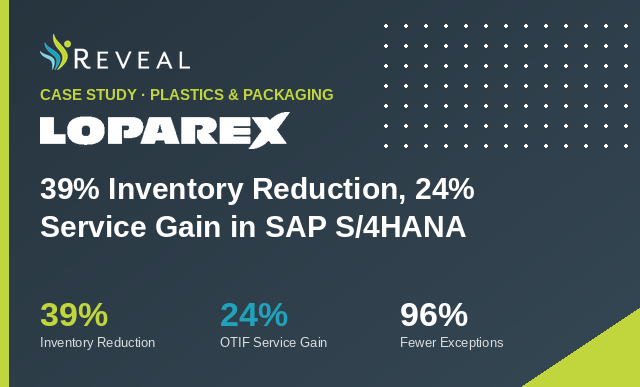
Loparex Cuts Inventory 39% and Lifts Service 24% Inside SAP S/4HANALoparex’s SAP S/4HANA go-live initially led to low user adoption, manual workarounds, and bloated inventory, prompting the company to seek a partner who could address both system use and business behaviors. Through Reveal’s embedded training, data and process tuning, and culture shift toward data-driven ownership, Loparex achieved double-digit improvements in inventory, OTIF, and exception management while increasing planner confidence and satisfaction.
1 minute read
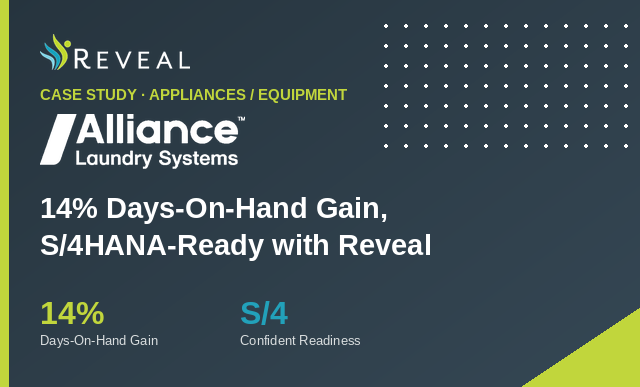
Alliance Laundry Gains 14% Days-On-Hand and S/4HANA Readiness with RevealFollowing its IPO and renewed focus on operational excellence, Alliance Laundry used Reveal to align current processes with SAP standard, clean up master data, and embed exception-minded working practices in daily operations. As teams gained confidence in SAP logic and execution, the company realized a 14% Days On Hand improvement, built a robust procurement and inventory control toolkit inside SAP, and created a foundation for safer, more informed S/4HANA decisions.
1 minute read