

1 minute read

Meet the Authors
Key Takeaways
What you need to know
The integration correlates SAP process logs with Knoa's user interaction data through shared case identifiers.
Process teams can trace transaction bottlenecks to specific screens, errors, and user activity patterns.
Edison delivers the combined service, adding a third-party implementation relationship for SAP customers.
Earlier this year, SAP Signavio welcomed Knoa as a new Solution Extension partner, and that relationship has now produced a working integration between SAP UEM by Knoa‘s task mining data and SAP Signavio Process Intelligence. SAP customers can access the combined capability through a new service from Edison, a leading SAP and Knoa partner, built on collaboration among SAP, Knoa, and Edison. The integration pairs task-level detail with process-level flow, giving process teams a fuller picture of how transactions move through SAP systems and how users interact with them along the way.
Inside the SAP UEM by Knoa and SAP Signavio Integration
SAP UEM by Knoa works by generating a detailed log of user interactions with the SAP system, screen by screen. It captures active and idle time on each screen, tracks interactions with buttons, hyperlinks, and other UI controls along with their response times, and flags error messages, whether user-generated or system-generated, with the surrounding context attached. The logging extends across any application screen a user touches, including custom transactions that would otherwise sit outside standard process mining visibility.
Connecting that data to specific business transactions requires a common reference point across systems. Knoa addresses this by detecting selected business identifiers, such as a Purchasing Document Number or an Item Number of Purchasing Document, embedded in the screens users work with. The business identifiers let the task mining data align with process mining data through shared Case IDs. As a result, two data streams feed into SAP Signavio Process Intelligence: SAP process logs supporting process-centric analytics, and Knoa’s task and user behavior logs supporting task-centric analytics. Correlating case-level identifiers across separate systems is a common technical requirement wherever organizations attempt to unify process and task mining views, and the Knoa integration follows that same pattern.
Explore related questions
Ask SAPi
Why Combining Process and Task Mining Matters for SAP Customers
Process mining tools built on system logs can show where a transaction slows down or deviates from an expected path, but they generally stop short of explaining why a specific step is slow or error-prone at the user level. Knoa’s task mining is positioned to fill that gap, adding visibility into the human element of process execution that process mining alone does not capture. The combined data set is meant to help teams address familiar problems such as process bottlenecks, user errors, and compliance issues, along with the related inefficiencies and higher costs that often follow.
The stated aim of the integrated solution is straightforward: give process managers and analysts a way to determine whether their business processes are executed efficiently and effectively, using evidence from both system flow and user behavior. The two-pronged approach, pairing process mining with task mining, is intended to improve operational efficiency while also improving the experience of employees and customers who depend on these processes. SAP customers evaluating process intelligence investments often weigh process-level mining tools against user-level tools when trying to close visibility gaps during transformation or post-go-live optimization work, and the Knoa integration folds that comparison into a single packaged option.
What This Means for SAPinsiders
Process teams gain user-level root cause data. Analysts can now trace a process bottleneck to a specific screen, error message, or idle-time pattern instead of stopping at the transaction level. The shorter path from spotting a problem to identifying its cause speeds diagnosis and remediation.
Renewed evaluation case for Knoa within SAP shops. Organizations that previously passed on standalone user experience management tools now have reason to revisit Knoa, given its Solution Extension status with SAP Signavio and a packaged path into Process Intelligence. The Solution Extension status shifts the buying conversation from a standalone tool decision to an extension of an existing SAP Signavio investment.
Partner delivery adds a planning step. Because the combined service is delivered through Edison rather than as a native SAP Signavio configuration, SAP customers need to account for engaging a third-party partner during implementation. Teams should budget time and governance attention for that partner relationship alongside their internal SAP Signavio administration.
More Resources
See All Related Content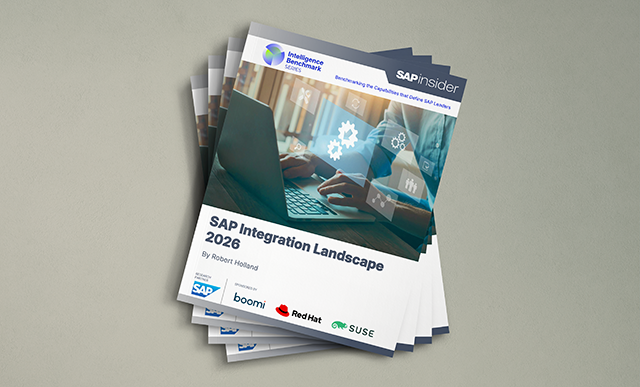
Enterprise Integration for SAP 2026 SAPinsider Benchmark Research ReportEnterprise integration is becoming a strategic platform capability for SAP organizations. As application landscapes expand across SAP and non-SAP systems, businesses increasingly depend on integration to support cloud transformation, operational visibility, analytics, partner connectivity, and artificial intelligence. The question is no longer whether organizations need an integration strategy. It is whether they can translate that strategy into a modern, governed, and scalable architecture.
SAP integration has become strategic, but it is not yet uniformly modern. Organizations are defining enterprise strategies and increasing investment as real-time visibility, cloud growth, SAP transformation, and AI create new connectivity demands. At the same time, legacy middleware, point-to-point integrations, skills shortages, and technical debt continue to limit execution.
This year’s integration research reveals substantial progress at the strategic level. Half of respondents describe their integration strategy as either enterprise-wide or platform-driven and AI-enabled, while only 4% have no formal strategy. Integration is also closely connected to transformation: 46% say it is strategically aligned with, or fully embedded in, broader cloud and digital transformation programs.
Download this benchmark research report to read a deeper analysis and receive insight on your own plans.
- Understand the integration strategies and architectures that organizations are using.
- Explore how organizations are transitioning to real-time and AI-ready integration.
- Learn about the integration challenges that are being created by AI.
- See what SAPinsiders are doing to implement the capacity to execute on integration.

Which Software Projects AI Makes Cheaper to BuildCoding agents are lowering the cost of writing software, but review, testing, and requirement definition now carry a larger share of build effort. The largest savings go to SAP projects with clear requirements, testable outputs, and documented interfaces.
2 minute read

Where Rules-Based Automation Ends and AI-Driven Automation BeginsRules-based automation stops or escalates when inputs vary, while AI-driven automation tries to interpret them. Most enterprise processes are combining the two, with AI handling interpretation and rules keeping control of records.
2 minute read

LTM Repositions IT Operations and Transformation Around Agentic AILTM has repositioned its iRun managed operations model and iTransform transformation suite around autonomous agents, outcome-based commitments, and its shared BlueVerse AI layer. The approach changes how SAP teams may evaluate service agreements, delivery models, and governance controls.
3 minute read