As enterprises evolve toward digital-first operating models, the integration layer traditionally seen as plumbing is now a strategic enabler of agility, scalability, and real-time intelligence. For organizations running SAP Process Integration (PI) and Process Orchestration (PO), the question isn’t whether to change, but how and when to transition to a modern integration foundation.
This article lays out a practical roadmap for
PI/PO to SAP Integration Suite migration, framing it as a strategic shift toward intelligent integration and not just another modernization step.
Why Modernization Alone Is No Longer Enough
Modernization, in the traditional sense, often focuses on lifting and shifting legacy systems or upgrading to newer versions. While this helps keep environments supported and secure, it doesn’t inherently transform how systems collaborate, especially in today’s dynamic business landscape.
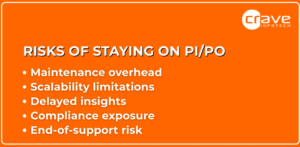
Legacy PI/PO architectures were built for a world of scheduled batch processes and tightly coupled systems. However, modern business demands real-time responsiveness, API-driven connectivity, and support for hybrid cloud ecosystems. Simply updating the technology stack without rethinking integration patterns leaves enterprises with limited agility and persistent technical deb which is indeed a huge risk as PI/PO approaches the end of mainstream support around 2027.
True transformation means adopting platforms and patterns that empower intelligent, event-driven, and API-first interactions, capabilities beyond what on-premise PI/PO was architected to deliver.
The Rise of Intelligent and Event-Driven SAP Integrations
In next-gen enterprises, integration must do more than connect applications; it must react, predict, and orchestrate across distributed landscapes. SAP Integration Suite, part of SAP Business Technology Platform (BTP), shifts integration from static connections to a dynamic mesh of events, APIs, and services.
Key capabilities driving this shift include:
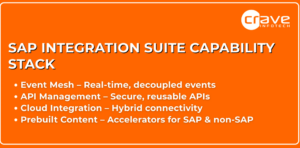
- Event Mesh: Enables asynchronous, event-driven architectures that decouple producers and consumers for real-time responsiveness.
- API Management: Promotes reusable interfaces with governance, security, and lifecycle visibility.
- Cloud Integrations:
- Prebuilt Connectors: Simplify integration with SAP and non-SAP systems, essential for hybrid landscapes.
Rather than reacting to changes at fixed intervals, intelligent integrations responds instantly to business events, whether it’s an order update, stock level change, or customer interaction or even creating a more responsive digital core.
Risks of Static, Point-to-Point Architectures
Legacy integration landscapes often grow organically, with each system pairing requiring its own custom interface. While manageable at small scale, these point-to-point designs contribute to:
- Maintenance Overhead: Each custom mapping or adapter becomes a long-term support burden.
- Limited Scalability: Hard-coded pathways can’t scale fluidly with cloud expansion or digital growth.
- Delayed Feedback: Batch and synchronous communication patterns make real-time insights difficult.
Staying on static architectures also increases risk as support for PI/PO wanes. Without migration, enterprises face elevated compliance, security, and operational risks.
Well, migration is not just a technical exercise, it’s an opportunity to reduce complexity, eliminate obsolete interfaces, and adopt scalable integration paradigms.
The Role of SAP Integration Suite in Intelligent Ecosystems
SAP Integration Suite forms the backbone of intelligent integration ecosystems by bringing multiple integration patterns onto a single, cloud-native platform. Unlike PI/PO, which was built for on-premise and largely synchronous communication, Integration Suite supports a more flexible and scalable integration model.
It enables:
- Cloud-native operations, running on SAP BTP with built-in scalability and continuous updates
- Hybrid integration, connecting on-premise systems with cloud applications without architectural friction
- AI-assisted integration, using intelligent recommendations to speed up mapping and integration design
Together, these capabilities allow enterprises to move away from rigid, tightly coupled integrations and adopt models that can evolve with changing business demands. With API management and event-driven messaging built in, organizations gain better control, visibility, and consistency across integrations — especially as landscapes grow more complex.
However, as integration ecosystems expand, flexibility alone is not enough. Without governance, even modern platforms can quickly become fragmented.
How Integration Workbench Enables Governance and Agility
This is where structured governance becomes essential. A successful PI/PO to SAP Integration Suite migration requires more than technical conversion; it demands clarity, control, and repeatability across the integration lifecycle.
Integration Workbench addresses this need by providing a governed framework for assessment, migration, and ongoing optimization. It helps organizations:
- Assess and catalog existing PI/PO artifacts: creating a clear baseline before migration
- Automate the transformation of legacy interfaces: reducing manual effort and migration risk
- Establish reusable integration patterns: ensuring APIs and events follow consistent architectural standards
By combining migration tooling with governance discipline, Integration Workbench helps teams move faster without sacrificing control. The result is not just a cleaner migration, but an integration landscape that remains scalable, compliant, and adaptable long after PI/PO is retired.
A Structured, Step-by-Step Migration Approach
A successful PI/PO to SAP Integration Suite migration works best when approached as a structured, phased journey rather than a one-time technical move.
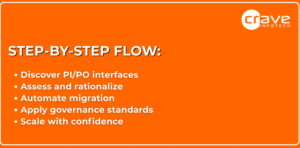
The process typically begins with
discovering existing PI/PO interfaces, creating a complete inventory of integrations, dependencies, and usage patterns. This visibility is critical to avoid blind spots during migration.
Next comes
assessment and rationalization. Not every interface needs to be migrated as-is. Some can be retired, consolidated, or redesigned using modern, API-first or event-driven patterns to reduce long-term complexity.
With a clear migration scope in place, organizations can
automate the migration of relevant artifacts. Automation reduces manual effort, accelerates timelines, and lowers the risk of inconsistencies when transitioning to SAP Integration Suite.
Once integrations are in place,
governance standards are applied to ensure consistency, security, and compliance across APIs and event flows. This step is key to maintaining control as integration landscapes scale.
Finally, enterprises are positioned to
scale with confidence, supported by a cloud-native platform that enables continuous change without reintroducing technical debt.
Conclusion
For enterprises looking to future-proof their integration landscape, PI/PO to SAP Integration Suite migration is not a box-checking exercise. It marks a strategic shift toward intelligent, resilient, and cloud-ready integration. By adopting API-first and event-driven models, organizations gain the ability to respond in real time, reduce integration risk, and scale with confidence as business demands evolve.
Crave InfoTech partners with enterprises through this transition, helping them move beyond technical migration to build integration foundations that deliver sustained business value.
Frequently Asked Questions
1. Why should enterprises move from SAP PI/PO to SAP Integration Suite?
Enterprises should move from SAP PI/PO to SAP Integration Suite to support modern integration needs such as real-time processing, API-first connectivity, and event-driven architectures. Unlike PI/PO, Integration Suite is cloud-native, scalable, and designed to integrate hybrid and multi-cloud landscapes efficiently.
2. Is PI/PO to SAP Integration Suite migration just a modernization effort?
No. PI/PO to SAP Integration Suite migration goes beyond basic modernization. It represents a strategic shift toward intelligent integration by enabling event-driven communication, reusable APIs, and centralized governance, which are critical for agility and long-term scalability.
3. What are the risks of continuing with point-to-point integrations on PI/PO?
Point-to-point integrations increase maintenance overhead, limit scalability, and delay real-time insights. As PI/PO approaches end of mainstream support, these static architectures also introduce higher compliance, security, and operational risks.
4. How does SAP Integration Suite support intelligent and event-driven integrations?
SAP Integration Suite supports intelligent integrations through capabilities such as Event Mesh for asynchronous communication, API Management for governed and reusable interfaces, and prebuilt connectors for SAP and non-SAP systems. These features enable real-time responsiveness and flexible integration design.