
8 minute read

Meet the Authors
Key Takeaways
What you need to know
Eitekh SAP services span S/4HANA implementation, SAP Cloud ERP, global template design, data migration, go-live support, and custom code remediation.
Five engagement summaries show how the firm supports food manufacturers, global enterprises, and multi-country SAP transformations from advisory through deployment.
The projects highlight practical priorities for SAP teams: clean up custom code early, govern local template variations, and protect business continuity during upgrades.
Eitekh, an IT consulting firm founded in 2013, has published a series of engagement summaries detailing SAP work that spans advisory, implementation, and support activities across multiple industries. The firm centers its practice on ERP, CRM, and cloud infrastructure, with stated expertise in SAP and Salesforce. Eitekh describes itself as an award-winning SAP partner covering the full SAP lifecycle. Its SAP services list platforms such as SAP Cloud ERP and SAP Integration Suite, with implementation work that ranges from configuration and data migration to go-live support. Five case studies reviewed here put specifics behind those claims, showing delivery work in food manufacturing, global template design, and enterprise-scale transformation.
Modernizing Core ERP for Food and Beverage Manufacturers
Two of Eitekh’s documented engagements center on food and beverage manufacturers replacing legacy ERP systems with SAP platforms. In one project, Eitekh led an SAP S/4HANA modernization for a food manufacturer, standardizing processes across finance, manufacturing, and supply chain functions. The firm’s scope included configuration, data migration, and go-live support, the standard sequence that carries a legacy environment through cutover to a live S/4HANA system.
A second engagement involved SAP Cloud ERP for a mid-market packaged food company. Eitekh delivered process improvements across finance, operations, and supply chain, with the platform intended to support the client’s growth objectives through scalable cloud infrastructure. Food and beverage manufacturers generally adopt this kind of platform to address traceability and supply chain visibility requirements common across the sector. Taken together, the two engagements point to a manufacturer profile where finance, operations, and supply chain data need to move onto a single integrated system to support growth or compliance demands.
Explore related questions
Ask SAPi
Supporting Complex, Global SAP Transformations
Three of Eitekh’s engagements involve larger, multi-country or enterprise-scale transformation work. Eitekh developed a standardized SAP S/4HANA global template for an ICT solutions provider operating across multiple countries, covering finance, procurement, and supply chain. The template was built to accommodate local country variations while keeping a standardized core, and the scope included change management and training activities to support adoption during rollout. Multi-country template projects of this kind typically require governance structures that let local teams adapt statutory or process details without breaking the shared core, a balancing act common to large SAP rollouts industrywide.
Eitekh led a custom code modernization project for a global steel and engineering enterprise, analyzing, remediating, and optimizing legacy SAP custom code ahead of a planned S/4HANA migration. The work aimed to reduce the custom code footprint and improve system maintainability as part of the client’s longer-term transformation roadmap. Custom code remediation of this sort is a common readiness step for organizations moving to S/4HANA, since the platform’s simplified data model often exposes years of accumulated custom objects that no longer align with current process design.
A third transformation engagement involved an SAP S/4HANA upgrade for a global trading company. Eitekh managed the upgrade with an explicit priority on business continuity, delivering innovation capabilities alongside the technical upgrade so the client could gain new functionality without disrupting ongoing operations. Trading operations that run continuously are particularly sensitive to downtime, which is why upgrade projects in this space often lean on parallel or brownfield approaches to limit disruption during cutover.
What This Means for SAPinsiders
- One partner across the S/4HANA lifecycle. SAP customers evaluating partners for multi-phase transformations can weigh working with a single firm across template design, migration, and post-go-live support instead of coordinating multiple vendors at each stage.
- Code cleanup precedes migration risk. Teams planning S/4HANA moves should budget dedicated time for custom code assessment and remediation before cutover, since unresolved legacy objects can surface as blockers late in a project timeline.
- Global templates require local governance. Organizations running multi-country SAP rollouts should establish clear decision rights so local teams can adapt statutory or process variations without undermining the standardized core template.
More Resources
See All Related Content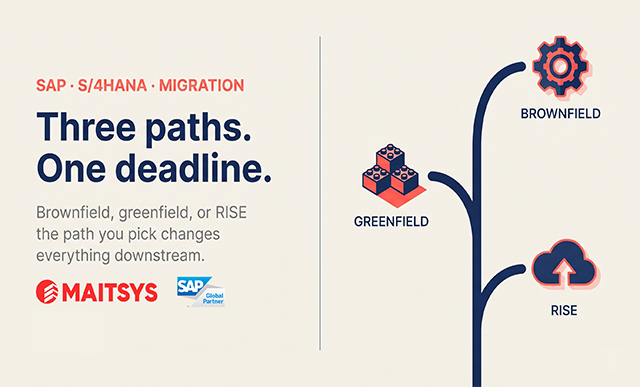
ECC to S/4HANA: Brownfield, Greenfield, or Selective Data Transition?To effectively transition from SAP ECC to S/4HANA, organizations must separately decide on their system transformation approach—whether through system conversion, new implementation, or selective data transition—and their operational model, with RISE with SAP primarily addressing the latter.

Beyond Greenfield and Brownfield: Rethinking SAP ModernizationIn a recent Lemongrass Live discussion, experts emphasized that SAP organizations should prioritize creating immediate business value through AI innovations rather than solely focusing on the Greenfield or Brownfield migration paths to S/4HANA.
3 minute read

The Mandatory Transformation Your Business Didn’t Choose Could Be Its Biggest OpportunityThe mandatory migration to S/4HANA, often viewed as a disruption, can be transformed into a strategic opportunity through Lemongrass's Brightfield approach, which integrates AI from the onset to streamline the process, reduce costs, and unlock business value before go-live.
6 minute read