

3 minute read

Meet the Authors
Key Takeaways
What you need to know
Yash Technologies has published a technical walkthrough on connecting AI agents to SAP S/4HANA using the Model Context Protocol (MCP), a governed standard for letting agents call enterprise systems safely.
The approach lets agents inherit SAP's existing authorization, audit, and data-integrity controls instead of improvising against raw APIs, the difference between a pilot security will approve and one that never leaves the sandbox.
With only 17% of organizations running AI in core workflows per SAPinsider research, a documented MCP pattern offers SAP architects a credible path from experiment to production agent.
The interesting question about AI agents and SAP is no longer whether they will touch the ERP core. It is whether they can do it without bypassing the controls that make SAP trustworthy in the first place. Yash Technologies (Yash) has put a concrete answer on the table, with a technical walkthrough on how to connect AI agents to SAP S/4HANA using the Model Context Protocol (MCP), the emerging open standard for enabling language models to call enterprise systems through a governed, structured interface. It is a deliberately practical posture in a conversation still crowded with conference theater. Yash paired the technical content with a separate milestone, qualifying for the SAP Partner-Led Territories initiative for the Kingdom of Saudi Arabia, extending its delivery footprint in a fast-growing SAP S/4HANA market.
The MCP angle is the more consequential of the two. For years, the hard part of putting AI near an ERP system was the plumbing for an SAP ERP practitioner. How an agent reads master data, triggers a transaction, or reasons over a process without working around the authorization, audit, and data-integrity controls that govern every SAP action. MCP gives that plumbing a standard shape, and Yash is documenting how to wire it into SAP S/4HANA specifically.
What Yash Is Demonstrating
Yash lays out an architecture in which an MCP server sits between AI agents and SAP S/4HANA, exposing SAP capabilities as structured tools that agents can call rather than letting the model improvise against raw APIs. That distinction matters. An agent that calls a defined, permissioned tool is governable; an agent that free-forms HTTP requests against a production ERP is a risk event waiting to happen.
Explore related questions
Ask SAPi
The practical value is in how it slots into existing SAP patterns. MCP-exposed tools can map to OData services, RFCs, and the business logic SAP teams already maintain, which means the agent inherits the authorization model rather than working around it. For SAP S/4HANA shops, that is the difference between an AI pilot that legal and security will sign off on and one that never leaves the sandbox.
The SAP Partner-Led Territories qualification for KSA is the commercial complement. It lets Yash lead SAP engagements in a region where public-sector and enterprise SAP S/4HANA demand is climbing, and pairs delivery scale with the forward-looking technical capability the MCP work represents.
Why This Matters for AI and Architect Leads
The research backdrop explains the urgency. According to SAPinsider’s AI Adoption and Maturity in the SAP Enterprise benchmark, 91% of organizations are using AI at some level, yet only 17% have it embedded in core workflows. That gap is the one MCP-style integration is built to close. Most organizations have experimented, but few have a governed path from experimentation to a production AI agent that touches ERP transactions.
The platform direction reinforces it. SAPinsider’s report found that 40% of organizations plan to deploy SAP AI Foundation through SAP Business Technology Platform (BTP), the same architectural neighborhood where governed agent integration lives. Teams investing in AI Foundation now will need a disciplined way to connect agents to SAP S/4HANA, and a documented MCP pattern is one of the cleaner answers available today.
The same report notes that while 55% of organizations have deployed SAP S/4HANA or SAP cloud, only 34% have fully transitioned. The agentic layer is arriving while the core migration is still underway, which means the architectural decisions made now will shape what AI can safely do later.
What This Means for SAPinsiders
Treat MCP as an architecture decision, not a science experiment. For enterprise architects, the takeaway is that connecting agents to SAP S/4HANA is now a design choice with a recognizable pattern, not an open research problem. The question to bring to your next architecture review is whether agent access flows through a governed, permissioned tool layer or improvises against APIs. With only 17% of organizations running AI in core workflows, the teams that standardize on a controlled integration pattern early will move from pilot to production faster than those still debating the approach.
Make the authorization model the first design constraint, not the last. For SAP security and Basis leads, the appeal of an MCP server is that agents inherit SAP’s existing authorization model rather than circumventing it. Before approving any agentic pilot, insist that agent actions map to defined tools tied to existing roles and audit trails. That single requirement separates a defensible AI deployment from a compliance liability, and it is far cheaper to enforce in design than to retrofit after an audit finding.
Pair delivery capability with technical readiness when selecting partners. For CIOs and program owners, especially those scaling SAP S/4HANA across regions, Yash’s combination of the KSA Partner-Led Territories qualification and documented agentic integration work is the pairing to look for. When evaluating SAP partners for AI-era programs, weigh whether they can both deliver the core SAP S/4HANA work at scale and show a credible, governed path to agentic capabilities on top of it.
More Resources
See All Related Content
Quickbase Extends SAP Project and Resource Management Beyond the ERPQuickbase extends no-code project and resource visibility into SAP-connected environments. The platform centralizes project tracking and resource allocation, linking directly to SAP, Salesforce, and Oracle through native connectors and APIs, mitigating risks and cutting costs.


CIB-Computer Moves Clinical Inventory Tracking From On-Premise to SAP Business One CloudCIB-Computer has successfully moved its CCS M2 clinical inventory tracking solution to SAP Business One Cloud, providing a new model for healthcare organizations. This migration enhances traceability and automation for medical and blood products through advanced technologies.
3 minute read
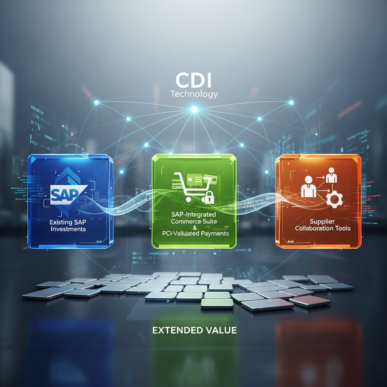
CDI Technology Positions SAP-Integrated Commerce Suite as an Alternative to New Core SystemsCDI Technology provides e-commerce, payment processing, and point-of-sale solutions with real-time SAP integration. Their offerings aim to enhance existing SAP investments and turn complex product configurations and payment needs into a competitive advantage.
3 minute read