4 minute read
Meet the Authors
Key Takeaways
What you need to know
Existing BusinessObjects investments can be modernized and integrated with SAP Analytics Cloud, preserving years of accumulated business logic and reporting structures.
Migrating to managed cloud platforms like SAP BusinessObjects Private Cloud Edition can free internal IT staff from infrastructure maintenance, allowing them to focus on higher-value analytics initiatives.
Organizations can adopt SAP's newer analytics tools at their own pace, utilizing solutions like Private Cloud Edition to bridge on-premise environments with SAP Analytics Cloud without immediate, disruptive replatforming.
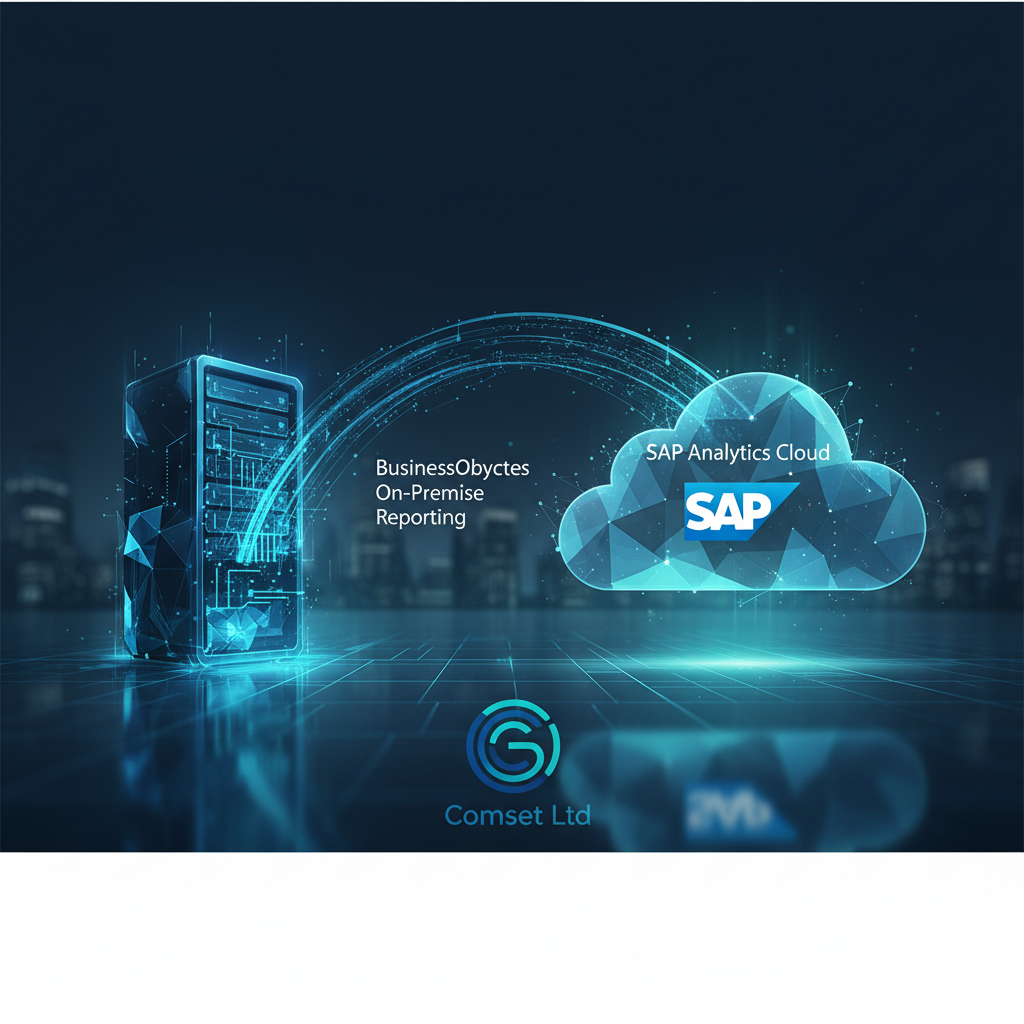
Comset, a UK-based Business Analytics and Business Intelligence consultancy, works across SAP BusinessObjects and SAP Analytics Cloud as part of a broader SAP Data Fabric Solutions offering built on the idea that getting underlying data right is a prerequisite for reporting, analytics and AI readiness. The firm’s long-standing engagement with a global banking and financial services client illustrates that approach through work that moved the client’s on-premise BusinessObjects estate to a cloud-based SAP BusinessObjects Private Cloud Edition and SAP Analytics Cloud environment.
Bridging Legacy BusinessObjects Investment
Comset describes its BusinessObjects expertise as long-standing, positioning the platform as a mainstay of enterprise reporting, and points to SAP Analytics Cloud as the next stage of that stack. The firm also works across Microsoft’s BI tools, including Power BI and Microsoft Fabric, giving it reach on both the SAP and Microsoft sides of the analytics landscape.
Underneath that technology reach, Comset points to a proprietary framework it calls CDIT, the Comset Data Integration Toolkit, meant to structure and speed up BI delivery work. The firm frames data quality and structure as foundational, arguing that a solid data framework must be in place before reporting, analytics, AI, or machine learning initiatives can deliver value.
Explore related questions
Ask SAPi
SAP has signaled a broader strategic direction toward SAP Analytics Cloud over time, which helps explain why BusinessObjects customers might explore modernization paths without discarding their existing reporting logic. Comset’s stated specialism in both platforms means it can support that transition on the client’s schedule.
On-Premise BusinessObjects to Cloud-Based PCE and SAC
Comset has supported the on-premises Enterprise Reporting platform of a global banking and financial services client since 2008, a relationship that predates the client’s move to the cloud by a decade. When the client’s corporate strategy shifted toward cloud infrastructure in 2018, Comset advised on software options and architecture, work that led the client to select SAP BusinessObjects Private Cloud Edition running on Microsoft Azure as its target platform.
Comset then provided the migration expertise to carry out that move. The resulting platform lets the client bring user applications onto SAP’s newer software at its own pace, while staying aligned with SAP’s stated direction for analytics. In the SAP ecosystem, SAP BusinessObjects Private Cloud Edition is generally understood as a managed cloud option for existing on-premises customers not yet ready for a full replatform to SAC, giving organizations a way to move infrastructure without an immediate application rewrite.
A central piece of the engagement is that SAP Analytics Cloud can directly access the client’s existing Business Objects universes, the semantic layer that maps underlying data structures to business terms. Preserving that layer let the client keep years of accumulated business logic instead of redeveloping it inside a new tool, a widely used approach during BusinessObjects modernization. Reports from Comset indicate that the shift also freed in-house personnel from maintaining complex on-premise technical infrastructure, redirecting that capacity toward higher-value work, and that the overall change produced lower total cost of ownership and reduced capital spend, with Microsoft Azure as the preferred platform.
What This Means for SAPinsiders
Legacy BusinessObjects logic can survive a cloud move. Teams evaluating SAP Analytics Cloud do not need to treat existing BusinessObjects universes as sunk cost to be discarded. Migration partners can be assessed on whether they preserve that business logic rather than rebuild it.
Cloud migration also reshapes internal IT workload. Moving to a managed platform such as Private Cloud Edition shifts maintenance burden away from in-house staff. That shift frees technical personnel to focus on reporting value rather than infrastructure upkeep.
Migration pace can remain self-directed. A path from Private Cloud Edition into SAP Analytics Cloud lets an organization control when it adopts newer SAP analytics tools. That control reduces the operational risk of an abrupt, all-at-once cutover.
More Resources
See All Related Content
Protecting twenty years of SAP expertise – and building faster than ever before.Minol-ZENNER-Group leverages a two-decade-old custom SAP landscape enhanced with the AI platform Conduct to optimize IT operations, enabling rapid knowledge sharing, streamlined development processes, and improved incident resolution, ultimately turning their complexity into a competitive advantage.
3 minute read