

3 minute read
Meet the Authors
Key Takeaways
What you need to know
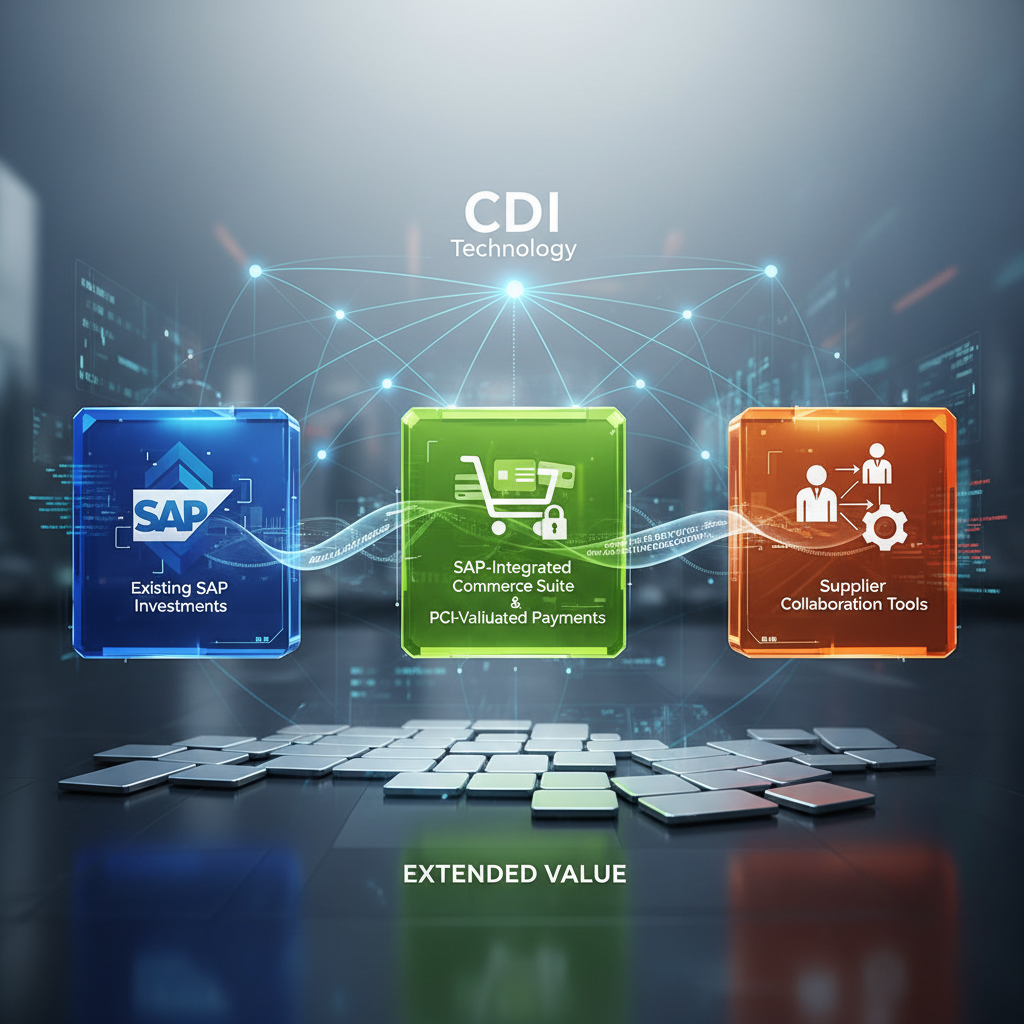
CDI Technology offers integrated e-commerce and payment solutions designed to extend the value of existing SAP investments without replacing core systems.
Their ERP2Web product provides real-time integration with SAP, leveraging ERP data directly for commerce transactions to improve revenue and simplify processes.
Implementing new payment layers like SnapPay necessitates careful consideration of PCI compliance and governance, requiring collaboration between IT security and finance teams.
CDI Technology, described as a First Data company, builds e-commerce, payment processing, and point-of-sale solutions with built-in, real-time integration to SAP, along with tools for supplier collaboration. The company frames its offering around turning existing SAP investments, complex product configurations, and varied payment needs into a competitive edge rather than a reason to replace core systems. CDI Technology holds certified integration status with SAP, which the company cites as evidence of its standing in the SAP partner ecosystem, along with a similar claim for Oracle.
Real-Time Integration Turns SAP into a Commerce Engine
ERP2Web, CDI’s e-commerce product, provides real-time integration for SAP and JD Edwards environments. Rather than syncing catalog, pricing, and order data on a batch schedule, the storefront draws directly against the ERP system as transactions occur. CDI states this approach leverages the ERP investment in real time, producing higher e-commerce revenue, cost reduction, and process simplification, particularly for sellers dealing with highly configured products or complex mobile selling scenarios. SAP B2B and SAP eCommerce sit among CDI’s core specialties, underscoring where the company focuses.
The emphasis on real-time behavior reflects a broader pattern in B2B commerce layered on ERP systems. Storefronts that focus on batch synchronization with inventory and pricing modules can run into overselling, stock discrepancies, or stale catalog data, especially when order volume is high or products carry complex configuration options. Vendors that build commerce tools directly against ERP interfaces are addressing a technical requirement common across the SAP ecosystem. SAP customers evaluating bolt-on commerce layers should focus on how integration is architected and how frequently data actually moves, since real-time claims can mean different things in practice.
Explore related questions
Ask SAPi
Payments and Supplier Collaboration Extend the SAP Footprint
Beyond the storefront layer, CDI’s products can mean different things, including a PCI PA-DSS validated payment solution serving both customers and suppliers. CDI says 25 years of experience has produced robust, PCI-friendly, and secure credit card handling within its solutions. Two solutions, 25apPOS for mobile point-of-sale and SnapVSS for supplier collaboration, extend the same architecture into payments and supplier-facing workflows. Supplier payment automation and enterprise payment solutions round out the areas where CDI concentrates its integration work.
Payment processing connected to ERP systems carries governance implications beyond the transaction itself. PCI DSS compliance is a standing concern for organizations running payment flows adjacent to core financial systems, since improperly segmented payment data can widen the scope of security audits and complicate compliance boundaries between commerce, payments, and the ERP core. IT security and finance governance teams typically weigh these boundaries when a new payment layer is introduced near SAP data.
What This Means for SAPinsiders
Real-time sync claims need volume-based verification. SAP teams evaluating bolt-on commerce tools should confirm sync frequency against actual order and inventory volume, since real-time integration claims can vary widely once tested against production-scale transaction loads. A pilot period focused on peak order conditions will help surface any gaps between the integration’s real-time claims and its production performance.
SAP certification status requires version-specific confirmation. Because SAP certification can be time-bound and tied to specific product versions, buyers should verify a vendor’s current certification against their own SAP version, including SAP S/4HANA readiness, before committing to procurement. A certification claim tied to an older SAP release may not carry forward automatically.
Payment layers add governance responsibilities. Introducing PCI-scope payment processing adjacent to SAP systems typically requires IT security and finance governance teams to reassess audit boundaries and data segregation duties. Teams should treat a new payments integration as much a compliance project as a technical one.
More Resources
See All Related Content
When Excel Stops Working for Enterprise PricingWhen costs rise, pricing teams have a limited window to respond before margins come under pressure. That window tightens as the pricing environment becomes more complex. Zilliant’s whitepaper, The Spreadsheet Trap: How Excel Is Undermining Your Pricing Strategy, describes what happens when spreadsheets remain at the center of that process. Manual updates can slow cost […]

SAP Support Deadlines Companies Should Be Planning for NowSAP's 2027 maintenance date leads to two planning horizons, 2030 and 2033, each with its own conditions. This article explains what each horizon requires, which SAP systems it covers, and how a lifecycle map keeps every system on schedule.
3 minute read

Enterprise Integration for SAP 2026 SAPinsider Benchmark Research ReportEnterprise integration is becoming a strategic platform capability for SAP organizations. As application landscapes expand across SAP and non-SAP systems, businesses increasingly depend on integration to support cloud transformation, operational visibility, analytics, partner connectivity, and artificial intelligence. The question is no longer whether organizations need an integration strategy. It is whether they can translate that strategy into a modern, governed, and scalable architecture.
SAP integration has become strategic, but it is not yet uniformly modern. Organizations are defining enterprise strategies and increasing investment as real-time visibility, cloud growth, SAP transformation, and AI create new connectivity demands. At the same time, legacy middleware, point-to-point integrations, skills shortages, and technical debt continue to limit execution.
This year’s integration research reveals substantial progress at the strategic level. Half of respondents describe their integration strategy as either enterprise-wide or platform-driven and AI-enabled, while only 4% have no formal strategy. Integration is also closely connected to transformation: 46% say it is strategically aligned with, or fully embedded in, broader cloud and digital transformation programs.
Download this benchmark research report to read a deeper analysis and receive insight on your own plans.
- Understand the integration strategies and architectures that organizations are using.
- Explore how organizations are transitioning to real-time and AI-ready integration.
- Learn about the integration challenges that are being created by AI.
- See what SAPinsiders are doing to implement the capacity to execute on integration.
1 minute read