3 minute read
Meet the Authors
Key Takeaways
-
SAP Joule for Consultants is expanding through an AWS partnership, using generative AI to provide SAP consultants with governed access to proprietary documentation, certification content, and best practices.
-
The integration uses Anthropic Claude models on Amazon Bedrock, delivered through SAP’s Generative AI Hub on SAP Business Technology Platform, to support SAP consulting and implementation projects.
-
The move highlights how generative AI is being embedded into SAP consulting delivery, with implications for project execution speed, knowledge access, and enterprise governance.
SAP and Amazon Web Services are expanding the use of generative AI inside SAP consulting projects, integrating Anthropic’s Claude models through Amazon Bedrock to power SAP Joule for Consultants, the companies said.
The capability is designed to give SAP consultants conversational access to SAP’s proprietary documentation, certification materials, and knowledge base articles during cloud transformation and implementation projects. SAP said the system can reduce time spent searching for information and help accelerate project delivery by grounding responses in curated SAP sources, rather than public data.
The integration is delivered through SAP’s Generative AI Hub and runs on SAP Business Technology Platform infrastructure.
Explore related questions
How SAP Joule for Consultants Works
SAP Joule for Consultants shortens the distance between a question and an answer. The system uses a retrieval-augmented generation architecture that limits responses to SAP-curated sources rather than open or general-purpose language models.
A query triggers retrieval of relevant SAP Notes, Knowledge Base Articles, certification material, and best-practice guidance. LLMs synthesize responses only after source material has been identified, anchoring output in existing SAP documentation.
Reasoning is handled using Claude models from Anthropic, delivered through Amazon Bedrock. Model access flows through SAP’s Generative AI Hub, which sits between SAP applications and foundation models. This layer governs model usage, data access, and update cycles without requiring changes to application logic.
Source retrieval relies on vector-based similarity search over SAP-curated content, using retrieval-augmented generation to ground responses in authoritative sources. Retrieved passages are ranked for relevance before being passed to the model. Responses include references to the original SAP sources.
The system processes both textual and visual material, including diagrams and structured artifacts alongside written documentation.
Deployed as a SaaS service on SAP Business Technology Platform, SAP Joule for Consultants operates within SAP’s identity and entitlement framework.
What It Means for Consulting Teams
The bigger shift concerns how expertise shows up inside delivery teams.
Tools such as SAP Joule for Consultants change the economics of consulting work. Consultants still design, configure, and advise, but less time is lost searching for authoritative answers or reconciling guidance. Project delivery dynamics shift as a result.
Faster access to validated SAP guidance can shorten design cycles, reduce rework, and smooth handoffs between consultants. The experience gap inside teams narrows when less-tenured consultants operate with closer alignment to best practices, while senior experts can spend more time on judgment-heavy decisions.
Margin and capacity implications follow quickly. Consulting firms manage utilization and leverage as carefully as delivery quality. The removal of low-value research time from engagements creates options: accelerate timelines, absorb additional work with existing teams, or redirect effort toward higher-value activities.
Delivery context also matters. SAP is treating governed, source-aware assistance as the default for consultants working in regulated and high-risk enterprise environments, where auditability and provenance often shape client confidence.
What This Means for SAPinsiders
- SAP’s integration with AWS increases model optionality. Foundation models available through Amazon Bedrock give SAP access to more than one model family without hard-coding calls to a single provider. This design approach helps SAP adapt if model performance, cost, or enterprise trust requirements shift over time.
- This architecture treats AI as infrastructure. SAP Joule’s design shows the company treating generative AI as a governed platform service rather than a lightweight embedded feature. Retrieval constraints, citation requirements, and abstraction layers point toward AI systems that behave like core enterprise infrastructure, not optional productivity tools.
- This could change how consulting is priced. If AI-assisted delivery becomes visible to customers, reduced research time may translate into lower project costs rather than higher margins. Consulting economics shift only when buyers recognize AI-driven efficiency and begin to expect faster, leaner delivery as standard.
More Resources
See All Related Content

The Deutschland Stack: Bridging the Gap Between AI Compute and SAP Business ValueDeutsche Telekom and SAP’s Industrial AI Cloud is more than a sovereign cloud pitch. Discover how the Deutschland Stack positions SAP as the operational control plane for digital twins, quality inspection, and sustainable industrial AI.
3 minute read
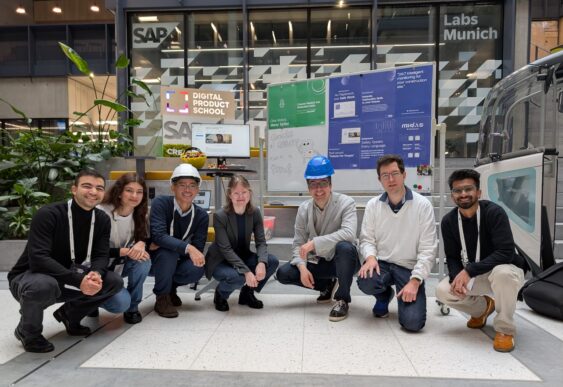
SAP, UnternehmerTUM Bringing Embodied AI to Shop FloorSAP's collaboration with UnternehmerTUM on the SafetyGuard prototype exemplifies the integration of embodied AI in operational processes to enhance workplace safety, streamline inspection workflows, and foster co-innovation for rapid prototyping, signaling a shift towards AI-native, robot-agnostic platforms within SAP's digital ecosystem.
3 minute read

How Generative UI Is Shifting Enterprise Software from Application to ExecutionEnterprise software is evolving towards generative UI systems that dynamically assemble data and actions at runtime, addressing fragmentation across multiple environments and shifting the focus from static interface design to the reliability of underlying data architecture and governance.
4 minute read