8 minute read
Meet the Experts
Key Takeaways
-
SAP Business Data Cloud (BDC) unifies SAP and non-SAP business data in a governed environment, facilitating advanced analytics and AI, in collaboration with Databricks.
-
The partnership leverages bi-directional, live zero-copy data sharing, simplifying the integration of SAP data with Databricks for seamless analytics and AI applications.
-
This integration encourages SAP customers to redefine their data architecture, streamline governance, and accelerate AI use cases by aligning SAP and Databricks workflows.
In early 2025, SAP introduced SAP Business Data Cloud, positioning it as the evolution of SAP Datasphere and the core of its data strategy going forward. At the same time, SAP announced a partnership with Databricks, bringing the Databricks lakehouse platform directly into the SAP data stack.
The overall vision for SAP BDC is that SAP customers should be able to unify SAP and non-SAP business data in a single, governed environment, then use that foundation for advanced analytics, machine learning, and agentic AI. Rather than shuttling data back and forth between SAP and non-SAP platforms, SAP BDC and Databricks are meant to function as a coherent ecosystem. In the recent SAPinsider research report, Enterprise Data and Analytics in the Era of AI, we found that companies were more likely to use Databricks as their database and data management strategies matured.
Shortly after the partnership announcement, Databricks launched SAP Databricks, a jointly positioned offering that combines SAP business data with the Databricks platform, governed via Databricks Unity Catalog, which helps manage access, lineage, and sharing of data and AI assets.
Explore related questions
As part of the their partnership, Databricks and SAP delivered SAP BDC Connect for Databricks, enabling bi-directional, live, zero-copy data sharing between Business Data Cloud and the Databricks lakehouse via Delta Sharing, an open source data sharing functionality offered by Data bricks that works to allow customers to share live data across platforms, clouds, and regions in a secure and governed fashion. SAP data products can appear directly inside Databricks with their business semantics intact, while Databricks assets can be exposed back into SAP as virtual models.
Practical benefits for SAP customers
- Many SAP customers have built separate data landscapes: SAP BW or Datasphere on one side, and a lakehouse like Databricks on the other. That typically means duplicated data pipelines, inconsistent governance, and multiple versions of the truth. The SAP–Databricks partnership is designed to reverse that pattern by enabling organizations to define a single set of governed SAP data products and reuse them across both SAP and Databricks environments.
- Historically, moving SAP data into external data science platforms has required custom integration, complex transformations, and duplicated pipelines. By providing a native, zero-copy connection and shared semantics, the SAP–Databricks integration lowers friction between SAP data and AI workloads. Data scientists and engineers can work directly with SAP business data in Databricks, join it with non-SAP data, and use the lakehouse provider’s ecosystem for model development and generative AI—without re-engineering the entire data stack each time.
- SAP customers often need a combined view spanning SAP and other sources such as customer experience platforms, IoT, or external market data. The joint solution supports federated queries and real-time synchronization so that analytics tools such as SAP Analytics Cloud or BI solutions on Databricks can query across SAP and non-SAP data without rigid batch movement.
- SAP BDC and SAP Databricks are designed to run on the leading cloud providers such as Microsoft Azure, AWS, and Google Cloud Platform. For SAP customers already standardizing on a cloud provider, the SAP–Databricks relationship could offer a clearer reference architecture for how SAP data and AI fit into that environment.
- There is a lot of discussion about AI agents and copilots in ERP, but agents are only as good as the data and governance that support them. By tightening integration between SAP’s governed business data and Databricks’ AI and ML tooling, the partnership gives SAP customers a stronger path to building AI agents that can safely reason over, and act on, critical business data.
What This Means for SAPinsiders
- Revisit your data architecture with SAP BDC and Databricks in mind. If you are running or planning SAP Datasphere, data warehouse, or BW landscapes alongside Databricks, this is the time to evaluate whether this partnership can simplify your architecture, reduce data copies, and provide a single governed layer for SAP data.
- Use the partnership to accelerate AI use cases, not just analytics. Treat Databricks as a way to operationalize AI on top of SAP data for functions such as forecasting, anomaly detection, generative scenarios, and agentic workflows while letting SAP BDC handle SAP semantics and governance. The value comes when you tie AI use cases directly to SAP processes and KPIs, not just dashboards.
- Align SAP, data, and cloud teams around a shared roadmap. This partnership will only pay off if SAP teams, data engineers, and cloud architects work from a common plan. That means jointly defining which data products live in BDC, which workloads land in Databricks, and how governance, security, and cost management will work across both. Treat the two offerings as a cross-team program, not a one-off integration.
More Resources
See All Related Content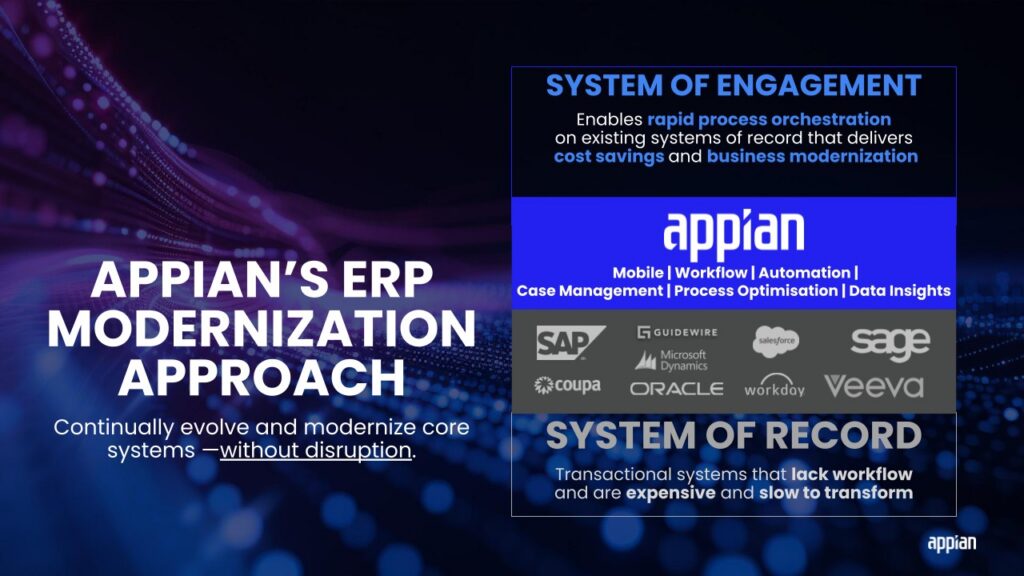
The End of the Wait-and-See Era for ERP ModernizationAppian’s 2026 ERP modernization blog emphasizes that many organizations can’t afford to delay modernization for years while waiting on SAP migrations or incremental enhancements. Instead, Appian promotes its unified process orchestration platform as a way to supercharge existing ERP systems by layering in automation, intelligence, and cross‑system orchestration without replacing the ERP core. By connecting workflows that span beyond SAP into other systems and data sources, Appian aims to help companies accelerate value delivery, increase agility, and optimize key business processes — evidenced by customer success stories in supply chain, finance, procurement, and more.
SAP Moves from Sponsor to Infrastructure Architect Behind New York Fashion WeekSAP is transforming New York Fashion Week into a connected digital platform for designers and consumers by partnering with N4XT Experiences, enabling real-time data integration and operational intelligence to enhance the fashion industry's retail experience.
5 minute read

Siemens Teamcenter and Microsoft Azure solve the tough challenges with a modern PLMSiemens Teamcenter, deployed on Azure, enhances visibility and connectivity across the entire product lifecycle, empowering businesses to improve efficiency and innovation with the support of advanced AI technologies.
4 minute read