Explore critical topics shaping today’s SAP landscape—from digital transformation and cloud migration to cybersecurity and business intelligence. Each topic is curated to provide in-depth insights, best practices, and the latest trends that help SAP professionals lead with confidence.
Discover how SAP strategies and implementations vary across global markets. Our regional content brings localized insights, regulations, and case studies to help you navigate the unique demands of your geography.
Get industry-specific insights into how SAP is transforming sectors like manufacturing, retail, energy, and healthcare. From supply chain optimization to real-time analytics, discover what’s working in your vertical.
Dive into the most talked-about themes shaping the SAP ecosystem right now. From cross-industry innovations to region-spanning initiatives, explore curated collections that spotlight what’s trending and driving transformation across the SAP community.
Explore critical topics shaping today’s SAP landscape—from digital transformation and cloud migration to cybersecurity and business intelligence. Each topic is curated to provide in-depth insights, best practices, and the latest trends that help SAP professionals lead with confidence.
Discover how SAP strategies and implementations vary across global markets. Our regional content brings localized insights, regulations, and case studies to help you navigate the unique demands of your geography.
Get industry-specific insights into how SAP is transforming sectors like manufacturing, retail, energy, and healthcare. From supply chain optimization to real-time analytics, discover what’s working in your vertical.
Dive into the most talked-about themes shaping the SAP ecosystem right now. From cross-industry innovations to region-spanning initiatives, explore curated collections that spotlight what’s trending and driving transformation across the SAP community.
Master data has a lifecycle similar to a human life, consisting of stages from creation to retirement, emphasizing the need for careful lifecycle planning.
The quality and correctness of the master data must be maintained throughout its lifecycle, as deteriorating quality impacts not only the master file but also any derived records.
Companies should utilize tools like the Libelle Master Data Service Suite to manage and preserve the value of their master data, protecting against data decay and ensuring effective transitions between systems.
The master data lifecycle parallels human life stages, comprising creation, validation, productive use, maintenance, evaluation, and eventual archiving, emphasizing the importance of careful management to preserve data quality and value for organizations.
When a person is born, many stages of his or her life are already determined: after kindergarten comes the school career, followed by a professional life that is as successful as possible, and then the well-deserved retirement. A typical life cycle.
Although master data is not sent to kindergarten or school, it also has a life cycle. Many people refer to this as the “master data lifecycle”. Master data is also “born” once and must go through certain processes before it is worked with and eventually sent into “retirement.”
Master Data Life Cycle: Life stages of master data
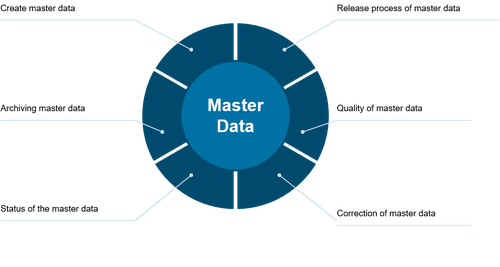
The value of a human life is of course difficult to compare with that of master data. Nevertheless, the value of master data for a company should not be underestimated, and careful lifecycle planning of master data is indispensable. Basically, it can be said that master data passes through six stages during its use – illustrated here in a diagram.
The creation of a master file must be carefully planned, and the reason for its use and the method of creation must be determined. The process of creation must be carried out cleanly so that the result, the master file, is correctly available in the system.
If a master file is created correctly, it must be checked for correctness before it is used productively. There are different processes for this, depending on the company and the type of master file.
If the master file is used productively, it is inevitable that further data records will be created in connection with it. The quality of this data depends on how well the master file itself is maintained. Otherwise, not only does the master file itself suffer, but so do the records that derive from it. If the quality of the master file deteriorates, corrections must be made. Depending on the use and timeliness, this is correspondingly complex. Of course, the corrections must be made with as much care as the creation of the master data.
As master files change and lose use over time, at some point the question of your status arises. If master files are too interconnected with other current files, the value of the master file will be different from that of a master file whose dependencies no longer have any meaning.
Eventually, master files also reach their life horizon. If they are obsolete and can no longer be used, they are archived. If you are moving systems, you take the master data with you into the new system or use it to create new master data.
Life advice for master data
Just as people organize their own life stages to live fulfilling lives, companies are interested in preserving their value and protecting themselves from data decay. Tools such as the Libelle Master Data Service Suite help take master data by the hand so that the quality of corporate assets does not go astray.