


3 minute read

Meet the Experts
Meet the Authors
Key Takeaways
What you need to know
SAP CFOs are under increasing pressure to streamline financial operations, with 53% of organizations taking four to seven days to close their books.
The integration of AI into finance processes is changing the landscape by enabling proactive analysis and automated workflows.
BlackLine's approach to AI-driven accounting automation emphasizes a unified data foundation and governance, addressing the common gaps in integration and compliance.
SAP CFOs are being asked to deliver faster, more reliable insight from finance operations that are still constrained by slow closes and fragmented systems. SAPinsider’s “The Office of the SAP CFO and the Future of Finance” benchmark report (Office of the CFO Report), published in December 2025, shows that 53% of organizations take four to seven days to complete the close, while another 42% take eight days or more. Only 5% can close in one to three days, even though 85% cite financial performance optimization and risk or compliance management as top strategic priorities.
In a world where markets move by the hour and board decisions cannot wait for “day 10 numbers,” the gap between aspiration and operational reality is becoming a structural liability. It is also driving renewed interest in applying AI to finance, not as a set of generic tools, but as capabilities embedded directly into governed accounting processes. This matters because nearly seven in 10 SAP‑centric finance organizations already report using AI, and more than half are evaluating agentic AI for close task orchestration. CFOs need AI to deliver insights they can confidently defend to an auditor.
A Digital Finance Workforce
Finance leaders have been experimenting with automation for years, but many initiatives stalled at task-level scripting or standalone analytics. Generic AI copilots can summarize documents or draft messages, but they are poorly suited to finance operations and tax compliance that require traceability, control, and auditability.
Explore related questions
Ask SAPi
SAPinsider’s research reflects this, as 86% of respondents rated data lineage and 43% rated auditability as important or very important for governing finance models.
BlackLine is taking a different approach by embedding AI-driven capabilities directly into its accounting automation platform, which underlines SAP Accounting Automation Solutions by BlackLine. Rather than treating AI as an overlay, these capabilities operate within standardized record-to-report and invoice-to-cash workflows, supporting what BlackLine describes as a digital finance workforce—AI acting as governed operational support, not an independent decision maker.
But what makes the “digital workforce” notion an evolution point? It joins together trends that have so far been separate: the desire to eliminate manual close work, the shift from simple RPA scripts to context‑aware agents, and the need to orchestrate tasks across multiple SAP and non‑SAP systems. Highlighted in the Office of the CFO Report, 57% of organizations are already evaluating agentic AI for close task orchestration, and technologies such as financial close automation tools, group reporting, and account substantiation are being deployed as a stack to reach a continuous close.
Three Pillars of Trusted AI
AI-driven accounting automation depends less on models than on foundations. BlackLine’s approach emphasizes three architectural elements that together form a reference pattern for “trusted AI” in finance:
- A finance-grade AI control layer.
BlackLine provides a centralized control layer that governs how AI models are used, with built‑in auditability and transparency across AI‑driven actions. This design is meant to give enterprises the ability to run AI safely in regulated financial contexts by logging decisions, model interactions, and outcomes at a level auditors and regulators can review.
- A unified accounting data foundation.
AI capabilities run on a consistent data layer that aggregates record-to-report and invoice-to-cash data across SAP and non-SAP systems. Unlike isolated AI features locked inside point applications, this architecture gives AI agents a broad view of the finance and accounting landscape, enabling more reliable, contextual decisions. Plus, it aligns with the Office of the CFO Report’s finding that 92% of SAP‑centric finance leaders see real‑time analysis and reporting as the most critical business requirement.
- Decades of process knowledge as blueprint.
BlackLine has codified more than 20 years of finance best practices from over 4,400 customers into the core logic of its AI, using these “blueprints” as reference models for how finance operations should behave. That domain encoding directly addresses the Office of the CFO Report’s observation that most organizations are “established but not optimized,” with 58% at Level 3 maturity but only 8% at Level 4, where continuous improvement is driven by analytics and automation.
SAPinsider’s research further noted only 17% of organizations report their finance systems and initiatives as fully integrated, while 50% operate in “mostly or partially integrated” states with SAP at the center and silos at the edges. In that context, the above elements—AI control layer, unified finance data, and standardized accounting workflows—create an integrated, governed finance hub many CFOs have been trying to assemble from the patchwork of separate tools.
Agentic Capabilities, Orchestrated Workflows
Within this architecture, AI is increasingly applied through agent-based capabilities that assist with discrete finance activities while remaining under human supervision. Rather than replacing finance professionals, these agents support them by handling high-volume analysis, surfacing exceptions, and coordinating workflow steps.
For example, agents can gather data from multiple ERP systems, identify anomalies in reconciliations or journals, and prepare draft variance explanations for review. A supervisory orchestration layer coordinates these activities, sequences tasks, and routes outputs through predefined approval workflows. Human users retain responsibility for judgment, approvals, and sign-off.
Downstream systems such as tax engines further expose why orchestration matters in practice. Tax calculation and compliance processes depend on reconciled, complete, and time-bound financial data flowing out of record-to-report workflows. When agent-based processes coordinate reconciliations, approvals, and exception handling upstream, tax engines receive cleaner, more reliable inputs. When those workflows are fragmented or poorly governed, tax engines simply amplify inconsistencies, increasing rework, late adjustments, and audit risk.
These use cases align with the Office of the CFO Report, which shows that 57% of organizations are evaluating agentic AI for close task orchestration and 42% are evaluating machine-learning-based forecasting and anomaly detection. The common requirement across these use cases is not autonomy for its own sake, but governed execution at scale.
AI Across the Finance Lifecycle
When AI is embedded into accounting automation, its impact is felt across the finance lifecycle, particularly in record-to-report and invoice-to-cash processes common in ERP environments. That cross‑process reach is particularly valuable in landscapes where finance operations span several SAP and non‑SAP ERPs, which is not uncommon: 42% of organizations manage four to nine ERP instances, 11% manage between 10 and 29, and 16% manage 30-plus, per the Office of the CFO Report.
How this plays out involves:
- Proactive analysis and intelligent insight. AI can help transform raw finance data into forward‑looking guidance, including predictive forecasting and proactive risk detection across reconciliations, journals, and intercompany transactions. SAPinsider’s research confirms that these are high‑value use cases: 42% of finance leaders identify forecasting as the most valuable AI capability, and 37% highlight anomaly detection.
- Next‑generation process automation. BlackLine adds a new layer of intelligence to its automation stack, including AI‑powered matching and intelligent data capture to handle high‑volume, complex processes with greater speed and accuracy. This aligns with the finding that improving financial close efficiency (53%) and automating closing processes (47%) are among the top strategies for optimizing the financial close, yet financial close automation tools are currently used by only 35% of organizations, with 23% implementing them.
- Automated content generation and summarization. AI-assisted drafting of fluctuation explanations, variance commentary, and audit responses can reduce manual effort while maintaining consistency when distilling large volumes of financial data and documentation into clear, actionable outputs. Although generative reporting is still an emerging priority—only 21% of the Office of the CFO Report’s respondents ranked it among the most valuable AI uses—organizations that have deployed AI report significant cycle‑time and manual‑effort benefits.
Tax engines further define the limits of where AI can safely operate in finance automation. Unlike exploratory analytics, tax calculation and reporting require deterministic outcomes, traceability, and defensible logic. This makes tax a practical boundary for AI in finance: If AI-driven processes cannot meet tax requirements, they are unlikely to satisfy broader regulatory and audit expectations.
The common thread across these scenarios is that AI success in finance is architectural, not incremental. Orchestrated workflows, governed execution, and reliable downstream handoffs define what is possible today, as well as what can be scaled tomorrow. That pushes the conversation beyond individual tools toward the ecosystem strategies shaping the path to autonomous finance.
Ecosystem Strategy, Path to Autonomous Finance
AI-driven accounting automation also reflects a broader ecosystem strategy. Rather than building all components internally, BlackLine leverages hyperscaler AI models and cloud data platforms while retaining control over governance, process logic, and auditability within its own platform.
BlackLine uses Google Cloud’s Gemini models alongside its own governance and process expertise, rather than trying to build all AI components from scratch. In launch materials, BlackLine and Google Cloud described a partnership intended to help customers “close their books faster with greater confidence and unlock the strategic insights within their financial data.” Additionally, the unified data layer in SAP Accounting Automation by BlackLine (formerly Studio360) is powered by Snowflake, which itself is expanding partnerships with Google Cloud around data and AI, including Gemini integrations.
For SAPinsiders, this architecture aligns with the direction many organizations are already heading. In the Office of the CFO Report, 52% said they use SAP Business Warehouse in financial close and reporting, and 45% use S/4HANA Finance for group reporting, often alongside cloud data platforms and specialist tools. Among third-party finance platforms used, BlackLine ranked as the most widely adopted solution (39%).
BlackLine’s approach lets finance teams leverage hyperscaler and multi‑cloud AI innovation while keeping ownership of controls, process logic, and audit trails in a finance‑centric platform rather than scattering AI logic across multiple tools. As such, its architecture is a step toward more autonomous finance operations, where AI handles routine analysis and coordination while humans focus on exceptions, scenarios, and decision making. SAPinsider’s research shows why this incremental path matters: Although AI adoption is widespread, many organizations still struggle to translate AI investment into consistent operational improvement.
What This Means for SAPinsiders
SAP CFOs are under pressure to move from “established” to optimized finance operations. That shift depends less on adopting new tools than on building an optimized architecture. Most SAP finance organizations sit at Level 3 maturity—processes are standardized, but true optimization driven by analytics and automation is still rare. SAPinsiders need architectures that combine an AI control layer, a unified finance data foundation, and codified finance process patterns that can work under SAP Accounting Automation Solutions by BlackLine.
AI strategies need to be grounded in finance‑grade governance and data. While 69% of organizations already report using AI in finance, SAPinsider’s research shows that data lineage, auditability, and integration remain non‑negotiable governance requirements. This means any move into AI for forecasting, anomaly detection, or narrative generation should be built on a unified data layer and an explicit AI control framework so close processes remain traceable.
Closing the automation gap in the financial close is a structural priority. Improving close efficiency (53%) and automating close processes (47%) are among SAP finance leaders’ top strategies, yet only 35% currently use financial close automation tools and 23% are implementing them, leaving a large execution gap. A path forward is to pair close‑automation technologies in SAP Accounting Automation Solutions by BlackLine with AI capabilities. Manual effort is reduced, cycle times shorten, and AI can start surfacing issues and drafting explanations before period‑end rather than after the fact.
More Resources
See All Related Content
DataWorks Connects Procurement and Inventory Across Single-Site and Multisite OperationsDataWorks combines procurement, inventory management and mobile workflows in a modular back-office platform designed for single facilities and multisite enterprises. The system integrates with existing POS and accounting environments while supporting hosted and on-premises deployment.

IBM Expands Granite 4.1 Model Family, Ties It Directly to the Watsonx PlatformIBM's Granite 4.1 model family, now natively integrated into watsonx.ai, signals a push towards auditable, production-ready AI for enterprise data. This update provides open, transparent foundation models designed for secure on-premises deployment and efficient performance.
3 minute read

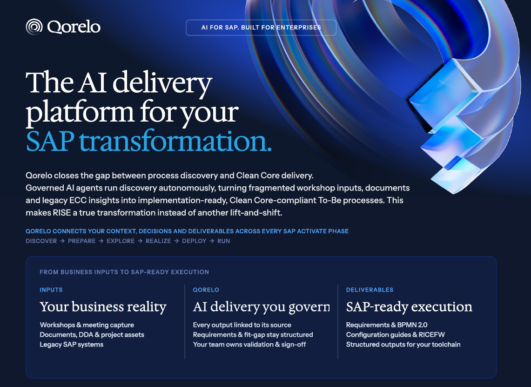
Qorelo: AI-Powered SAP Transformation Delivery, From Discovery to DeploymentQorelo is an enterprise AI platform that enhances SAP transformations by converting business inputs and legacy data into SAP-compliant deliverables, enabling faster delivery and reduced rework through improved governance and traceability.
1 minute read