
15 minute read
Category 1: Print-Centric Operational Output
When Printing Is the Business Requirement
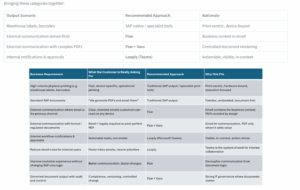
Some SAP output scenarios are fundamentally about printing, not communication. Typical examples include:
- Warehouse and logistics labels
- Barcode and QR code labels
- Pick lists and packing documents
- High-volume, device-specific print output
These scenarios are characterized by:
- Tight coupling to printers and hardware
- Very specific layout and sizing requirements
- No expectation of email or user interaction
- Operational speed taking priority over presentation
This is still SAP output, but it is not a fit for Floe or Floe + Varo.
In these cases, traditional SAP output technologies — including SMARTFORMS, Adobe Forms, or specialist label-printing solutions — remain entirely appropriate. Attempting to force communication-centric tools into these scenarios adds risk without delivering value.
Key point:
Not all output should be modernized in the same way. Print-driven operational output should remain print-driven.
Traditional SAP Output (Documents First)
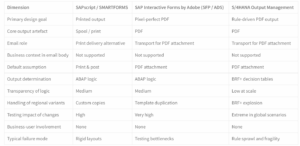
SAP’s native output technologies excel at generating documents, but they share a common assumption: the document itself is the output.
This model still dominates many S/4HANA systems — even when the recipient never prints the document.
Detailed Comparison: SAP Native Output Approaches
Category 2: External Business Communication (Email First)
Reframing Output as Communication
External communication with customers, suppliers, and partners has very different requirements:
- Information must be immediately visible
- Content must render well on any device
- Attachments should be optional, not mandatory
- Branding, clarity, and context matter
This is where Floe fundamentally changes the model.
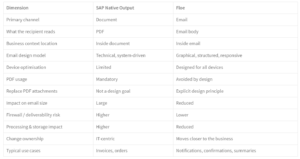
Floe is still SAP output, but it redefines what output looks like.
Instead of treating email as a delivery mechanism, email becomes the output.
With Floe, the business context is presented directly in the email body using structured, responsive HTML — designed to be read, not downloaded.
Detailed Comparison: SAP Native Output vs Floe
Category 3: External Communication with Regulated Documents
When PDFs Still Matter
There are legitimate scenarios where PDFs remain essential:
- Regulatory or compliance documents
- Customers who explicitly require printable formats
- Scenarios demanding pixel-perfect layouts
The answer is not to abandon PDFs, but to use them deliberately.
This is where Floe + Varo provides a combined strategy:
- Floe remains responsible for the communication
- Varo is used only where complex PDF rendering is required
Detailed Comparison: Floe vs Floe + Varo

Category 4: Internal Notifications and Approvals
Why Internal Email Is the Wrong Channel
Many SAP systems still rely heavily on automated internal emails for:
- Workflow notifications
- Approval requests
- Status updates
These emails are easily missed, buried in inboxes, or duplicated across channels.
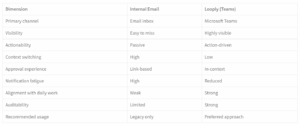
For internal communication, Arch recommends Looply instead of Floe.
- Internal notifications belong in Microsoft Teams, not email
- Approvals should happen where people already work
- SAP events should surface as actionable tasks, not messages
This creates a clear, intentional split:
Internal communication → Looply (Microsoft Teams)
External communication → Floe (Email)
Detailed Comparison: Internal Email vs Looply (Teams)
A Clear Output Strategy for SAP
From Output Generation to Intentional Communication
SAP’s native tools are excellent at generating documents.
Arch’s approach recognises that not all output is the same — and that communication channels should be chosen deliberately.
By separating print-centric output, external communication, regulated documents and internal notifications, organizations can reduce complexity, improve user experience, and align SAP output with how people actually work today.
More Resources
See All Related Content
Getting SAP Approvals into Microsoft Teams: Choosing the Right Integration ApproachThis article outlines the main architectural approaches for delivering SAP approvals into Microsoft Teams, explains the business requirements that determine which approach fits best, and provides a practical framework to help organizations choose the right option for their SAP landscape. In many organizations, a two-minute SAP approval becomes a two-day delay simply because the approver […]

Closing the Data Gap – The Power of the Digital Thread at the EdgeThe collaboration between Red Hat and SAP addresses the data gap between operational technology and enterprise IT systems in manufacturing by utilizing a three-tier architecture that ensures a reliable digital thread for consistent data flow from machine sensors to executive decision-making.
2 minute read

Driving Digital Transformation with SAP InnovationThe article emphasizes the importance of seamless technology integration and scalability, supported by AI-driven automation and industry expertise, to enhance development efficiency, negotiation power, and adaptability to evolving business needs.
1 minute read

How Generative UI Is Shifting Enterprise Software from Application to ExecutionEnterprise software is evolving towards generative UI systems that dynamically assemble data and actions at runtime, addressing fragmentation across multiple environments and shifting the focus from static interface design to the reliability of underlying data architecture and governance.
4 minute read