



Mar 16-19, 2026Las Vegas, Nevada, NV
SAP Inventory Management
Featured Insiders
Upcoming Events
SAPinsider Las Vegas 2026
Related Vendors


Supply Chain Management: SAP Inventory Management
Inventory is a fundamental part of your business. Without proper inventory management, the organization can suffer inefficiencies, profit decline, and sustainability impacts.
What is Inventory Management?
Inventory Management is the practice of controlling inventory flow for maximum organizational efficiency. It is suitable for businesses of any size and focuses on organizing and streamlining product storage and fulfillment. The management of stock can be done on a quantity or value basis. Inventory management in SAP is an important component of the Material Management (MM) module, it deals with stocks and goods movement.
With SAP, many companies have real-time data on inventories, which is vital for capacity management and expansion of complex supply chains. The application provides several management tools to help users create an organized warehousing space while uncovering valuable operational data. A couple of examples include the following.
Supply Chain Management: SAP Inventory Management
Inventory is a fundamental part of your business. Without proper inventory management, the organization can suffer inefficiencies, profit decline, and sustainability impacts.
What is Inventory Management?
Inventory Management is the practice of controlling inventory flow for maximum organizational efficiency. It is suitable for businesses of any size and focuses on organizing and streamlining product storage and fulfillment. The management of stock can be done on a quantity or value basis. Inventory management in SAP is an important component of the Material Management (MM) module, it deals with stocks and goods movement.
With SAP, many companies have real-time data on inventories, which is vital for capacity management and expansion of complex supply chains. The application provides several management tools to help users create an organized warehousing space while uncovering valuable operational data. A couple of examples include the following.
Physical locations or organizational levels:
- Plant: A high-level physical location to which the materials are assigned.
- Storage Location: A specific area within the plant where the material is stored.
Four primary movement of goods are:
- Goods Receipt: Inventory can be approved for immediate use or be checked in.
- Goods Issue: A company may choose to process inventories for production or to sell to customers.
- Return Delivery: When materials are being returned from a customer or vendor.
- Internal Movements: When inventory is transferred internally from one location to another.
Most importantly, proper inventory management allows you to move goods with as little wasted time and money as possible. It can help you to optimize demand fulfillment for e-commerce, which is quickly becoming the norm in business to business today.
Benefits of SAP inventory management are:
- Accuracy and timeliness
- Realistic production schedule
- Quality checking
- Inventory analysis
- Proper reporting.
Technical resource partners for consideration might be –Movilitas, Opsveda, SAP.
Further insights for SAPinsiders around SAP Inventory Management
- Real Time Inventory and Order Visibility: Key for Successful Supply Chain Management. Probodh Chiplunkar from Ithena Technologies, outlines how real-time inventory transparency within a technological landscape affects business operations.
- Pick and Choose: How Kingston General Hospital Manages its Inventory with SAP. Author Davin Wilfrid interviews Derrick Morey at Kingston General Hospital (KGH), about the complex network of systems and people managing all the tubes, bandages, needles, and other medical supplies distributed throughout KGH. As an early adopter of SAP ERP technology, the hospital adopted a centralized inventory management system to track supplies for better accuracy.
- Next-Generation Inventory Management. Tom Chason addresses questions about the SAP Enterprise Inventory and Service-Level Optimization and SmartOps solutions. See how an integrated approach offers a powerful way to meet all these requirements for modern supply chains.
61 results

Real-Time Inventory and Order Visibility: Key for Successful Supply Chain ManagementJul 21, 2021 — With advancements in technology such as Internet of Things (IoT), cloud, and big data, demands and expectations for supply chain management have continuously grown over the past few decades. Greater organization of real-time data and visibility into inventory and orders can be a crucial tool in achieving more efficient operations and greater customer value. Large-scale expansion of data and business process complexity has opened the door for predictive and integrated enterprises, where machine learning, platform and cloud, and analytic capabilities are at the forefront of running efficient operations. Broader, real-time visibility accessible anytime and anywhere is crucial for leveraging big data and making data-driven decisions. In this article, learn how inventory and order visibility can help achieve efficient distribution networks, customized customer experience, and uniform omnichannel capabilities.
7 minute read

New Solutions for Real-Time Inventory Replenishment Amid Covid-19 DisruptionApr 8, 2021 — How does a responsive supply chain dynamically flex itself to avoid business disruption? How to ensure that customer satisfaction and experience is safe guarded from a stock-out situations? These are questions being asked across all industries in the wake of a global pandemic and its impact on the global supply chain. A more agile and […]
1 minute read
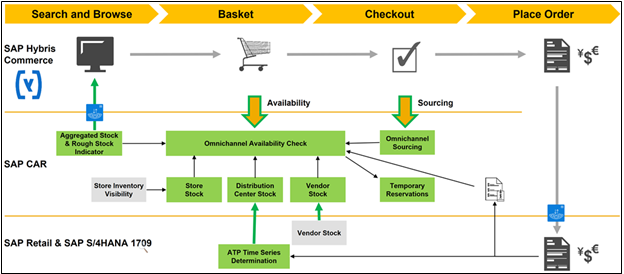
Digital transformation with SAP – Omnichannel Inventory and Sourcing with SAP Customer Activity Repository (CAR)Mar 18, 2021 — Going live on your digital transformation journey, writes Rizing Principal Consultant Chris Veli, is only the first step in a larger journey. To maximize your SAP S/4HANA investment, you should add two key transformation functionalities that will help you vastly improve customer experiences while following through with cost-effective and timely deliveries: omnichannel inventory visibility, which is the ability to know when and where your stock is in near real-time across your organizational channels, and sourcing, which is the method of how customer online orders are filled. How can you leverage these two add-ons to better achieve your business objectives while keeping customers engaged?
Using real-world examples, this article will empower organizations to leverage SAP Customer Activity Repository (CAR) in order to:
• Achieve omnichannel inventory visibility by implementing SAP CAR Point of Sale Data Transfer and Audit, empowering SAP S/4HANA to calculate near-real-time stock
• Ensure the lowest impact to web shops and back-end systems by supplying inventory and time series data
• Improve fulfillment of e-commerce sales by leveraging Omnichannel Article Availability (OAA) to ensure that only available inventory is presented to the customer and that all transactions undergo a final validation availability check
• Understand the components of sourcing, including data sources, filtering, sorting, and business objectives
9 minute read
Case Study: Johns Hopkins improves inventory managementJan 21, 2021 — As a company operating healthcare facilities, Johns Hopkins Health Systems (JHHS) faces heavy regulations and must operate 24/7 with no downtime. JHHS Affiliates used to manage all inventory on non-SAP software. At the time, JHHS struggled to share all the information across its supply chain units and manage inventory in a way that guaranteed the central stores and procedural areas always had the supplies they needed without too much dead stock. As a result, JHHS moved all its hospitals to SAP software, one at a time. Attend this case study session to learn how Johns Hopkins:
- Created system integration and automation to optimize inventory processes
- Trained supply chain specialists to use standard SAP functionality for inventory management
- Implemented SAP ERP in a hospital system
- Integrated SAP material requirements planning
1 minute read

Aggregate Inventory Management in SAP, Part II of IIApr 1, 2020 — by Venkata Ramana Nethi CSCP, CPIM.; Business Process Lead – Operations, Schlumberger Organizational inventory policy drives the threshold values and guidelines on how individual material should be managed in manufacturing or procurement processes. Putting the right information in the hands of the right people at the right time can save millions of dollars for companies. […]
14 minute read

Aggregate Inventory Management in SAP, Part I of IIMar 26, 2020 — Organizations strive to achieve high standards in customer service with balanced investment inventory. Material planners, from the plant to managerial to the corporate level, work on managing inventory on a periodic basis to maintain balance between inventory to carry vs. customer satisfaction. The right tools can replace spreadsheets to help organize this information effectively on a periodic basis. Using SAP's MRP Monitor add-on tool can help companies avoid manipulations that could occur on a spreadsheet.
After reading this article you will be able to:
- Implement material document analysis with various parameters including stock tables, movement types relevant for consumption
- Translate organization's inventory policy guidelines and threshold values of ABC/XYZ/LMN into SAP system parameters
- Analyze consumption, receipts and stock calculations on both make to stock (MTS) and make to order (MTO) product mix across group of plants
- Set up batch schedules and periodic maintenance procedures for functional and basis teams
- Understand how to optimize system performance
16 minute read

Logistics and SCM: Case study: How Minuteman International worked collaboratively across business units to achieve supply chain transformation and a 34% inventory reductionMar 5, 2019 — Hear how Minuteman International was able to maintain superior customer delivery performance with lower inventory using best practice techniques and a laser-focused approach of balancing demand and supply across its supply chain. SCM2017_Boebel_Casestudyhowminutemaninternational Steve Boebel If you have comments about this article or publication, or would like to submit an article idea, please contact the […]
1 minute read

Process optimization through capacity utilization and intelligent use of cloud servicesOct 31, 2017 — Large physical storage space produces high costs. Process optimization is the magic word used by many companies seeking to reduce the accumulation of high inventories, and thus become faster, more flexible and efficient. With Just-in-Time or Just-in-Sequence (synchronous procurement), production processes are specifically optimized – at least in theory. Full capacity utilization while minimizing inventory levels is a goal that all modern companies strive for.
4 minute read
How to Accelerate Your Inventory Sorting Using Batch Search StrategyOct 25, 2017 — Discover how to set up and use a batch search strategy to accelerate inventory sorting with business scenarios. Learn certain precautions to take while implementing the use of batch search strategy functionality. Key Concept The SAP system has provided a system strategy to efficiently sort materials or product batches in inventory using batch search strategy […]
29 minute read
A Look at Demand Sensing for SAP CustomersMay 26, 2017 — SCM 2017: One on One with Sujit Singh of Arkieva Sujit Singh is chief operating officer at Arkieva, which made its debut as an exhibitor at SCM 2017. Singh also spoke for the first time at this event. I asked Singh a few questions about key points in his session. Your session was on implementing […]
3 minute read