



Mar 16-19, 2026Las Vegas, Nevada, NV
SAP Infrastructure
Featured Insiders
Upcoming Events
SAPinsider Las Vegas 2026
Related Vendors

What is SAP Infrastructure?
Rapidly evolving from historical on-premise servers to private, public, and hybrid cloud and cloud-like environments, SAP infrastructure includes the systems, hardware, and platforms on which SAP systems and applications are run. Originally, SAP Infrastructure was limited to mainframe computers, though that changed with the client/server architecture included in the SAP R/3 release. While client environments have typically been Microsoft Windows-based systems, host environments normally included Unix systems. Over time, this shifted to include servers running Linux operating systems, though these were still located in data centers local to an organization’s physical locations.
What is SAP Infrastructure?
Rapidly evolving from historical on-premise servers to private, public, and hybrid cloud and cloud-like environments, SAP infrastructure includes the systems, hardware, and platforms on which SAP systems and applications are run. Originally, SAP Infrastructure was limited to mainframe computers, though that changed with the client/server architecture included in the SAP R/3 release. While client environments have typically been Microsoft Windows-based systems, host environments normally included Unix systems. Over time, this shifted to include servers running Linux operating systems, though these were still located in data centers local to an organization’s physical locations.
SAP Infrastructure now includes on-premise or local data centers, private cloud environments or hosting partners, public cloud and managed service providers, and hybrid combinations of these environments. SAP’s transition to a cloud-based company has resulted in a rapidly growing number of solutions and offerings being entirely cloud based, which in turn means that more SAP workloads are moving to the cloud. While these are not always public cloud or hyperscale environments, the infrastructure supporting SAP systems is more cloud based each year.
Organizations offering SAP Infrastructure solutions include: Atos, AWS, Dell Technologies, Google Cloud, HPE, IBM, Lenovo, Microsoft, Navisite, NTT Data, Nutanix, Rackspace Technology, Virtustream, and VMware.
Key Considerations for SAPinsiders:
- SAP Infrastructure continues to move towards the cloud, but SAP S/4HANA remains top of mind when it comes to infrastructure planning. As organizations make plans for the future, they need to determine what their future infrastructure should be. For many this revolves around SAP S/4HANA, while others are simply looking to eliminate older legacy infrastructure by doing a lift and shift to the cloud. This panel discusses what the priorities for organizations have been for SAP Infrastructure, where SAP S/4HANA plays into the picture, what technologies are areas of investment, and what impact RISE with SAP is having.
- SAP workloads, and the infrastructure that they are running on, are moving to the cloud. Based on research conducted by SAPinsider, 88% of organizations are running at least some SAP workloads in the cloud. While this isn’t every system, most of those who are still running workloads in on-premise infrastructure say that they plan on moving those systems to the cloud within the next two years. This article covers which workloads are still running on local infrastructure, which are most likely to be running in the cloud, and what approach organizations are taking when it comes to moving those workloads.
42 results

Building Cloud Infrastructure in Your LandscapeDec 27, 2022 — In order to run today’s SAP systems, you need infrastructure that will not just support SAP HANA, but that which will provide the foundation for future innovation. While some organizations are looking at the cloud to meet these infrastructure needs, others continue to invest in local infrastructure. But the option of a managed environment on-premise that provides both a cloud like experience and an operational expenditure cost may be a third option that you hadn’t considered.
• Organizations are updating infrastructure as they update their SAP solutions.
• There is an increased need to iterate rapidly while putting in place infrastructure that reduces costs and adds flexibility and performance.
• Managed environments on-premise can provide the same benefits as a cloud environment while residing in your data center.
6 minute read

Leveraging Edge Computing to Simplify and ScaleSep 14, 2022 — Over the past decade, there has been a significant shift for many organizations in the infrastructure supporting their business activities. From an environment that was on-premise, many organizations are moving most of their operations to the cloud. There are several reasons for this move, including cost, ease of management, scalability, and flexibility of infrastructure, and […]
8 minute read

How Do You Better Manage Systems and Improve Resilience?Sep 14, 2022 — How Do You Better Manage Systems and Improve Resilience? How do you better manage systems and improve resilience? Organizations today need to keep their business solutions up and running, and they have focused infrastructure providers on activities that help organizations speed up implementations and reduced both planned and unplanned downtime and increase resilience. However, enterprise […]
6 minute read
Output Management Plays A Vital Role for SAP CustomersDec 2, 2021 — When organizations with hundreds of SAP systems and thousands of printers in different parts of the world make big changes in their SAP architectures, ineffective output management add to the complexity and hamper the success of digital transformation initiatives.
This is why it’s important to understand the vital role output management plays for SAP customers. According to Leo Kaltenhauser, Director EMEA Central, LRS, customers need to consider the complexity in managing business-critical outputs with SAP solutions such as SAP S/4HANA, especially in large organizations.
What role does output management play in reducing costs and complexity and supporting agendas such as digital transformation and sustainability? Read this Technical Insights to:
- Learn why output management is relevant in today’s increasingly digital world and a core talking point in digital transformation conversations.
- Explore how a complex and costly output management architecture can be centralized to address business and technical pain points and support digital-first agendas.
- See how output management can drastically reduce the number of print servers, simplify SAP output management, provide more control, and reduce the cost of maintaining hardware.
7 minute read
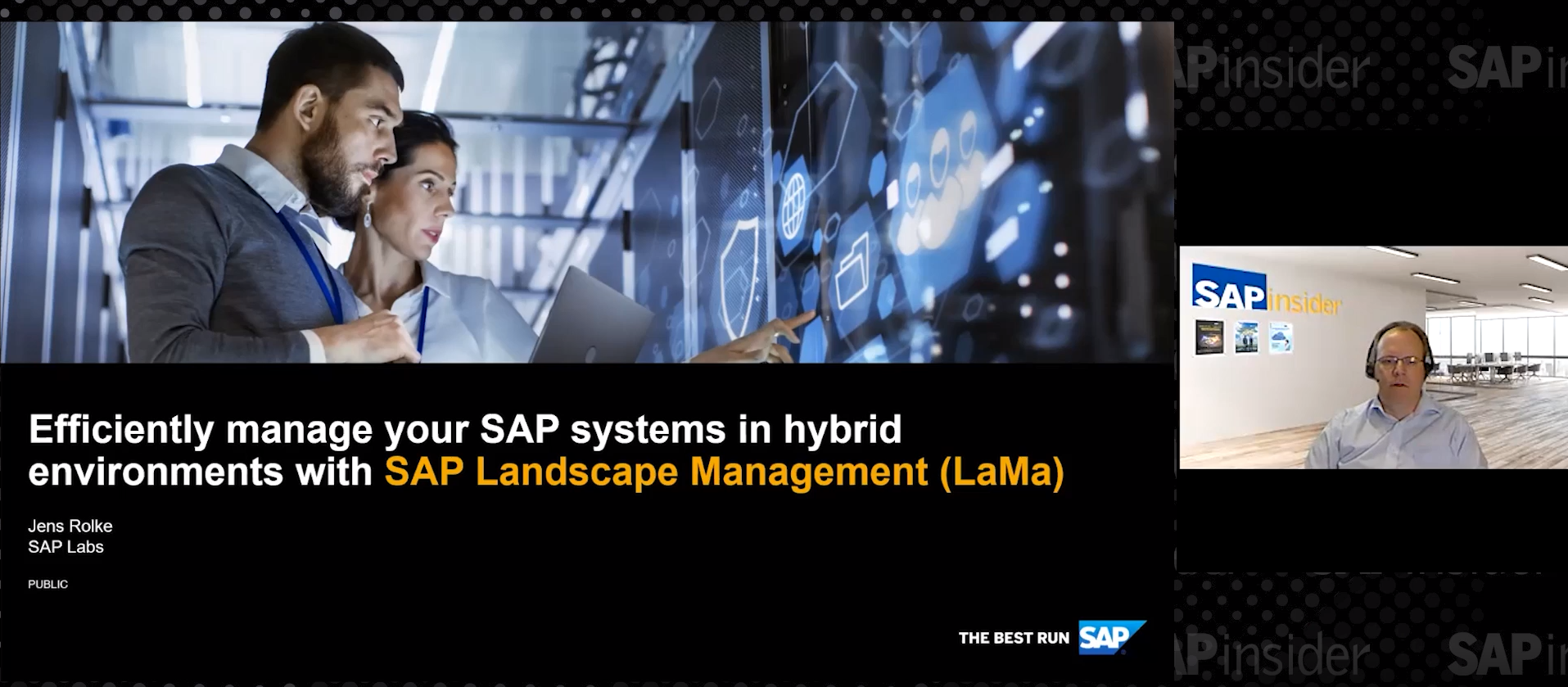
Efficiently manage your SAP systems in hybrid environments with SAP Landscape ManagementMay 26, 2021 — SAP Landscape Management is an orchestration and automation solution that assists with managing your SAP systems deployed on-premise, private cloud, Infrastructure-as-a-Service (IaaS) aka Hyperscaler environments, or in a hybrid setup. SAP Landscape Management helps many customers in the world to be more efficient, flexible, and resilient. The solution supports in the journey to be an Intelligent Enterprise. Attend this session to:
-Get an overview about the key capabilities like End-to-End System Copy/Refresh, System Start and Stop, Near Zero Downtime Maintenance for SAP systems running on SAP HANA (like SAP S/4HANA and BW/4HANA), and Automation Studio
-Watch a demo and realize how easy it is to automate and accelerate repetitive, time-consuming tasks like performing a system copy/refresh
-Learn how you can try and deploy SAP Landscape Management in Hyperscaler environments
1 minute read
The complete & open hybrid Infrastructure for SAPMay 26, 2021 — One of the biggest goals of organizations that are moving to SAP S/4HANA is to increase reliability and flexibility while reducing downtime during the transition. Red Hat and SAP have shared a long and successful history, and Red Hat is committed to helping SAP customers on their journey to achieve these goals and become an intelligent enterprise.
During this session, you will:
- Learn how to build an automated hybrid infrastructure for your SAP workloads
- Explore extending your SAP landscape’s capabilities using agile integration, cloud-native development, and modern tools
- Understand how to use these turnkey components in today’s and tomorrow’s SAP environments
1 minute read
How to Automate and Accelerate System Copy and Refresh with SAP Landscape ManagementOct 20, 2020 — System copy/refresh is an essential process that has to be done on a regular basis to keep the test systems in sync with the latest productive business data. It is very time-intensive, resource-consuming and error-prone, especially as system landscapes become more complex. Learn how SAP Landscape Management (LaMa) helps to simplify, automate and orchestrate the operations of your SAP systems running on premise, on Hyperscalers, or in a hybrid environment. Attend this session to:
- Get an overview of the latest innovations and key capabilities, such as end-to-end system copy/refresh, system start/stop, and advanced management of SAP systems running on SAP HANA (e.g. ECC, BW, SAP S/4HANA)
- Step through a live demo to see how the solution manages and visualizes SAP systems and landscapes, and how you can automate and accelerate repetitive, time-consuming tasks such as system copy/refresh
- Learn how you can try SAP Landscape Management in the cloud
1 minute read

Modernize your SAP landscape with Red Hat and IntelJun 28, 2020 — Organizations are digitally transforming to take advantage of growth opportunities in new markets, adapt to evolving customer behaviors and preferences, and combat increased competitive pressure. As a result, modernizing infrastructure with increased agility, flexibility, manageability, and security is a top long-term goal for 49% of organizations. Technologies like containers, microservices, and cloud infrastructure support these […]
1 minute read

Host Your SAP Systems in a Fast-Performing, Highly Available, Nondisruptive, Managed EnvironmentMay 28, 2020 — For companies running SAP software, SAP’s announcement that it is extending the end-of-mainstream-maintenance deadline from 2025 to 2027 means that organizations now have another two years to decide when and how to build a migration plan to SAP S/4HANA into their roadmap. This transition will be a complicated one for many companies and is a perfect time for organizations to review options for third-party support. SAP partners, such as the Managed Services division of NTT Ltd., see the migration being a compelling event for SAP customers to turn to outsourcing their SAP systems in a public or private cloud. This article helps SAPinsiders:
- Learn where other organizations are in their migration planning
- Discover the many managed services capabilities the Managed Services division of NTT Ltd. offers via its Pure Storage platform
- Understand what specifically the Managed Services division of NTT Ltd. provides for SAP customers, such as its ControlPanelGRC product
- Interpret the advantages of moving to all-flash storage, such as freeing up resources and improving operational efficiency
13 minute read