Featured Content
Topics

Explore critical topics shaping today’s SAP landscape—from digital transformation and cloud migration to cybersecurity and business intelligence. Each topic is curated to provide in-depth insights, best practices, and the latest trends that help SAP professionals lead with confidence.

Regions

Discover how SAP strategies and implementations vary across global markets. Our regional content brings localized insights, regulations, and case studies to help you navigate the unique demands of your geography.

Industries

Get industry-specific insights into how SAP is transforming sectors like manufacturing, retail, energy, and healthcare. From supply chain optimization to real-time analytics, discover what’s working in your vertical.

Hot Topics

Dive into the most talked-about themes shaping the SAP ecosystem right now. From cross-industry innovations to region-spanning initiatives, explore curated collections that spotlight what’s trending and driving transformation across the SAP community.

Featured Content
Topics

Explore critical topics shaping today’s SAP landscape—from digital transformation and cloud migration to cybersecurity and business intelligence. Each topic is curated to provide in-depth insights, best practices, and the latest trends that help SAP professionals lead with confidence.

Regions

Discover how SAP strategies and implementations vary across global markets. Our regional content brings localized insights, regulations, and case studies to help you navigate the unique demands of your geography.

Hot Topics

Dive into the most talked-about themes shaping the SAP ecosystem right now. From cross-industry innovations to region-spanning initiatives, explore curated collections that spotlight what’s trending and driving transformation across the SAP community.

SAP Global Tax Management

Upcoming Events

SAPinsider Las Vegas 2026
Mar 16-19, 2026Las Vegas, Nevada, NV

Related Vendors

Global Tax Management: An Overview and Key Considerations

What is Global Tax Management

Global tax management is the process by which tax managers evaluate the global taxability of an organization’s industry, corporate structure, business model, operations, products or services, business activities, and daily transactions.

To ensure global tax reporting requirements are met accurately and consistently by all subsidiaries across multiple tax jurisdictions, global tax management requires a holistic view of an organization’s entire flow of transactional data across its entire value chain.

Global tax management brings together disparate technologies from multiple vendors, such as SAP, Vertex, Sovos, Avalara, Thomson Reuters, and different currencies and various regulators, contributing to complexity across the tax function.

Global Tax Management: An Overview and Key Considerations

What is Global Tax Management

Global tax management is the process by which tax managers evaluate the global taxability of an organization’s industry, corporate structure, business model, operations, products or services, business activities, and daily transactions.

To ensure global tax reporting requirements are met accurately and consistently by all subsidiaries across multiple tax jurisdictions, global tax management requires a holistic view of an organization’s entire flow of transactional data across its entire value chain.

Global tax management brings together disparate technologies from multiple vendors, such as SAP, Vertex, Sovos, Avalara, Thomson Reuters, and different currencies and various regulators, contributing to complexity across the tax function.

For many organizations, global tax management typically involves these three steps:

  • Define compliance needs worldwide across all operating units, lines of business, tax jurisdictions.
  • Map businesss processes to govern how compliance should flow through the organization globally.
  • Implement technology solutions that can accurately collect information and content updates from disparate sources in alignment with defined business processes to deliver master data and financial information asynchronously as required.

Key Considerations for SAPinsiders

Understand the growing complexity of global tax management. Organizations considering different areas of the world for new potential opportunities must be aware of how these business interests can affect the local country’s taxation. Changing legislation and mandates around global tax management is becoming ever more complex as organizations face growing challenges in evaluating how their growth initiatives may impact global tax liabilities.

Evaluate your content needs for effective global tax compliance. Tax managers need to consider what global activities may be taxed in which locations and ensure that they are meeting the tax requirements of each country accurately and promptly. Greater global tax compliance efficiency can help organizations reallocate accounting resources to support revenue-generating tax compliance opportunities.

Implement technology to simplify global tax management needs. The Ingram Micro and Dow Chemicals case studies provide best practices outlining how technology makes it possible to create a global view of the enterprise, enabling tax function managers responsible for global compliance, global reporting, and global controls. Content updates that provide real-time data on tax jurisdictions, tax rates, and tax content changes are critical for efficient global tax compliance.

182 results
Keynote | Taxation on the Horizon: Key Regulations and Industry Shifts
Keynote | Taxation on the Horizon: Key Regulations and Industry ShiftsOct 5, 2021  —  Major regulatory demands are aiming to encourage real time transactions and business activities.  The foundations of the current tax systems were built a century ago to address the changes of the Second Industrial Revolution. Historically, tax systems have been developed to reflect the cost optimization strategies defining industries during the 20th century. Maintaining tax accuracy requires the need for more innovative tax solutions to intelligently manage invoice data and streamline the e-filing process. Attend this session to: - Recognize how to build a dynamic digital tax strategy and the importance of integrating a global tax engine. - Identify factors that impact an organization’s current or future digital tax strategy. - Discover current technologies organization are using or plan to adopt to support their strategy. 
1 minute read
SAP S/4HANA: What are the Tax Implications?
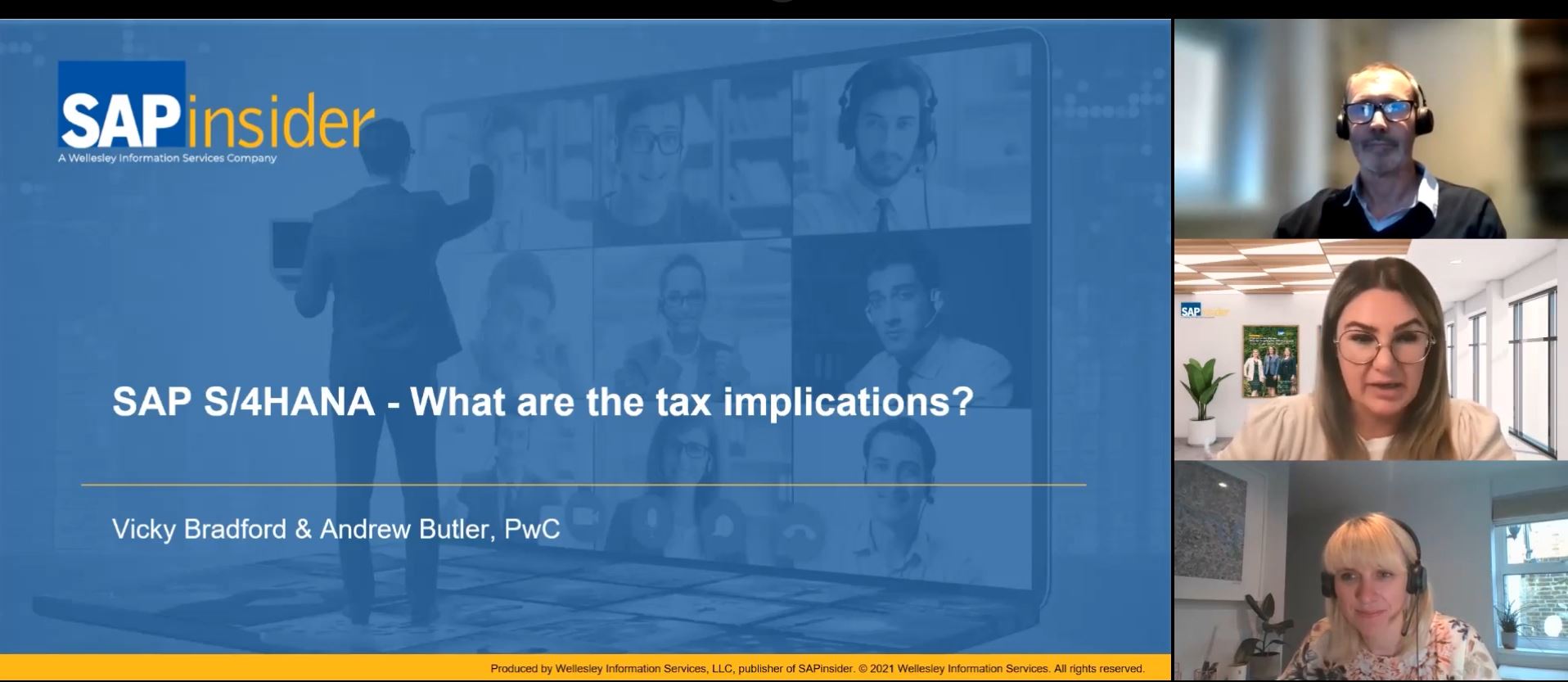
SAP S/4HANA: What are the Tax Implications?Oct 5, 2021  —  Organizations face tremendous pressure to operate with more agility and speed to survive the current business climate. In response, many companies are making investments into intelligent technology systems to help reduce complexity and deliver valuable insights.  SAP S/4HANA leverages technology that allows for enhanced data management and can provide the foundation for transforming to your digital tax strategy. In this session you will: Define requirements and a roadmap for tax for the new ERP system and how that will be affected by your organization’s migration to SAP S/4HANA. Understand critical challenges and how SAP S/4HANA can alleviate those issues and offer increase control over their business processes for tax.
1 minute read
Building a Modern, Digital Tax Strategy for the Enterprise
Building a Modern, Digital Tax Strategy for the EnterpriseOct 4, 2021  —  Companies managing disparate, outdated, and/or on-premise tax solutions face a high total cost of ownership due to the demands of an increasingly complex regulatory landscape driven by the digital transformation of governments worldwide. A key strategy to reduce total cost of ownership and increase scalability for future growth is to centralize tax solutions using cloud technology. This creates more efficient and effective processes, allowing IT teams to focus on other important projects. What would a centralized approach mean for your business? How does your company’s cloud strategy impact your bottom line? How can you get to a better end state? After attending this session, attendees will be able to: - Implement a cohesive strategy between IT and Tax for automating tax management - Create a more scalable environment through a centralized approach to tax - Reduce the IT footprint required to manage the compliance process 
1 minute read
Thomson Reuters Session
Uniting Tax, Finance, and IT Professionals to Accelerate ProfitabilitySep 24, 2021  —  As we adapt to a new way of working and living, business profitability is under even more scrutiny. Staying profitable, requires quickly responding to shifting customer needs, diversifying partnerships, and developing new products and services. Accelerating profitability takes a new way of thinking. For too long, the industry has seen “tax” as a “compliance necessity,” isolating it from finance, and IT initiatives in an organization. Yet, expanding tax jurisdictions, regulatory changes, and growing complexity of international taxes all impact the strategies used to maximize business profitability. Join us to learn how uniting tax, finance, and IT strengthens an organizations ability to adapt to changing commercialization models and accelerate profitability.
1 minute read
SAP S/4HANA fit for purpose? How a tax engine can improve VAT accuracy.Sep 22, 2021  —  The rapid changes taking place in today’s global business, technology, and regulatory environments are having a compounding effect on the complexity of indirect tax management. This includes authorities requiring businesses to file their VAT return in (near) real-time and with more granular data than ever before. In addition to this, with businesses entering new geographies and extending their supply chains it is becoming increasingly important to automate their VAT to remain compliant across the jurisdictions they operate across. Furthermore, with the ongoing migration from SAP ECC to S/4HANA, thousands of companies will need to work on their ERP design plans, during what is already a turbulent time. This virtual roundtable discusses the rising need for tax transformation technology, as well as the potential solutions and opportunities for tax departments to automate and optimize the company’s VAT determination processes. View this round table discussion where our SAP experts will discuss: The challenge that businesses face when using native SAP for VAT calculation and reporting How tax automation solutions such as VAT compliance, tax data management and chain flow data mapping tools can help manage end-to-end VAT processes across your global business Use cases/best practices for implementation - examples of what companies are doing with Vertex to plug the gaps (egs without naming names) Learn more about how to reduce VAT risk and enable more efficient and effective VAT processes, and how automating VAT operations can help VAT teams regain control at a central level.
1 minute read
Vertex Talks VAT and Chain Flow Accelerator image
Vertex Talks VAT and Chain Flow AcceleratorAug 16, 2021  —  By: Rizal Ahmed, Chief Research Officer, and Ogo Nwanyanwu, Research Director, Financial Management & Technology   Growing e-filing requirements and VAT regulation updates continue to elevate the cost burden and risk quotient associated with indirect tax management.  Organizations navigating international trade activity in the current environment, are seeing new regulations and tax guidelines create supply chain […]
2 minute read
Vertex Talks VAT and Chain Flow Accelerator image
Reduce E-Filing Complexity with Intelligent VAT-related Data MappingAug 4, 2021  —  by Ogo Nwanyanwu, Research Director, SAPinsider Extending Indirect Tax functionality in SAP ERP tax systems Government efforts to curtail tax avoidance and fraud are driving continuous change in tax law and regulation.  Decision makers at these organizations face increasing cost burden and compliance risks due to these challenges. Frequent tax authority content updates and real-time […]
6 minute read
Transforming Tax: The path from data to AIJun 8, 2021  —  Data matters to any tax department. To transform your tax department, it is vital that you get the most out of your data and to do so, it is critical that you have a strategy in place. A good strategy defines your tax department data needs and priorities, articulates how you want to use data in your function, plans a course for reaching your goals, and for sets up future technology expansion. In this session about your tax data, you’ll learn how to craft a strategy, best management practices, data types, and how it can be stored and leveraged for analytic indirect tax purpose. In addition, this session will explore future AI technology opportunities with indirect tax use cases.
1 minute read
Tax trends panel discussionJun 8, 2021  —  Join this interactive panel discussion to learn the latest tax trends and their potential impact on your finance and compliance operations We will cover a wide range of topics from the impact of Brexit to the latest ecommerce tax regulations to new laws for tax reporting that you need understand. Bring your key questions and lessons as you: - Learn what global regulations and changes that many enterprises are preparing to support - Understand how complexity within IT and finance poses challenges for tax calculation and reporting and what you can do about it - Find out how you can prepare audit and reporting teams to meet the emerging tax standards
1 minute read
Navigating tax solutions for SAP customersJun 7, 2021  —  Tax laws and regulations are in constant flux making it more difficult for global companies to keep pace and ensure compliance. This session discusses the latest solutions from SAP and partners to help organizations navigate important decisions and better understand what tax functionality they need to deploy and where to find it. You will: - Learn the latest about how SAP is supporting global tax compliance within core ECC and SAP S/4HANA - Understand where partner solutions play a role and how they integrate with SAP - Discover what you need to make the right decisions about the tax solutions and technologies that are right for your organization
1 minute read