Topics

Explore critical topics shaping today’s SAP landscape—from digital transformation and cloud migration to cybersecurity and business intelligence. Each topic is curated to provide in-depth insights, best practices, and the latest trends that help SAP professionals lead with confidence.

Regions

Discover how SAP strategies and implementations vary across global markets. Our regional content brings localized insights, regulations, and case studies to help you navigate the unique demands of your geography.

Industries

Get industry-specific insights into how SAP is transforming sectors like manufacturing, retail, energy, and healthcare. From supply chain optimization to real-time analytics, discover what’s working in your vertical.

Hot Topics

Dive into the most talked-about themes shaping the SAP ecosystem right now. From cross-industry innovations to region-spanning initiatives, explore curated collections that spotlight what’s trending and driving transformation across the SAP community.

Topics

Explore critical topics shaping today’s SAP landscape—from digital transformation and cloud migration to cybersecurity and business intelligence. Each topic is curated to provide in-depth insights, best practices, and the latest trends that help SAP professionals lead with confidence.

Regions

Discover how SAP strategies and implementations vary across global markets. Our regional content brings localized insights, regulations, and case studies to help you navigate the unique demands of your geography.

Hot Topics

Dive into the most talked-about themes shaping the SAP ecosystem right now. From cross-industry innovations to region-spanning initiatives, explore curated collections that spotlight what’s trending and driving transformation across the SAP community.

SAP ECC Migration

This SAPinsider page is the definitive resource hub for organizations planning, executing, or evaluating SAP ECC migration to SAP S/4HANA. With mainstream maintenance for SAP ECC scheduled to end in December 2027, the window for deliberate, well-resourced migration planning is narrowing rapidly. Content on this page spans every phase of the migration lifecycle, from initial readiness assessments and approach selection to data cleansing, custom code remediation, testing, and go-live cutover. Whether an organization is at the strategy stage or deep in execution, this page delivers the intelligence, research, and expert guidance needed to migrate successfully.

What Is SAP ECC Migration?

SAP ECC migration is the structured process of transitioning an organization’s SAP ERP Central Component environment to a new platform, primarily SAP S/4HANA. The process involves evaluating existing system readiness, acquiring new software licenses, cleansing and converting data, selecting a deployment model, and deciding on a migration approach. Organizations can choose from three primary paths: greenfield, which rebuilds processes from scratch; brownfield, which converts the existing system while preserving historical data; and a hybrid approach that blends elements of both. Each path carries distinct tradeoffs in complexity, cost, data retention, and opportunity to reimagine business processes.

This SAPinsider page is the definitive resource hub for organizations planning, executing, or evaluating SAP ECC migration to SAP S/4HANA. With mainstream maintenance for SAP ECC scheduled to end in December 2027, the window for deliberate, well-resourced migration planning is narrowing rapidly. Content on this page spans every phase of the migration lifecycle, from initial readiness assessments and approach selection to data cleansing, custom code remediation, testing, and go-live cutover. Whether an organization is at the strategy stage or deep in execution, this page delivers the intelligence, research, and expert guidance needed to migrate successfully.

What Is SAP ECC Migration?

SAP ECC migration is the structured process of transitioning an organization’s SAP ERP Central Component environment to a new platform, primarily SAP S/4HANA. The process involves evaluating existing system readiness, acquiring new software licenses, cleansing and converting data, selecting a deployment model, and deciding on a migration approach. Organizations can choose from three primary paths: greenfield, which rebuilds processes from scratch; brownfield, which converts the existing system while preserving historical data; and a hybrid approach that blends elements of both. Each path carries distinct tradeoffs in complexity, cost, data retention, and opportunity to reimagine business processes.

What Are The Use Cases for SAP ECC Migration?

  • Greenfield implementation: Organizations with significant technical debt, heavily customized legacy systems, or a strategic imperative to reimagine processes choose a greenfield migration, rebuilding on SAP S/4HANA from scratch with minimal legacy baggage.

  • Brownfield system conversion: Companies that need to preserve historical transactional data and limit business disruption adopt a brownfield conversion, upgrading the existing SAP ECC system directly to SAP S/4HANA while retaining configurations and master data.

  • Custom ABAP code remediation: Most SAP ECC systems contain custom ABAP code that must be evaluated, adapted, or retired before migration. SAPinsider covers tools and methodologies for assessing code compatibility and preparing development teams for post-migration environments.

  • Consolidating multiple ECC environments: Organizations running parallel SAP ECC systems use migration as an opportunity to consolidate into a single SAP S/4HANA instance, streamlining operations and reducing total cost of ownership.

  • Zero-cost and reduced-cost migration acceleration: Organizations under budget pressure explore AI-enabled migration tools and partner programs designed to lower service costs and accelerate SAP S/4HANA Cloud adoption, as featured in this SAPinsider webinar.

SAPinsider Research On SAP ECC Migration

  • SAP S/4HANA Migration 2025: This SAPinsider benchmark report found that 57% of organizations cite end-of-maintenance pressure as their top driver for migration. It also confirms SAP Readiness Check as the leading tool organizations use to evaluate whether their current environment is ready to move.

  • ERP Migration and Transformation 2026: This SAPinsider benchmark report, based on 296 customer responses, reveals that migration velocity is accelerating and highlights the strategic, technical, and organizational factors shaping enterprises’ approaches to the SAP ECC-to-S/4HANA transition.

  • Practical Frontline Lessons to De-Risk SAP Cloud ERP Migration: This SAPinsider analysis shares real-world lessons on managing technical debt, handling custom code, and selecting migration approaches that balance speed with long-term system integrity.

Conquer SAP Licensing Challenges for SAP S/4HANA and the Cloud
Conquer SAP Licensing Challenges for SAP S/4HANA and the CloudThe first critical step with managing SAP licenses is to understand what you have, so you can better manage your assets and maximize the return on the investment. Join this virtual panel discussion, where experts from SoftwareONE and Snow Software will discuss how to gain visibility and unlock powerful insights into your SAP engagement. As an […]
Output management for SAP infrastructure image
Video: Output Management’s Vital Role for SAP CustomersWhen organizations with hundreds of SAP systems and thousands of printers in different parts of the world make big changes in their SAP architectures, ineffective output management add to the complexity and hamper the success of digital transformation initiatives. This is why it’s important to understand the vital role output management plays for SAP customers. According to Leo Kaltenhauser, Director EMEA Central, LRS, customers need to consider the complexity in managing business-critical outputs with SAP solutions such as SAP S/4HANA, especially in large organizations. What role does output management play in reducing costs and complexity and supporting agendas such as digital transformation and sustainability? Read this Technical Insights to: - Learn why output management is relevant in today’s increasingly digital world and a core talking point in digital transformation conversations. - Explore how a complex and costly output management architecture can be centralized to address business and technical pain points and support digital-first agendas. - See how output management can drastically reduce the number of print servers, simplify SAP output management, provide more control, and reduce the cost of maintaining hardware.
SAP S/4HANA Migration Tips with Tammy Powlas image
SAP S/4HANA Migration TipsCompanies are migrating to SAP S/4HANA because of SAP's 2027 deadline for ending SAP ECC support and because they want easier reporting, workforce mobility, and digital transformation, observes Tammy Powlas, Senior Business Analyst, Fairfax Water.  Powlas says that having the time and expertise to pull off the SAP S/4HANA migration can be challenging. You need to decide whether you do everything in-house or get help from outside consultants.   She recommends that companies considering a migration attend SAP enterprise support workshops for guided implementations, which discuss the readiness check report, the custom code migration, and how to migrate to SAP S/4HANA Finance. To learn more, watch SAPinsiders' brief video interview with Powlas. 
SAP S/4HANA Main Finance Table
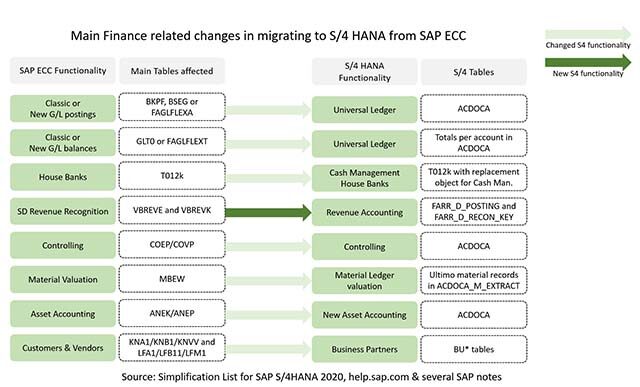
SAP S/4HANA Migration from SAP ECC – A Controls PerspectiveCompliance needs are in constant flux thanks to new laws and changing regulations. Private and sensitive data must be protected at all times as cyber attacks on critical systems increase. Control frameworks need to meet the evolving demands of the digital age. Whatever the driver for migrating from SAP ECC to SAP S/4HANA, audit and controls professionals know that migrating data must be done in a controlled way. However, the process can include challenges such as incorrect or incomplete migration of business partner data such as customer and vendors, conflicting G/L account figures, and instances where stock totals per materials do not match. Audit and controls professionals must also determine if there are sufficient controls to ensure correct and complete migration through the process and validate the results. Ad van Dijke and Hugo Rothengatter of KPMG Advisory | GRC Technology have faced these challenges with previous SAP S/4HANA migrations. Their article provides practical guidance for SAP audit and control professionals involved in risk and control activities before, during, and after SAP S/4HANA migration. This practical guide illustrates steps for executing the SAP S/4HANA roadmap from a data migration controls perspective. It focuses on migrating existing SAP ECC systems data to SAP S/4HANA.
Closing the Customer Experience Gap

Many organizations are creating a disjointed customer experience (CX) and need to find new ways to capture the exponentially growing amount of customer data, integrate their isolated systems, and achieve a single view of the customer. While companies commonly are talking about doing more with less and improving customer satisfaction, few seem to be allocating budget to reach this end. In this article, SAP experts share advice for how companies can respond to evolving customer needs and take steps to improve the customer experience. Topics include what customer experience means, how to allocate budget for improvements, and how to ensure the right software solutions are in place to keep up with customer expectations and not lose out on opportunities.


The Road to SAP S/4HANA from ECC6Sponsor: SAP SAP S/4HANA provides the opportunity for IT to lead digital transformation efforts. With SAP S/4HANA, IT can not only improve its own operations, but also deploy technology innovation to bring transformation and productivity gains to the business. Not sure how to get there? Join us to learn more about the path to SAP […]
Biopharmaceutical Startup AbbVie Receives Healthy Long-Term Prognosis
After being spun off in 2013, specialty biopharmaceutical maker AbbVie needed to unify technologies across more than 100 global sites. It rolled out SAP ERP and standardized global processes across these sites. Find out how the company developed a standard SAP global template that, after a few updates, allowed it to move swiftly and successfully through the rollout — and prepared it for future SAP HANA-based technology adoptions.
Case Study: How We Successfully Upgraded to SAP ERP Enhancement Package 7The United Nations (UN) Common System Compensation Package was revised following the UN General Assembly decision on December 2015. To achieve this, the International Civil Service Commission (ICSC), in cooperation with SAP, developed the Entitlement Validation Engine (EVE) to be implemented for all UN organizations, by the first of January 2017. On the SAP ERP […]

Related Vendors