



Mar 16-19, 2026Las Vegas, Nevada, NV
SAP Data Strategy
Featured Insiders
Upcoming Events
SAPinsider Las Vegas 2026
Related Vendors


What Is SAP Data Strategy?
Business and IT executives are convinced that data equates to value. Yet, to convert data into tangible business value, companies need a strong data strategy.
SAPInsider research on Data Management and Data Warehousing on Cloud found that 58% of respondents are completely or mostly satisfied with how their data strategy is meeting their organization’s data access, reporting, and intelligence requirements, while 33% are partially satisfied.
What Is SAP Data Strategy?
Business and IT executives are convinced that data equates to value. Yet, to convert data into tangible business value, companies need a strong data strategy.
SAPInsider research on Data Management and Data Warehousing on Cloud found that 58% of respondents are completely or mostly satisfied with how their data strategy is meeting their organization’s data access, reporting, and intelligence requirements, while 33% are partially satisfied.
A data strategy is a vision for how a company will collect, store, manage, share, and use data. Increasingly, enterprises recognize the importance of formulating an enterprise data strategy that spans across SAP and non-SAP data.
A good data strategy is driven by the business strategy. It translates the goals, risks, and requirements of the business into data models, processes, policies and technologies. Without a good data strategy, the organization is likely to have inefficient and poorly executed business processes, frequent data privacy and compliance issues, poor data analytics, customer dissatisfaction due to delays and errors, and significant costs due to manual operations.
Many specialist consultants can help companies with data strategy such as Pythian and cbs-Consulting.
Data Strategy Elements
There are four commonly acknowledged elements of data strategy that generate questions to consider:
- Goals and Objectives for Data: What are the goals for data? For example, goals may be to enable enterprise analytics and smooth business processes, provide data to business users efficiently, and reduce data storage costs. Companies also have short-term goals such as consolidating data stores in one location or cleaning up master data.
- Organizational Roles: What are the roles that manage or use the data? Data architects and engineers may build the data infrastructure, data scientists may use it for analytics, while business users may create, update, or use specific data based on their role.
- Data Architecture: Where will data be stored and how will it be accessed? A wide variety of storage is used both on-premise and on cloud. Increasingly, companies are consolidating data on the cloud in the form of data lakes, data hubs, or data warehouses with SAP HANA or other solutions. Vendors like Dell, NetApp, NTT Data, and TIBCO offer robust solutions to store and manage data.
- Data Management: How will data be governed, converted, transported, and archived? Data is considered a business asset; similar to a physical asset, companies develop ways to govern its use and manage it over its lifecycle. There is a proliferation of vendors offering services such as master data governance, including the Laidon Group.
In addition to the above, companies are now considering a short-term data strategy around how to migrate to SAP S/4HANA. This presentation, Data Readiness and Preparation for Your SAP S/4HANA Implementation, outlines how to develop a data foundation during and before the migration.
21 results
Enabling Data-Driven Enterprises with Data Lakes for SAPNov 19, 2021 — Today’s leading companies are leveraging the massive amounts of data generated by SAP systems, devices, and people to create new, re-imagined business processes. To turn data into a competitive advantage, companies must establish a modern data platform that can not only effectively integrate SAP and non-SAP data sources, but is also capable of supporting the […]
1 minute read
Building a Winning Culture For Data Analytics ExcellenceNov 11, 2021 — A Series on Data Excellence By Deepa Salem, Vice President and Research Director, SAPInsider “Culture eats strategy for breakfast” – a quote commonly attributed to Peter Drucker, the management expert. This fact rings true today in the realm of enterprise data analytics strategy. Without a data culture that catalyzes the strategy and brings it to life, any […]
4 minute read
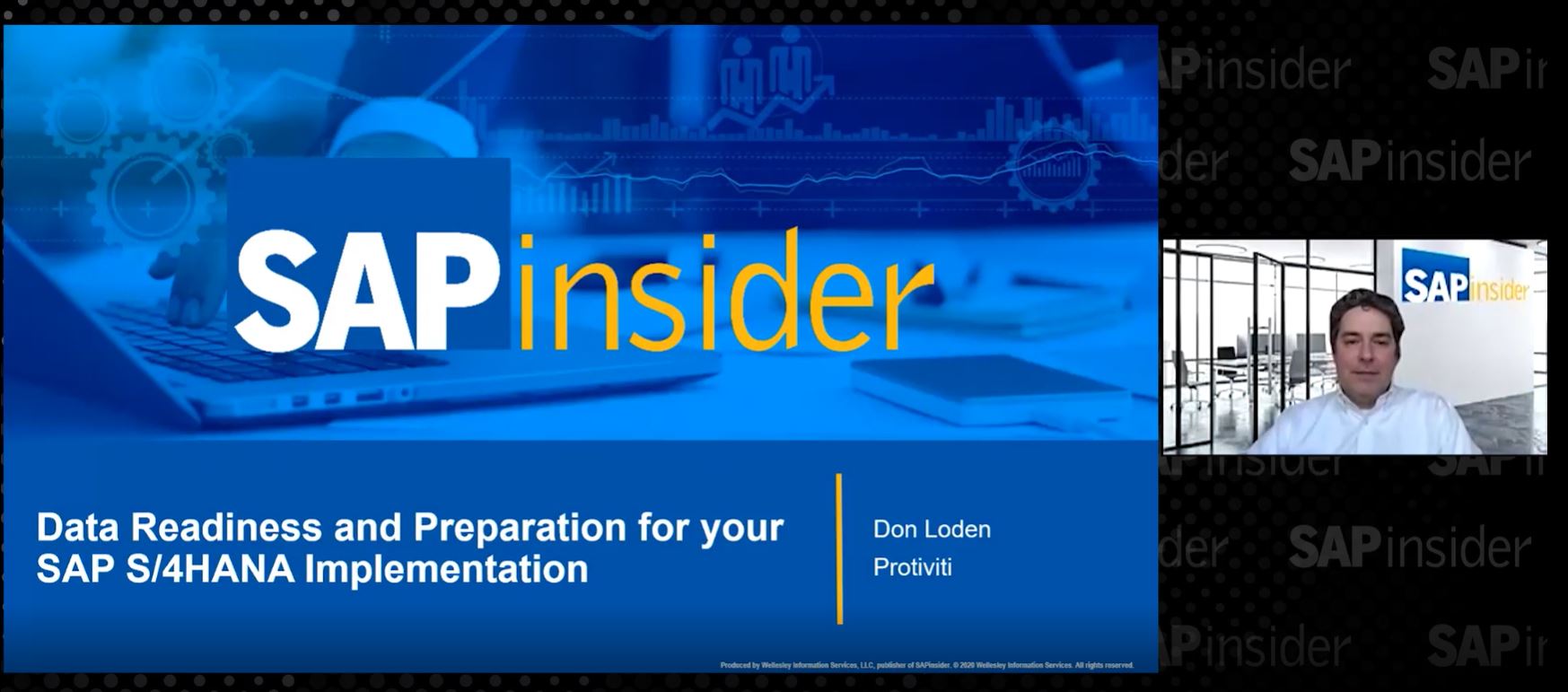
Data Readiness and Preparation for Your SAP S/4HANA ImplementationJan 19, 2021 — To develop a sound and scalable data foundation, it is critical to start with a clear understanding of your current data landscape. In this session, we will share the key activities that lead to a successful outcome. Attend this session to gain access to:
- Team dynamics from execution to ownership
- The building blocks for a data readiness assessment (DRA)
- Key decision factors for data management and conversion
1 minute read

What’s Your X-Data Strategy?Oct 30, 2019 — For many years, human resources (HR) applications have been largely focused on capturing transactional data across an employment life cycle. This data — often referred to as operational data, or O-data — is used to measure the effectiveness of HR business processes, track compliance, and demonstrate HR’s value to the organization. As valuable as O-data […]
4 minute read

Data Can’t Wait: Start Planning TodayOct 3, 2019 —
Since the inception of SAP S/4HANA, one of the main risks that often derails the implementation journey centers around preparing, cleansing, converting, and managing the data. This article presents leading practices that SAP customers can leverage during their SAP S/4HANA implementations to significantly reduce program risks associated with the data conversion process. The advice provided includes focusing on pre-planning activities well in advance of the initial data conversion, ensuring that data quality, management, and governance foundations are established early and that initiatives are continuously ongoing, and leveraging the data conversion phase to address other key requirements such as jumpstarting self-service analytics.
14 minute read

Navigate the Complexities of Big Data with SAP VoraDec 1, 2017 — In today’s world of distributed and near endless big data, IT faces a wealth of new challenges. Data scientists must find ways to work with multiple data sets pulled from a myriad of sources to derive conclusions and reach actionable business decisions. SAP Vora, an in-memory query engine that plugs into the Apache Spark execution […]
13 minute read
SAP Capture Solutions: The First Step in Digital TransformationDec 1, 2017 — Today, economic conditions are motivating corporations to embrace digital transformation to increase the speed, accuracy, and immediate visibility of their business processes. The digital journey strategy is based on advanced technology and process optimization. The first step in the digital journey is essential for transforming manual data capture to digital capture and ingestion in an […]
11 minute read
Are Your Data Uploading Processes Slowing You Down?Jan 25, 2017 —
As the need for more timely and accurate financial data continues to grow, many organizations are looking for ways to automate and streamline their data uploading practices. The learning curve for new technology can often be challenging, however, and can create resistance to change. This article shows how to automate data uploading in SAP landscapes with a tool that integrates with Microsoft Excel to provide an easy-to-navigate experience and a front end that users can readily recognize and adopt.
2 minute read
Merck Focuses on Data-Driven Platform StrategyDec 19, 2016 —
Merck & Co., one of the world’s largest healthcare companies, has seen its data explode since it first implemented SAP Business Warehouse (SAP BW) on a third-party database that started to struggle as Merck’s massive data volumes hit the 15TB mark. To enable deep analytics insights and real-time access to all its growing data, Merck needed to upgrade its SAP BW instance. Learn how the organization migrated to SAP BW powered by SAP HANA, leveraging in-memory technology and obtaining fast, accurate, and predictive analytics for its business.
7 minute read