



Mar 16-19, 2026Las Vegas, Nevada, NV
SAP ABAP
Featured Insiders
Upcoming Events
SAPinsider Las Vegas 2026
Related Vendors


What Is SAP ABAP?
The SAP ABAP programming language allows organizations to process large amounts of data within SAP business solutions. Having a working knowledge of SAP ABAP code enables customization within a system, offering greater control over essential business functions. It is supported on the SAP NetWeaver ABAP application server platform.
What Is SAP ABAP?
The SAP ABAP programming language allows organizations to process large amounts of data within SAP business solutions. Having a working knowledge of SAP ABAP code enables customization within a system, offering greater control over essential business functions. It is supported on the SAP NetWeaver ABAP application server platform.
Predictions about the death of ABAP (Advanced Business Application Programming), SAP’s four-decade old programming language, have continually failed. ABAP has evolved to stay relevant through the waves of change such as object-oriented programming, Java, Webdynpro, SAP HANA, SAP Fiori, and cloud applications. With large SAP customers continuing to use ABAP, a new generation of programmers continue to join the passionate, senior cohorts of ABAP programmers.
History and Evolution
ABAP is a fourth-generation programming language that was introduced by SAP in the 1980s. It was created for the development and customization of SAP software. For many decades, it was the only language that could be used to customize or develop SAP software components. ABAP is a multi-paradigm programming language, meaning programmers can utilize procedural, object-oriented, and other programming principles. Programs written with ABAP can run alongside those based on other languages such as Java, JavaScript, and SAPUI5. ABAP has continued to thrive even as SAP acquired non-ABAP solutions. SAP has released ABAP on the cloud, enabling the extensibility of SAP solutions to the cloud. Now, ABAP is used to develop applications for SAP Fiori, SAP S/4HANA, SAP Business Technology Platform, etc.
Should You learn SAP ABAP?
Developing technical skills in SAP ABAP allows you to modify virtually all SAP solutions and even create web applications. SAP provides its users with an ABAP Learning Journey via SAP Press in the form of books, blog posts, and videos. These tips and tricks can help you hone work processes in SAP ABAP to maximize the effectiveness of your SAP landscape.
All SAP solutions up through SAP S/4HANA can be modified with ABAP code. This means that mastering ABAP gives you the capability to develop and modify reports, interfaces, forms, data conversations, and much more. Learning SAP ABAP gives users the technical ability and skills to master their SAP environment. It is the technology that underpins SAP’s traditional Business Suite, the flagship solution SAP S/4HANA, and many others. In a competitive business environment, it is vital for organizations to have talent with fluency in SAP ABAP.
SAP says its ABAP programming language runs in over 100,000 customer systems, offering users enterprise-ready business applications that can help reduce costs as it is already integrated with SAP. With a reported 4.5 million registered ABAP developers, it is essential to have access to the innovation capabilities that SAP ABAP provides.
SAP ABAP combines SAP’s in-memory database SAP HANA with the digital user experience through SAP Fiori. This technology is consistently updated and extended to maximize its utility and functionality for added application development capabilities and new business scenarios.
How ABAP Works
As a multi-paradigm programming language, SAP ABAP allows programmers to use both procedural and object-oriented principles. This allows programmers to follow the programming model that works the best for them and for their project as well.
Each ABAP program operates within the ABAP Runtime environment, which processes statements and handles events and the flow logic of screens. Though it is SAP’s primary programming language, some applications that SAP acquired may not fully run on ABAP in SAP. However, these products will still come into contact with ABAP when they interface with a central ABAP-based system like an SAP ERP.
Since its release in the 1980s, SAP ABAP has consistently changed and evolved to best meet the needs of SAP users and organizations. To that end, SAP provides users with a set of tools and programs known as the ABAP Workbench. This development environment allows users to test, develop, and execute new programs within SAP, as well as edit existing ABAP programs, write report programs, function modules, and module pools.
This functionality helps programmers create a simple graphical user interface, handle the complete ABAP application development lifecycle, communicate between desktop applications, and access all programming objects. As it is feature-driven, the execution of apps will be affected by user actions and system events.
Before users can start working on their business processes and applications, the SAP database must first be filled. There are a handful of different methods to transfer data into the system. These methods should be weighed based on both the volume and the complexity of the data at hand that is set to be moved over. Data can also be transferred between SAP systems or from a non-SAP system to an SAP system that relies on the SAP ABAP language.
SAP ABAP also offers users different options for writing general programming, using the capabilities of the R/3 system. Users can either execute programs online or, if they would prefer, those programs can also be executed in the background. Users may opt for jobs that run in the background so they can be scheduled at different intervals.
Looking Ahead
SAP made a big move in releasing ABAP for the cloud to ease the migration and maintenance of existing applications to the cloud via the ABAP environment in the SAP Business Technology Platform. ABAP developers can now leverage their seasoned expertise on the cloud with only some training in the ABAP RESTful application programming model. They can do this despite some substantial differences between the new and old ABAP. The most popular use of ABAP for the cloud is adding custom functionality to SAP S/4HANA installation on the cloud. There are restrictions on this capability, with ABAP cloud applications only having limited access to data in the core SAP S/4HANA through a set of OData services.
Clients can be opportunistic in their application development and integration strategy with ABAP, along with other options such as Java, Python, node.js, HTML5, etc., based on their software portfolio, developers’ skillsets, and specific use cases. In addition, SAP customers with complicated customizations are now aiming for a clean core. Modern approaches allow for decoupling customizations from the core business systems with cloud extensions. Clients also aim for clear separations between SAP and third-party extensions.
In summary, ABAP can continue to play a major role in the application strategy. However, organizations must invest in upskilling and select the programming model that suits them best. They must also aim for a clean core to deliver nimble and rapid applications that impact the business.
Join SAPinsider Today
Join SAPinsider to access opportunities for networking and engagement in the dynamic SAP ecosystem. As a member, you will have access to a wealth of valuable resources and content tailored to SAP technologies and best practices like the latest research reports, articles, webinars, and events that will keep you informed and ahead of the curve.
Join SAPinsider to access opportunities for networking and engagement in the dynamic SAP ecosystem. As a member, you will have access to a wealth of valuable resources and content tailored to SAP technologies and best practices like the latest research reports, articles, webinars, and events that will keep you informed and ahead of the curve.
SAPinsider membership grants you exclusive access to in-depth analyses, expert insights, and practical guidance that will empower you to navigate the ever-evolving SAP landscape with ease. SAPinsider membership will enable you to remain one step ahead and harness the latest trends, innovations, and strategies to drive your own powerful digital transformations, optimize your SAP investments, and unlock business success.
41 results

SAP Authorization VulnerabilityMay 8, 2023 — While it’s challenging for organizations to keep up with the publication of SAP security notes for the extensive product portfolios, ABAP development teams do check for these types of vulnerabilities using analyzer tools on the market that offer essential functions for this purpose, which are constantly available throughout the development process.
1 minute read

Consuming APIs in ABAP and Solving SSL IssuesOct 6, 2022 — In this article, you will find a step-by-step guide to implement and troubleshoot a basic API consumption with SSL connection.
How often do you get the order to consume a WS, establish an SSL connection and troubleshoot any possible incident? The simple task of consuming an API usually requires several technical teams to give support: programmers, basis, networking and security. It is usually not easy to align the planets with all the teams and give a solution or answer to quickly start testing the interface.
There are five steps in this process: To define the connection in SM59, we must define the URL that we want to reach according to the definition obtained in the API documentation. In case the endpoint changes, the only thing we need to do is to update our connection, defined in transaction SM59.
4 minute read

Research Findings on ABAP: To Rewrite, Replace or RetireMar 30, 2022 — SAPInsider research studies the trends in ABAP strategy as more companies move to SAP S/4HANA and Cloud. It presents findings on the factors that drive ABAP strategy, whether companies are retiring, rewriting or replacing it with standard functionality, and the challenges such as skills and risks.
1 minute read

Key Considerations for SAP S/4HANA Cloud ABAP EnvironmentOct 28, 2021 — The SAP S/4HANA Cloud ABAP environment provides ABAP developers with full ABAP development tool access to released SAP S/4HANA Cloud business objects and extension points. These interfaces are guaranteed to be stable, removing adaptation efforts after a version change. ABAP developers can directly connect and carry out on-stack development tasks similarly as in the on-premise world. After successful introduction in SAP S/4HANA Cloud, this approach will also be introduced as an extension option in SAP S/4HANA on-premise so that customer and partner code can be designed in a deployment-neutral fashion (both cloud and on-premise).
Read this article and learn:
- How to enhance developer extensibility with SAP S/4HANA Cloud ABAP environment.
- How to connect tools to SAP S/4HANA where customers and partners can directly connect to SAP S/4HANA Cloud with their ABAP Development Tools for Eclipse;
- How SAP enables the ABAP RESTful application programming model for SAP S/4HANA Cloud.
7 minute read
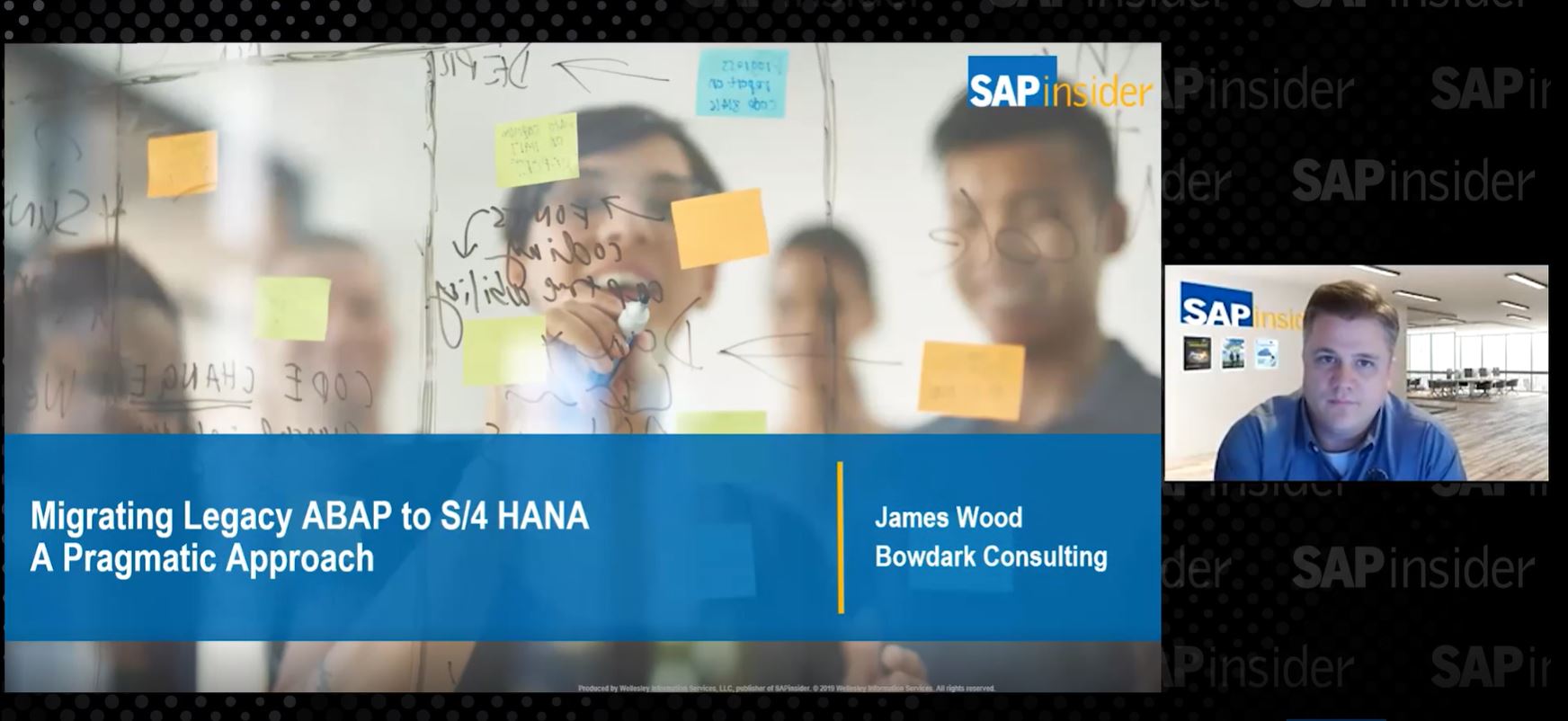
Migrating Legacy ABAP to SAP S/4HANA: A pragmatic approachJan 19, 2021 — For customers that have invested heavily with custom ABAP over the years, the idea of trying to migrate to SAP S/4HANA can feel overwhelming. But with careful planning, hope is not lost. In this session, we’ll explore some pragmatic and methodical approaches to SAP S/4HANA migration that allows you to take stock of where you are and carefully migrate content at a pace you can feel comfortable with. By attending, you will:
- Learn more about the specific technical challenges related to an SAP S/4HANA migration
- Discover tools that are available to help you catalog your custom development inventory and assess migration scope
- Gather tips on how to transition the skill sets of your development team and prepare for life in the SAP S/4HANA world
1 minute read

Developer Guide: Understanding the ABAP RESTful (RAP) Programming ModelMar 2, 2020 — To help ABAP developers meet the business needs of their organizations and make coding more efficient, SAP provides programming models. These models have changed over the years as requirements and technologies have changed, and now, with the user experience taking center stage in a constantly evolving business landscape, a flexible and efficient development model that optimally supports SAP Fiori, SAP HANA, and sophisticated technologies has become a pressing need. To meet this need, SAP now offers the ABAP RESTful programming (RAP) model. Included with SAP Cloud Platform ABAP environment, the RAP model provides an intrinsic approach to building SAP Fiori applications in ABAP that are optimized for SAP HANA and run both in the cloud and on premise.
This article introduces ABAP developers to the basic principles and philosophies of the RAP model so they can hit the ground running and quickly start taking advantage of its benefits. You will learn:
• How and why the ABAP programming model has evolved over the years
• The components of the RAP model and how the model works
• What development using the RAP model looks like through a step-by-step example scenario
17 minute read

New Features for SAP Cloud Platform ABAP EnvironmentAug 13, 2019 — by Karl Kessler, Vice President of Product Management ABAP Platform, SAP SE SAP Cloud Platform ABAP environment was released in September 2018 as a platform-as-a-service offering for the ABAP developer community. It enables developers to build cloud applications with an SAP Fiori user interface optimized for SAP HANA, with a primary purpose of […]
16 minute read

Migrating Custom ABAP Code to SAP S/4HANAAug 12, 2019 —
Ever since SAP first introduced SAP S/4HANA back in early 2015, there’s been a lot of confusion in the SAP community about what SAP S/4HANA really is and how it will affect the SAP development landscape going forward. With so much misinformation out there, these mysteries can be hard to unravel — especially for customers that have significant investments in customized solutions within their legacy SAP systems. Learn from an SAP expert what you need to know about migrating custom ABAP code to SAP S/4HANA.
18 minute read

Introducing ABAP Platform 1809Apr 15, 2019 —
While the cloud has been receiving the lion’s share of attention, a significant number of on-premise ABAP-based systems are running productively in SAP customer landscapes. To support these customers, SAP has released ABAP platform 1809, which serves as the technical foundation for SAP S/4HANA 1809. ABAP platform 1809 delivers a wide range of valuable improvements to various ABAP development tools to increase efficiency. It includes an ABAP programming layer that is fully optimized for SAP HANA and for the development and enhancement of modern applications. This article examines some of the key innovations delivered with ABAP platform 1809 and how they help you develop sophisticated applications that meet your digital business needs.
18 minute read

ABAP Platform 1809 Optimizations for SAP HANA and SAP S/4HANAApr 2, 2019 — by Karl Kessler, Vice President of Product Management ABAP Platform, SAP SE ABAP platform 1809, the latest release of the on-premise ABAP platform — is a thorough foundation for SAP S/4HANA and SAP S/4HANA Cloud. In addition to delivering improvements to the Eclipse-based ABAP development tools that enable the efficient development and enhancement of business […]
5 minute read