3 minute read

Key Takeaways
What you need to know
As AI transforms enterprise applications, organizations face a rapidly expanding access surface area, posing a critical risk due to a lack of visibility into identities and permissions. Comprehensive inventory management is essential to mitigate these risks and enhance security.
Cross-application Segregation of Duties (SoD) is a significant blind spot in risk management. Overlapping permissions across systems like SAP and Oracle can lead to fraud, particularly within critical financial processes, necessitating a holistic view of entitlements across platforms.
Access certifications must evolve from mere documentation to active risk management techniques. Organizations risk exposing themselves to dormant vulnerabilities by certifying access without full context or visibility, especially during crucial SAP migrations.
As enterprise application landscapes become more fragmented and increasingly automated identity and access governance (IAG) has shifted from a compliance exercise to a critical business risk discipline. In a recent SAPinsider Live podcast, I spoke with Manoj Makhija, Director of Professional Services at Pathlock, about why organizations continue to underestimate identity risk and what must change as AI accelerates access, automation, and exposure.
The Most Underestimated Risk: The Expanding Access Surface Area
Makhija emphasized that many organizations still lack a complete inventory of applications, identities, and entitlements across their ecosystem, a problem that has persisted for years and is now compounding with AI-enabled agents. Without a full system of record, enterprises cannot effectively manage risk because they don’t know what or who they’re securing.
One of the most consistent challenges Makhija sees across enterprises is the lack of a complete view into applications, identities, and access rights. Despite years of digital transformation, many organizations still don’t have a reliable system of record for access.
Explore related questions
Ask SAPi
“Do I have a full system of record? Do I actually know what identities and access I’m controlling risk on?”
— Manoj Makhija, Pathlock
As AI agents are introduced, each with credentials and privileges, the access surface area expands rapidly. This gap becomes even more dangerous as organizations adopt AI and agent-based automation. Each Makhija points out that “with AI and agentic AI in the mix, this problem isn’t going away. It’s only going to increase.” According to Makhija, this is not a future-state concern, it is happening now, at scale, and at machine speed.
Cross-Application SoD: Where the Real Risk Lives
Another major blind spot is cross-application segregation of duties (SoD). While individual systems may appear compliant, risk often emerges when entitlements are combined across SAP, Oracle, and third-party SaaS platforms. Makhija noted that traditional tools still ask, “Who has access to what?” when the more dangerous question is, “What can someone actually do across the full landscape?”.
This is especially critical for finance processes such as vendor creation, invoice submission, and payment approval—where cross-system visibility is essential to prevent fraud.
Without cross-application SoD rule sets, organizations miss the compound risk created by overlapping permissions, particularly in critical finance and procure-to-pay processes.
Certifications Without Context Create Dormant Risk
Makhija also challenged the way organizations approach access certifications. Too often, certifications are treated as documentation exercises rather than active risk management. Manual reviews, stale spreadsheets, and lack of usage data result in organizations certifying access they don’t understand, in systems they can’t fully see.
“We are certifying access we don’t understand in systems we can’t see across for a reality that stopped being accurate the moment the last reorg happened.”
— Manoj Makhija, Pathlock
Unused administrative roles and dormant entitlements introduce silent exposure, risk that remains invisible until it’s exploited.
SAP Transformations: A Once-in-a-Decade Opportunity
With many organizations migrating from ECC to S/4HANA, Makhija stressed that SAP transformations represent a rare chance to eliminate years of accumulated access model debt. Sharing, “migration is your one clean window to retire 10-plus years of access model debt. Don’t defer it.”
Equally important, organizations must apply continuous controls monitoring (CCM) before cutover, not after, especially when ECC and S/4HANA run in parallel. He shares why before cutover is so critical, “Auditors don’t give you a grace period because you’re doing a migration. GRC has to be a go-live requirement.”
Identity Governance in an AI-First World
Looking ahead, Makhija challenged the assumption that AI-driven risk is a long-term concern. In reality, AI agents are already drafting contracts, triggering workflows, and approving transactions.
“The IGA playbook was built for humans at human speed. Agents operate at machine speed across multiple systems simultaneously. The old playbook doesn’t apply.”
— Manoj Makhija, Pathlock
As AI agents begin to outnumber human users, governance models must evolve bridging IGA and GRC to enable preventative, data-driven controls.
Listen to the full SAPinsider Live podcast featuring Manoj Makhija:
More Resources
See All Related Content
CACI Grows Its Federal Portfolio While Building a Compliance-Ready Path to SAP CloudCACI is expanding its federal portfolio with new contracts and showcasing significant gains in ERP modernization for the U.S. Marine Corps. Their affiliate, SAP NS2, provides a CMMC Level 2 certified path for secure SAP cloud adoption by federal agencies.

C2B Consulting Frames Its SAP Practice Around Full Portfolio CoverageC2B Consulting, established in 2004, frames its SAP practice around full portfolio coverage. The firm offers solutions spanning core ERP, HR, customer experience, supply chain, and analytics, providing comprehensive support for diverse enterprise needs and simplifying vendor selection.
2 minute read
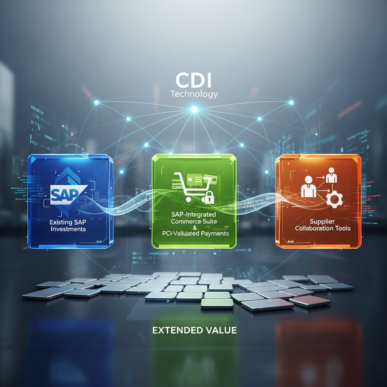
CDI Technology Positions SAP-Integrated Commerce Suite as an Alternative to New Core SystemsCDI Technology provides e-commerce, payment processing, and point-of-sale solutions with real-time SAP integration. Their offerings aim to enhance existing SAP investments and turn complex product configurations and payment needs into a competitive advantage.
3 minute read

CIB-Computer Moves Clinical Inventory Tracking From On-Premise to SAP Business One CloudCIB-Computer has successfully moved its CCS M2 clinical inventory tracking solution to SAP Business One Cloud, providing a new model for healthcare organizations. This migration enhances traceability and automation for medical and blood products through advanced technologies.
3 minute read