

2 minute read

Meet the Authors
Key Takeaways
What you need to know
SAP warehouse AI pilots stall because most execution tools see only SAP's roughly 2,000 standard objects, missing the custom batch rules, Z-objects, and bin strategies that govern real warehouse operations.
With SAP WM mainstream maintenance ended in December 2025 and nearly 60% of SAP migrations running late or over budget, warehouse execution gains cannot wait for a completed SAP S/4HANA transition.
Neptune Software's Stock Smarter whitepaper cites results including 80% faster inventory counts at the Norwegian Armed Forces and $1.12 million in annual savings at Johnson & Johnson from closing the execution gap.
SAP warehouse AI will not scale if it only sees the standard version of SAP. Inventory inaccuracies, delayed cycle counts, paper workarounds, and stalled AI pilots point to a gap between SAP as the system of record and what warehouse workers can execute on the floor.
For SAP warehouse teams, that distinction matters now. For example: SAP Warehouse Management (WM) mainstream maintenance ended in December 2025; between 40 and 60% of SAP’s ECC customer base has not yet migrated; and nearly 60% of SAP migrations run late or over budget. SAPinsider’s ERP Migration and Transformation 2026 Benchmark Report also confirms the squeeze. It shows that 55% of organizations report deploying SAP S/4HANA or SAP S/4HANA Cloud, yet only 34% have fully completed the transition. As migration work absorbs budget and attention, warehouse floors keep relying on paper counts, shared terminals, delayed postings, and low-adoption transactions.
The Warehouse Runs Two Operating Systems
Neptune Software’s Stock Smarter whitepaper describes every SAP warehouse as effectively running two operating systems:
Explore related questions
Ask SAPi
- SAP: The system of record for bin assignments, batch rules, movement history, and inventory status.
- The Execution Layer: This includes worker behavior, paper processes, improvised tools, shared devices, and delayed postings that get a shift completed.
That second operating system is where inventory accuracy erodes. The whitepaper quantifies the cost. At 85% inventory accuracy, roughly one in seven stock decisions is made on data that does not reflect physical reality. The gap between top and median inventory accuracy is nearly ten percentage points, and inventory distortion, including overstocking and stockouts, is cited as a $1.7 trillion global problem.
The argument is not that SAP lacks data. It is that the data often fails to reach the worker in the right form as the work happens. SAP transaction codes are precise but unintuitive for frontline users under time pressure. When the SAP path is too slow, the floor creates a faster path through institutional knowledge.
Why AI Pilots Stall Before Reaching the Floor
The same execution gap helps explain why warehouse AI pilots struggle to move beyond experimentation. The whitepaper cites McKinsey research showing 88% of organizations now use AI in at least one business function. Yet, ASUG data from February 2026 finds only 10% of SAP customers have reached enterprise-scale AI deployment. The ambition is clear: SAPinsider’s 2026 research finds 43% of organizations now cite SAP’s AI announcements as the primary external factor shaping their ERP strategy, ahead of the 2027 maintenance deadline at 39%.
However, the whitepaper states that most externally built execution tools can access SAP’s standard library of roughly 2,000 objects. Still, they cannot see custom tables, Z-objects, bespoke batch rules, non-standard bin strategies, or customer-specific putaway logic. That matters because those customizations govern many SAP warehouses. Thus, an AI agent that cannot see plant-specific batch rules or custom safety stock logic is not running the warehouse but a generic version of it. Therefore, workers and supervisors are unlikely to trust recommendations that conflict with the rules that govern the floor.
The Inside-SAP Approach and Its Trade-Off
Neptune Software positions Neptune DXP as an SAP-native platform for business applications and AI agents that runs inside ECC and SAP S/4HANA and exposes the full SAP data model, including customizations. Neptune DXP executes the actual logged-in user rather than a generic service account, preserving visibility into SAP authorizations and letting execution apps and AI agents work against the warehouse as it operates.
That design also raises familiar governance questions. If an agent can take governed read and write action across ECC and SAP S/4HANA, reviewers will ask what the agent may post, under whose authority, and how those actions appear in audit and segregation-of-duties controls. Neptune cites Clean Core Level A + C certification and ISO 42001 certification for AI governance, though enterprise control teams would still validate how that model maps to their own requirements.
Execution Ahead of Autonomy
One theme running through the whitepaper is that warehouse execution improvement is separable from the SAP S/4HANA migration calendar. An execution layer working on ECC will work on SAP S/4HANA after migration and does not need to be rebuilt. The starting points it describes are unglamorous and measurable: mobile cycle counting, goods receipt, eliminating reconciliation steps, and replacing high-volume transactions with role-specific mobile apps.
The whitepaper’s customer results suggest the pattern holds at scale. It cites the Norwegian Armed Forces, which achieved 80% faster inventory counts, cutting count transactions from eleven to three in a classified, zero-error-tolerance environment. Rust-Oleum deployed more than 40 mobile SAP apps in four months on ECC and reached fully paperless operations by day three of go-live, with no S/4HANA migration required first. Johnson & Johnson cites $1.12 million in annual savings and a 40% reduction in supply chain process time, with more than 2,000 scans per day across 16 sites.
From there, AI-assisted replenishment or anomaly-triggered recounts can be built against full SAP context rather than a simplified subset. The case Neptune makes is less about adding another warehouse tool than about giving the execution layer access to the custom logic the floor already follows.
What This Means for SAPinsiders
Scope warehouse AI around visibility into custom logic, not just standard processes. Enterprise architects evaluating execution tooling should verify it can see custom batch, bin, and Z-object logic before committing to a rollout, and confirm how logged-in-user execution maps to existing segregation-of-duties and audit controls.
Decouple warehouse execution gains from the SAP S/4HANA migration calendar. CIOs do not need to wait for a completed migration to improve warehouse execution. Because improvements built on ECC carry forward to SAP S/4HANA without repeating the work, warehouse AI can run as a parallel value stream rather than a post-migration project.
Bring clean-core execution into pre-migration architecture conversations. SI and GSI leaders should expect clean-core-compliant, in-SAP execution to surface earlier in client discussions, particularly where governance questions around ISO 42001 and agent authorization scope arise. Advisors who can answer those questions during architecture planning will be better positioned to shape the migration roadmap.
More Resources
See All Related Content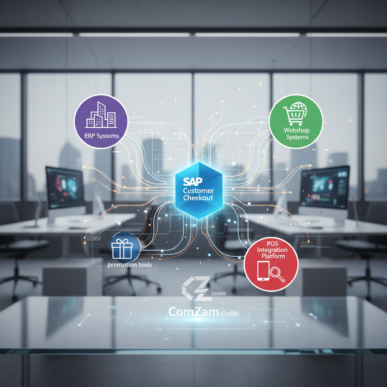
ComZam GmbH Builds Integration Layer to Connect SAP Customer Checkout with ERP and Webshop SystemsComZam GmbH offers an integration platform connecting point-of-sale systems with ERP and webshop platforms. This solution helps retailers running SAP Customer Checkout unify operations, manage inventory, and handle promotions, leveraging over 12 years of specialized SAP expertise.

Logres Evolves From Unit4 Roots Into an SAP Business One Premier PartnerLogres BV, a Dutch SAP Business One Premier Partner, successfully navigated a founder-to-successor leadership transition. This ensured continuity in their SAP practice, offering robust integration and flexible deployment options for wholesalers and process manufacturers seeking scalable ERP solutions.
3 minute read

What you should know about logistics with agentic AIWhat you should know about logistics with agentic AI examines how agentic AI is transforming logistics operations by connecting real-time insights to autonomous decision-making and execution across transportation, warehousing, inventory management, and carrier collaboration. The guide outlines the AI maturity journey, practical logistics use cases, and key criteria for evaluating AI-enhanced logistics solutions that improve efficiency, resilience, and operational performance.
2 minute read

What you should know about planning with agentic AIWhat you should know about planning with agentic AI explores how agentic AI is reshaping supply chain planning by connecting insight to action through continuous monitoring, scenario evaluation, and coordinated decision-making across the enterprise. The guide outlines the evolution from traditional and generative AI to agentic AI, and provides a framework for evaluating planning solutions that improve responsiveness, efficiency, and business outcomes.
1 minute read