

2 minute read
Meet the Authors
Key Takeaways
What you need to know
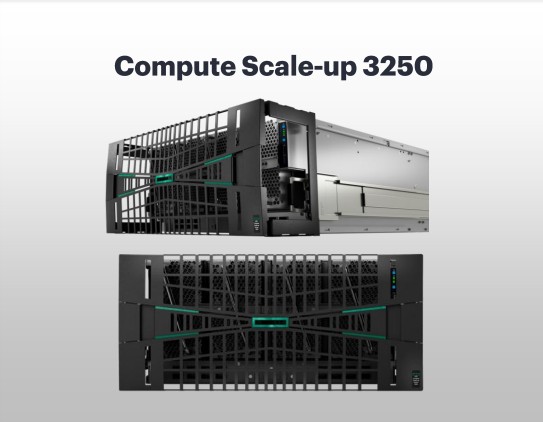
HPE launched the Compute Scale-up Server 3250 to support SAP HANA workloads with a unified, scale-up architecture designed to reduce system complexity.
The server enables organizations to run transactional and analytical workloads on a single system without relying on distributed infrastructure.
Designed for SAP S/4HANA environments, the platform supports high memory capacity, real-time processing, and fault-tolerant operations.
Hewlett Packard Enterprise (HPE) has introduced the HPE Compute Scale-up Server 3250, a server designed for large in-memory databases and complex business workloads. Powered by sixth-generation Intel Xeon Scalable processors, the system is intended to provide the scalability and resilience required for mission-critical transactional and analytics environments.
The scale-up server aims to provide the ability to execute faster transactions and gain real-time insights without disrupting standard operations. The HPE Compute Scale-up Server 3250 can help organizations run large SAP HANA workloads on a single system while reducing the complexity and latency associated with scale-out architectures, HPE said.
According to HPE, the platform is most suited for industries such as finance, healthcare, telecommunications, and government, which use in-memory databases and AI/ML workloads.
Explore related questions
Ask SAPi
Addressing the Challenges of Scale and Complexity in SAP HANA Environments
As organizations pursue SAP S/4HANA transformations and data-first modernization, legacy infrastructure often creates constraints in scalability and performance. Modern SAP HANA workloads demand the elimination of data silos to support real-time data mobility across hybrid environments.
Traditional scale-out architectures, which utilize clusters of many small servers, often introduce network latency and management overhead due to multiple “hops” between nodes. This complexity can slow down critical ERP and CRM applications, particularly when enterprises attempt to run analytical tasks, such as fraud detection, simultaneously with operational tasks like predictive maintenance.
The HPE Compute Scale-up Server 3250 raises the bar for business-critical infrastructure, as enterprises are under pressure to scale performance and capacity without disrupting operations or compromising security. The system is designed for complex applications such as ERP and customer systems, enabling faster transactions, real-time insights, and continuous operations.
These specifications and SAP benchmark validation indicate the system is designed to support both high-volume transactional processing and advanced analytics within a single system.
Why SAP Environments Struggle With Scale and Complexity
Unlike scale-out models, this design uses a single system with shared memory and processors, which is intended to reduce management overhead and eliminate inter-node communication penalties.
As data volumes grow and SAP environments demand real-time processing, these limitations can impact performance and make systems harder to manage.
The HPE Compute Scale-up Server 3250 addresses these challenges through a shared-memory, scale-up architecture that enables all processors to access a unified memory pool within a single system. Key architectural characteristics include:
- Unified shared-memory design, enabling all CPUs to access the same data without network delays
- High-speed interconnects, designed to enable rapid data movement compared to traditional Ethernet-based systems
- Single-system architecture, reducing the need for clustered environments and simplifying system management
- Modular scale-up capability, supporting expansion from 4 to 16 sockets as workload demands grow
How Scale-Up Architecture Simplifies SAP Infrastructure
The HPE Compute Scale-up Server 3250 introduces a newer generation of Intel Xeon Scalable processors compared to earlier models, along with increased memory capacity of up to 64 TB, representing higher memory density for large in-memory SAP workloads.
To ensure the system is always available, it is the only one in its class to earn the highest industry rating for reliability (AL4 per IDC). The server is designed to automatically find and fix internal technical errors before they cause a shutdown, which helps prevent system crashes and reduces the chance of manual mistakes during maintenance.
These capabilities are designed to support SAP S/4HANA systems that require consistent uptime, fault tolerance, and stable performance, enabling organizations to run core business processes without disruption even as workloads scale.
What This Means for SAPinsiders
Converging transactions and analytics on one platform. Enterprises are moving toward architectures that eliminate separation between operational and analytical workloads. This approach supports real-time processing in SAP environments without introducing system fragmentation or performance trade-offs.
Shifting from distributed complexity to unified infrastructure. Large SAP landscapes often struggle with the operational overhead of clustered systems. A scale-up model can simplify management, reduce coordination across nodes, and support more consistent system performance at scale.
Reinforcing uptime as a non-negotiable requirement. For organizations running SAP S/4HANA, infrastructure must support continuous operations with minimal disruption. High availability and fault-tolerant design are increasingly critical as core business processes become fully dependent on real-time systems.
Explore the platform’s full capabilities online at HPE.com
More Resources
See All Related Content



SAP Modernization TrapSAP leaders are facing transformation paralysis amid overlapping decisions about cloud ERP, RISE with SAP, BTP, and AI, and the article argues that successful enterprises reduce risk by treating modernization as a staged journey that delivers value incrementally rather than as one big leap.
1 minute read