3 minute read
Meet the Authors
Key Takeaways
What you need to know
Start with the execution gap, not the AI model: the highest-value use cases sit where workers already rely on spreadsheets and workarounds in warehouses, field service, planning, and order processing.
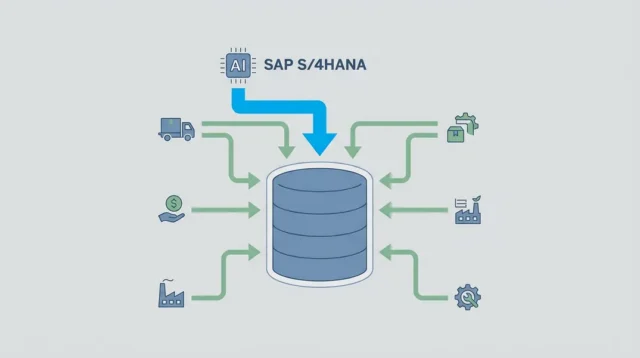
Keep agents native to SAP: reusing SAP data, logic, and the existing security model avoids synchronized copies and middleware and keeps agent actions auditable.
Measure in cycle time and effort: Yazaki Brazil moved from two person-days per planning cycle to a 1.8-second automated run across 4,417 items.
Everyone in the SAP ecosystem is talking about the autonomous enterprise. Far fewer can explain how to get there from a real landscape, whether that is SAP ECC, SAP S/4HANA, or a mix of both, with stretched IT teams and delivery cycles measured in months while business requirements change in weeks. In a September 17, 2026, SAPinsider webinar, Stefan Captijn, Product Marketing Director, and Dan Wiseman, Principal Solutions Consultant at Neptune Software, argued that the real barrier to autonomy is not SAP itself but the distance between SAP systems and how work gets done.
The Execution Gap
Captijn framed the problem as a mismatch between how applications and systems are designed and how the people doing the work really operate. He pointed to three root causes:
- Rigid, system-centric application design
- Fragmented and disconnected landscapes, including workers in the belly of a ship or on top of a wind turbine with no connectivity
- Change cycles too slow for IT to keep pace with business demand
These symptoms are familiar to any SAP shop. Workers navigate multiple systems and screens, then fall back on Excel sheets, shadow systems, and paper. The consequences are operational delays, higher manual effort, weaker adoption, and a direct hit to workforce productivity. Migration and integration complexity, he added, can destroy the ROI that justified the systems in the first place. Neptune sees the gap surface most often in warehouse picking, field service, maintenance and asset management, supply chain planning, sales order processing, and invoice processing.
Explore related questions
Ask SAPi
Why AI Stalls in the Enterprise
Captijn connected the gap to reframing ERP as enterprise resource execution and SAP’s own autonomous enterprise vision.SAP Insider’s own research shows how far most organizations still are from that destination. In the June 2026 Spotlight Series report, Orchestrating AI-Driven Process Transformation in SAP-Centric Enterprises, 74% of SAP customers said their AI-enabled SAP use cases remain in the identification, experimentation, or no-plans phase, and 43% are not yet using AI in SAP-related processes at all. Obstacles center on trust and execution: 63% cite the accuracy and reliability of AI outputs in critical processes as their top concern, 59% flag data leakage through AI services, and 49% name role-based access control aligned with SAP authorizations as the single most important security control for AI operating on SAP data. Tellingly, 39% already view low-code and no-code platforms as core or important to turning AI output into governed business applications. The stalled use cases share a common trait. AI produces an output, and there is no safe, native path to turn that output into something the business can run inside SAP. Neptune’s view is that the foreseeable future looks like the middle stages of that journey: people, applications, and AI agents working together with a human in the loop for final decisions. InCaptijn’ss view, getting there depends on staying native to SAP. “Running inside SAP data, logic, security model, no synchronized copies, no middleware layer to maintain is critically important to the success of implementing AI. The minute you have what I call a Frankenstein architecture, it becomes difficult to implement AI properly,” Captijn said.
Proof in Production: Yazaki Brazil
Captijn grounded the demo with a live customer example. Yazaki Brazil, which produces cable systems for major automotive brands, was planning stock for roughly 1,000 materials across multiple plants by pasting eight SAP reports into spreadsheets. Each fortnightly cycle consumed two person-days, and data could be up to 15 days old by the time decisions were made.
Neptune helped build an AI-powered material dashboard that pulls stock, in-transit items, purchase orders, consumption, and bill of material usage into a single view, reusing standard SAP logic for a five-level BOM implosion and full MRP context with no duplicated data model. The first app was delivered in about four weeks and 337 consulting hours, roughly 60% less effort than traditional platforms.
Moreover, in a live pilot across two plants, the engine evaluated 4,417 items and performed 603 AI root cause analyses in 1.8 seconds, and a weekly report now publishes unattended. Captijn noted that Yazaki plans to extend the solution to seven more plants and add an agent that recommends inventory transfers.
Neptune will launch Neptune DXP 25, with expanded AI and platform capabilities, on October 1.
See the Stock Smarter demo and the full Yazaki Brazil case in detail. Watch the on-demand webinar: How to Build Business Applications and AI Agents for SAP, Wherever You Are on Your SAP Journey.
What This Means for SAPinsiders
Start with the execution gap, not the AI model. The highest-value use cases sit where workers already rely on spreadsheets and workarounds: warehouses, field service, planning, and order processing.
Keep agents native to SAP. Reusing SAP data, logic, and the existing security model avoids synchronized copies and middleware and keeps agent actions auditable.
Measure in cycle time and effort. Yazaki’ss shift from two person-days per cycle to a 1.8-second automated run shows the kind of metric that makes an AI business case credible.
More Resources
See All Related Content
Rethinking SAP Modernization: The Shift from AI Later to AI NowThe article discusses the urgent shift in SAP transformation strategies from a sequential modernize-migrate-innovate approach to an 'AI First, AI Now' paradigm that prioritizes immediate AI-driven value creation amidst complex legacy systems.

SAP Says Supply Chain AI Should Start With the DecisionAt SAP Connect 2026, SAP's new supply chain product chief urged teams to define the business decision and its metric before choosing an AI use case. Bosch, Döhler, and Microsoft described how they apply that approach to supply chain agents.
4 minute read