Featured Content
Topics

Explore critical topics shaping today’s SAP landscape—from digital transformation and cloud migration to cybersecurity and business intelligence. Each topic is curated to provide in-depth insights, best practices, and the latest trends that help SAP professionals lead with confidence.

Regions

Discover how SAP strategies and implementations vary across global markets. Our regional content brings localized insights, regulations, and case studies to help you navigate the unique demands of your geography.

Industries

Get industry-specific insights into how SAP is transforming sectors like manufacturing, retail, energy, and healthcare. From supply chain optimization to real-time analytics, discover what’s working in your vertical.

Hot Topics

Dive into the most talked-about themes shaping the SAP ecosystem right now. From cross-industry innovations to region-spanning initiatives, explore curated collections that spotlight what’s trending and driving transformation across the SAP community.

Featured Content
Topics

Explore critical topics shaping today’s SAP landscape—from digital transformation and cloud migration to cybersecurity and business intelligence. Each topic is curated to provide in-depth insights, best practices, and the latest trends that help SAP professionals lead with confidence.

Regions

Discover how SAP strategies and implementations vary across global markets. Our regional content brings localized insights, regulations, and case studies to help you navigate the unique demands of your geography.

Hot Topics

Dive into the most talked-about themes shaping the SAP ecosystem right now. From cross-industry innovations to region-spanning initiatives, explore curated collections that spotlight what’s trending and driving transformation across the SAP community.

Financial Services

Financial Services is a crucial industry for SAP. Financial services companies face many growing challenges, including ever-changing regulations, evolving consumer expectations, economic instability, and increased competition brought on from digital-only organizations. These drivers make it imperative to transform and become more efficient, better engaged, and resilient.

SAP and Partner Solutions for Financial Services (H2)

There are many solutions in the SAP ecosystem that are relevant to the Financial Services sector:

Financial Services is a crucial industry for SAP. Financial services companies face many growing challenges, including ever-changing regulations, evolving consumer expectations, economic instability, and increased competition brought on from digital-only organizations. These drivers make it imperative to transform and become more efficient, better engaged, and resilient.

SAP and Partner Solutions for Financial Services (H2)

There are many solutions in the SAP ecosystem that are relevant to the Financial Services sector:

  • Digital Customer Engagement is about modernizing the way companies reach consumers, which can include omnichannel commerce, customer experience management, digital banking, customer analytics, and marketing offerings.
  • Finance and Risk solutions help companies stay compliant and avoid risk by touching on Governance, Risk, and Compliance (GRC) functionality, financial planning and analysis, data services, reporting, and accounting for financial instruments.
  • Banking Operations tools aim to help those in the banking industry with key functions including card management, retail services, payments, cash and liquidity management, and commercial lending.
  • Total Spend Management is about helping companies get a centralized view of spend by combining multiple cloud offerings around procurement, vendor management, sourcing and contracting, invoicing and payables, travel reimbursement, and analytics.
  • HCM and HXM solutions help organizations with recruiting, onboarding, talent management, and more.
  • Core ERP systems act as a system of record for key transactional information.

The financial services sector is turning to technology to assist with becoming more digital and more relevant to consumers. At the same time, they are looking to build processes and systems that can provide centralized views of data around customers, compliance, risk, finance, and employees.

Key Considerations for SAPinsiders

Financial services companies are utilizing SAP and partner solutions as part of their transformation programs within a variety of focus areas, including security, automation, and digitization.

  • How Zurich North America used BlackLine to move to SAP S/4HANA. Read this case study to hear about Zurich North America’s SAP S/4HANA migration, including how it utilized Blackline Solutions for Automation & Control during the project.
  • Swiss Federal Administration planned its SAP S/4HANA move with security design in mind. Read this case study to learn how the Swiss Federal Administration managed SAP Security within its SAP S/4HANA migration.
  • Deutsche Börse Group’s approach to digitization, process redesign, and defining sustainable user journeys. Read this Q&A to learn about Deutsch Börse Group is transforming its SAP landscape while also transforming its business overall.

Modern glass building facade representing SAP data architecture and financial planning systems integration.
What CCH Tagetik Can Do for Financial Planning in SAP EnvironmentsFinancial planning is becoming a system design issue in SAP environments. This article examines how CCH Tagetik shifts planning onto SAP data structures, connecting budgeting, operations, and financial outcomes within a unified architecture.
Embedding FX Execution and Payment Tracking Into Beneficiary Management APIsMonex USA's integration of FX execution and payment tracking APIs into SAP systems enhances automation, visibility, and control for finance teams, streamlining global payments and replacing manual processes with embedded, policy-driven workflows.
Aerial view of city buildings representing SAP HANA data architecture and financial systems integration
CCH Tagetik: Modernizing Financial Close on SAPCCH Tagetik on SAP HANA supports financial close, consolidation, and planning directly on SAP data. The platform integrates with S/4HANA and legacy systems, reducing reliance on separate data pipelines and enabling finance processes to operate closer to SAP data structures.
Reimagining SAP Implementation: When Speed Meets Precision With USTUST advocates for AI-enabled SAP S/4HANA delivery models that shorten implementation timelines while maintaining regulatory rigor and data integrity.
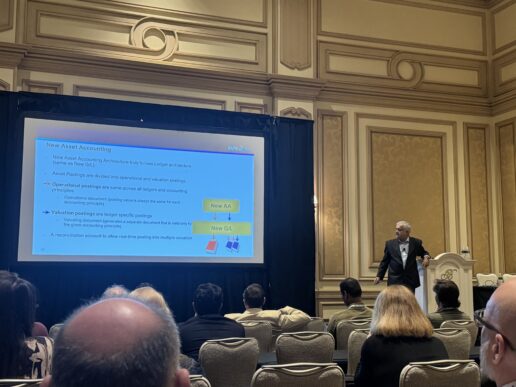
SAPinsider Pre-Con Session Urges Finance Teams to Treat SAP S/4HANA as an Architecture TransformationSAPinsider speaker Mitresh Kundalia emphasizes that successful SAP S/4HANA Finance transitions hinge on strategic architectural decisions made prior to migration, as automatic simplification is a misconception and legacy complexities may persist unless deliberately restructured.
Business Planning and Consolidation Benefits for UsersAs SAP customers transition from legacy tools like BPC to unified cloud-based platforms for planning and consolidation, finance teams are experiencing enhanced agility and real-time insights, prompting a shift in focus towards selecting solutions that offer measurable improvements.
Skyscrapers in a financial district representing enterprise finance leadership and strategic decision-making.
Wolters Kluwer Survey Shows How the CFO Role Is Expanding Beyond FinanceA new Wolters Kluwer survey finds the CFO role expanding beyond traditional finance responsibilities. As organizations adopt integrated planning platforms and AI-driven analytics, finance leaders are taking on broader roles in enterprise planning, technology initiatives, and investment decisions.
Brazil Tax Reform IRPS and SAP Automation
Why Indirect Tax Became a Real-Time SAP Constraint in 2025—and Why 2026 Is the Turning PointIn 2025, the transition of indirect tax into real-time operational processes within SAP emphasized the critical need for tax accuracy to ensure smooth transaction workflows and regulatory compliance, compelling organizations to rethink tax management strategies and adopt external tax engines for effective adaptation to rapidly changing regulations.
global tax
Techwave Introduces SAP-Aligned Blueprint for Open Banking, Compliant Financial IntegrationTechwave is advocating for an API-first approach to open banking, enabling financial institutions to enhance compliance and create scalable, interconnected experiences, as open banking payments are set to exceed $116 billion by 2025.
The Importance of Portfolio Ideation and Project Risk Scoring EnginesEmerging risk scoring engines are vital for SAP leaders to prioritize and manage proposals effectively, transforming portfolio decisions into data-driven choices that enhance governance and optimize resource allocation in a competitive enterprise landscape.


Related Vendors