

2 minute read

Meet the Authors
Key Takeaways
What you need to know
Monex USA is embedding FX execution, payment tracking and beneficiary management APIs into SAP, transitioning from manual processes to automated workflows.
The integration of Monex's APIs means SAP customers can access real-time FX quotes and manage transactions directly within their systems, which provides enhanced visibility into payment processes, benefitting finance teams by offering real-time tracking and reducing reconciliation issues.
For SAP finance professionals, adopting embedded FX and payment solutions will redefine modernization efforts, which sets a precedent for leveraging API-driven automation to meet evolving business needs, ensuring operational resilience and improved cash management.
Monex is bringing FX execution, payment tracking, and beneficiary management APIs directly into SAP-centered finance operations, replacing external portals and manual handoffs with embedded, policy-driven automation. For SAP technology leaders, that shift means fewer swivel-chair workflows, tighter controls and a clearer path to scaling global payments without custom development.
Turning SAP Into an FX-Aware Payments Hub
Monex’s open API gives enterprises programmatic access to real-time FX quotes, spot transactions, forwards, beneficiary creation and updates, payment delivery, and end-to-end tracking from within their existing systems. Finance and IT teams can use that API to trigger FX deals, fund transactions, and release cross-border payments based on rules defined in SAP, while using SAP as the system of record for posting and reconciliation.
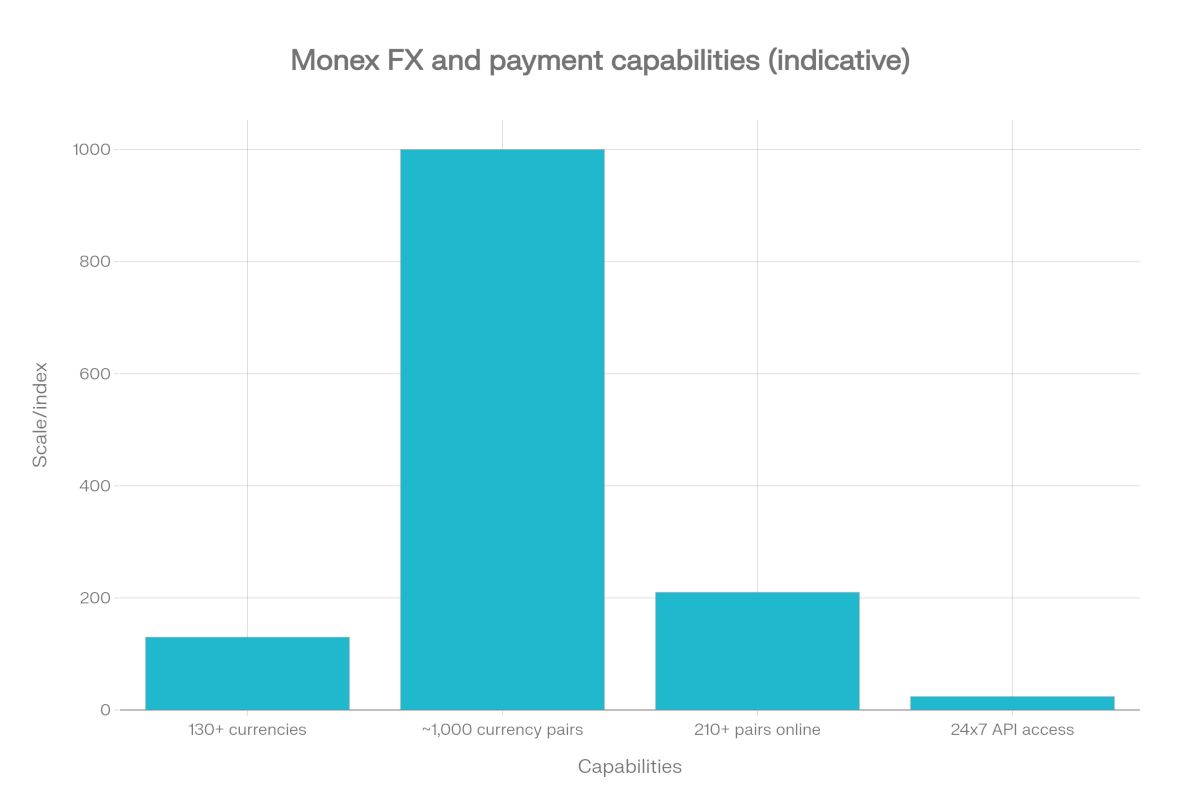
For organizations that prefer low-lift integration, Monex has partnered with SAP-focused providers, which aligns with a broader trend in the FX and payments market: enterprise buyers expect the same always-on, embedded experiences they see in consumer apps, but with treasury-grade controls. Monex supports high-volume global transactions across a wide currency set and processes roughly $650 million in payments daily as part of a group handling more than $277 billion in annual FX volume, giving SAP customers industrial-strength infrastructure behind their embedded workflows.
Explore related questions
Ask SAPi
What Changes for SAP Finance and IT Leaders
Day to day, SAP finance teams gain automation, visibility, and control. Automation comes from orchestrating FX pricing, approvals, funding, and payment releases via APIs and SAP-embedded rules instead of emailing instructions or rekeying bank data, which reduces errors and accelerates invoice-to-cash cycles.
Visibility improves as Monex’s payment reports and trackers stream back into dashboards and SAP-connected portals, giving controllers and shared services teams real-time status on outgoing payments and exceptions. Control increases because treasurers can standardize beneficiary management, enforce multi-tier approvals, and measure FX costs at the transaction level rather than relying on blended bank fees.
When evaluating embedded FX and payments providers, SAP executives should prioritize breadth of API coverage, quality of SAP-centric integrations, transparency of FX pricing, and availability of developer tooling and implementation support. Best practices emerging from Monex projects include starting with a limited supplier or region, using Monex’s sandbox and documentation to prototype integration patterns, and aligning treasury, IT, and shared services on routing rules before gradually decommissioning legacy bank portals. Organizations following this playbook report lower FX fees on small-value payments, faster payment investigations thanks to end-to-end tracking, and fewer reconciliation issues, all while keeping SAP at the center of their finance architecture.
What This Means for SAPinsiders
Embedded FX will redefine SAP finance modernization. SAP customers should treat FX, payment tracking, and beneficiary management APIs as core building Blocks for future roadmaps, pushing vendors and GSIs to deliver payment hubs, routing logic, and FX-aware workflows as standard components rather than custom add-ons.
API-first thinking will shape SAP integration strategy. Enterprise architects will need to standardize patterns for consuming Monex-style APIs through both middleware and direct SAP integration, driving investment in reusable services, event-driven designs, and cloud-native platforms that can extend FX automation across multiple business units and regions.
Operational resilience will depend on FX automation maturity. Transformation leaders will increasingly view embedded FX capabilities as a resilience lever, using them to diversify payment routes, improve cash visibility, and codify controls, creating new opportunities and responsibilities for partners focused on observability, compliance, and multi-rail payments within SAP ecosystems.
More Resources
See All Related Content
AI Chart of Accounts: Automating Month-End Close on SAPAn AI chart of accounts, a learning-based system placed alongside SAP's general ledger, automates critical finance tasks, achieving a 40-50% reduction in cycle times and up to 90% fewer reconciliation errors while promoting rapid adoption, provided it is built as a side-by-side SAP BTP extension rather than modifications to the core.
7 minute read

SAP BPC End of Life: What You Need To Know and Alternatives To ConsiderSAP is discontinuing maintenance for its Business Planning and Consolidation (BPC) platform, prompting many customers to start planning migrations, as only 11% are prepared for the transition by the 2026 deadline while existing users may face risks without ongoing support.
6 minute read
AI in the SAP Month-End Close: Where It Helps, Where Control Must StayThe article discusses the complexities of month-end financial closing, emphasizing the role of automation and AI in streamlining processes, managing dependencies, and ensuring robust financial controls while outlining best practices for implementation and evaluation.
5 minute read